Artificial Intelligence is no longer an experimental technology.
Across industries, organizations are investing in AI to improve productivity, automate workflows, enhance customer experiences, and create new business opportunities.
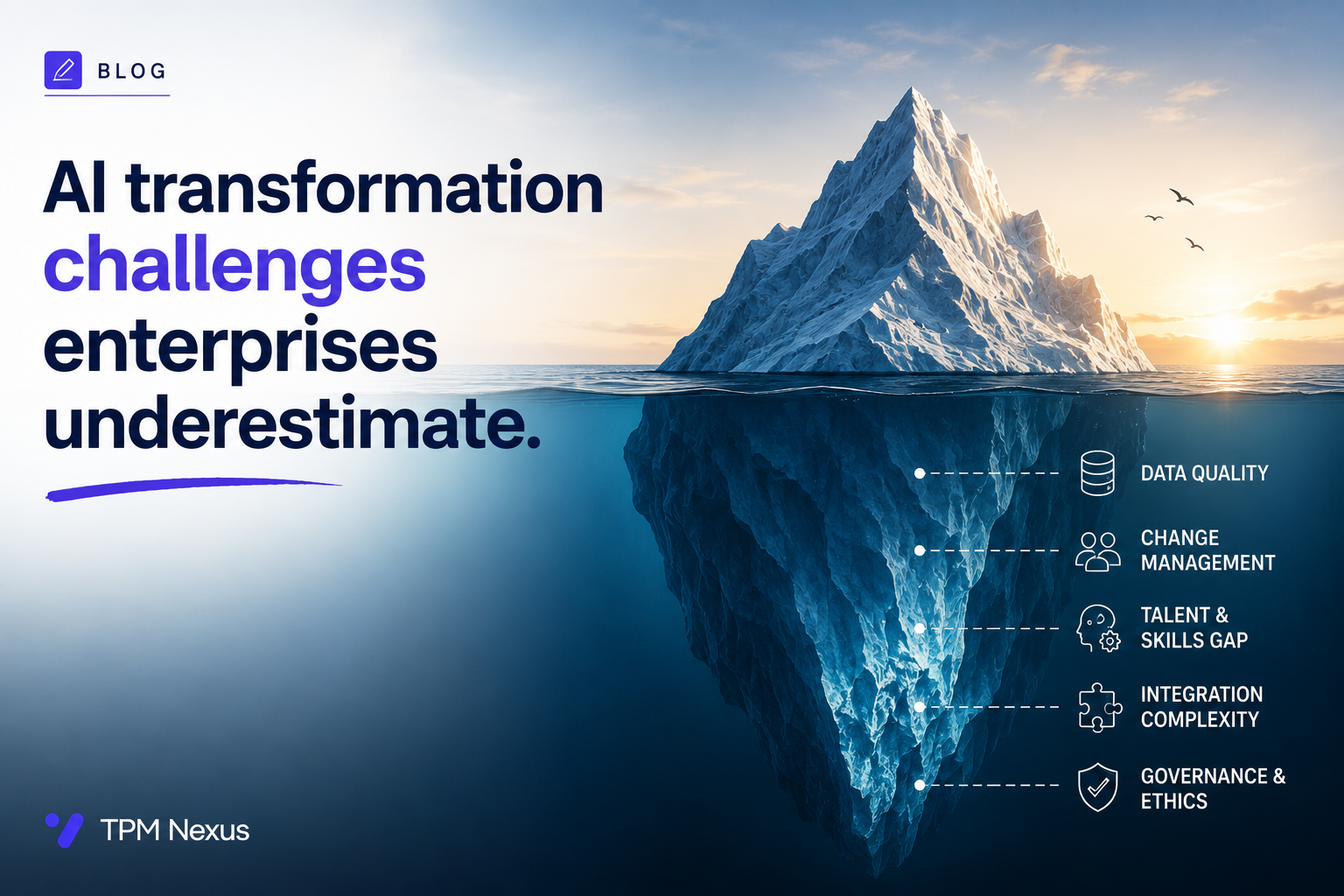
Yet despite significant investments, many AI transformation initiatives fail to deliver the expected business value.
The reason is rarely the AI model itself.
The biggest challenges often have little to do with technology.
They are rooted in people, processes, governance, and execution.
As Technical Program Managers and technology leaders, understanding these challenges is essential for leading successful AI transformation programs.
Challenge 1. Treating AI as Just Another IT Project
Many organizations approach AI initiatives the same way they approach traditional software projects.
That is a mistake.
Traditional applications follow predefined business rules.
AI systems learn from data, produce probabilistic outputs, and require continuous monitoring and improvement.
AI transformation is an ongoing capability, not a one time implementation.
Challenge 2. Poor Data Quality
AI is only as good as the data it receives.
Many enterprises discover that their data is:
- Inconsistent
- Incomplete
- Outdated
- Duplicated
- Stored across disconnected systems
Without reliable data, even the most advanced AI models cannot produce reliable outcomes.
Many AI projects become data improvement initiatives before they become AI initiatives.
Challenge 3. Unclear Business Objectives
Organizations often begin with a question like:
“Where can we use AI?”
A better question is:
“Which business problem are we trying to solve?”
Successful AI transformation starts with measurable business outcomes such as:
- Reducing operational costs
- Improving customer satisfaction
- Increasing employee productivity
- Accelerating decision making
- Improving revenue growth
Technology should support strategy, not define it.
Challenge 4. Underestimating Change Management
AI changes how people work.
Employees may worry about:
- Job security
- New responsibilities
- Learning new tools
- Changes to existing processes
Without effective communication, training, and executive sponsorship, adoption becomes difficult regardless of how capable the AI solution is.
Successful AI transformation is as much about people as it is about technology.
Challenge 5. Weak Governance
As AI becomes more autonomous, governance becomes increasingly important.
Organizations must establish clear policies for:
- Responsible AI
- Data privacy
- Security
- Human oversight
- Compliance
- Model monitoring
- Decision accountability
Governance should be embedded throughout the program, not added after deployment.
Challenge 6. Expecting Immediate ROI
Many executives expect AI to produce immediate business value.
In reality, successful AI adoption often follows a phased approach.
Organizations typically begin with small, targeted use cases, measure outcomes, learn from implementation, and gradually expand adoption across the enterprise.
AI transformation is a journey rather than a single milestone.
Challenge 7. Operating in Silos
AI programs require collaboration across multiple functions.
Success depends on alignment between:
- Business leaders
- Product teams
- Engineering
- Data science
- Security
- Legal
- Compliance
- Operations
When these teams work independently, AI initiatives become slower, riskier, and less effective.
Cross functional collaboration is one of the strongest predictors of successful AI transformation.
The Role of Technical Program Managers
Technical Program Managers play a critical role in AI transformation.
Beyond delivery management, TPMs help organizations:
- Align AI initiatives with business strategy.
- Coordinate cross functional teams.
- Identify and mitigate risks.
- Establish governance.
- Manage dependencies.
- Measure business outcomes.
- Drive organizational adoption.
This combination of execution, technical understanding, and business alignment enables TPMs to lead successful AI programs.
Final Thoughts
The greatest obstacles to AI transformation are rarely technical.
Most organizations already have access to powerful AI models.
The real challenge is integrating those capabilities into business processes, organizational culture, and enterprise operations.
Technology alone does not transform an organization.
People, processes, governance, and disciplined execution do.
Organizations that recognize these challenges early will be better positioned to turn AI investments into measurable business value.
For Technical Program Managers, understanding these realities is becoming one of the most valuable leadership skills in the AI era.
Which AI transformation challenge do you believe organizations underestimate the most? Share your perspective in the comments.
Follow us for weekly insights on AI Program Management, Enterprise Delivery, Technical Program Leadership, and Enterprise AI Transformation.