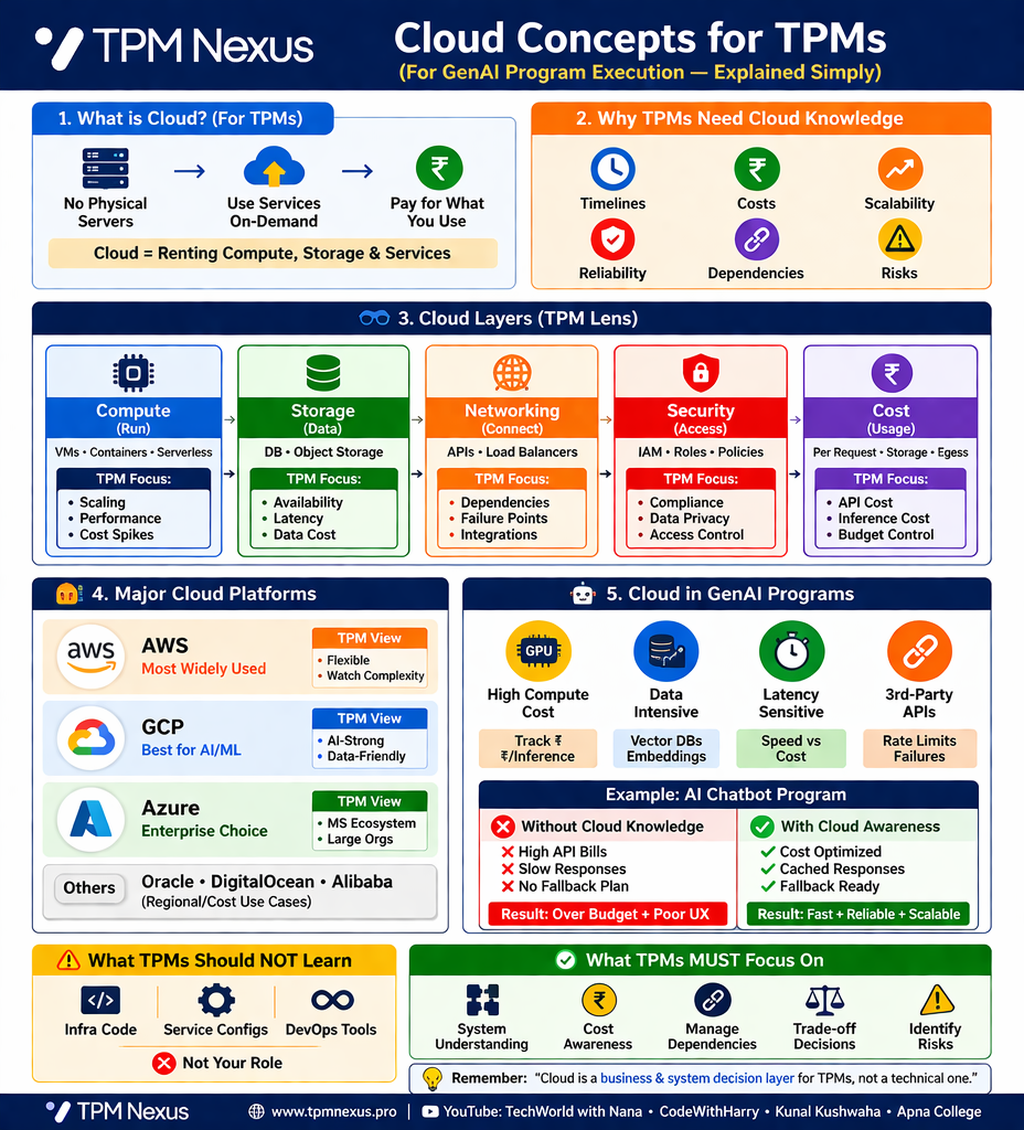
Most TPMs think they need to “learn cloud” like engineers.
You do not.
You need to understand how cloud decisions impact systems, cost, scalability, and execution. Not how to configure services.
This blog is designed for exactly that.
Clear. Practical. Focused on GenAI program execution.
What “Cloud” Means for a TPM
At a high level, cloud is simple:
Cloud = Renting computing power, storage, and services instead of owning them
Instead of managing physical servers:
- You use services
- You scale on demand
- You pay based on usage
Why Cloud Knowledge Matters for TPMs
You are not deploying infrastructure.
But you are responsible for:
- Program timelines
- Dependencies
- Cost implications
- Scalability risks
- System reliability
Cloud directly affects all of this.
Cloud Through a TPM Lens
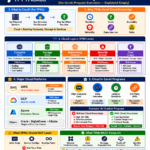
Forget deep technical details. Focus on these 5 layers:
1. Compute (Where things run)
- Virtual machines
- Containers
- Serverless functions
👉 TPM angle:
- Scaling impact
- Cost spikes
- Performance bottlenecks
2. Storage (Where data lives)
- Databases
- Object storage
👉 TPM angle:
- Data availability
- Latency
- Cost of storing large AI datasets
3. Networking (How systems connect)
- APIs
- Load balancing
👉 TPM angle:
- System dependencies
- Failure points
- Integration complexity
4. Security (Who can access what)
- Identity and access management
👉 TPM angle:
- Compliance risks
- Data privacy (critical for AI programs)
5. Cost (The most ignored layer)
👉 TPM angle:
- Cost per API call
- Cost per model inference
- Budget overruns
Major Cloud Platforms You Should Know
You do not need to master all.
But you must understand positioning.
1. AWS (Amazon Web Services)
- Most widely used
- Huge service ecosystem
- Strong in startups and enterprises
👉 TPM perspective:
- High flexibility
- Can become complex quickly
- Cost control is critical
2. GCP (Google Cloud Platform)
- Strong in data and AI
- Preferred for analytics and ML workloads
👉 TPM perspective:
- Easier for AI programs
- Good integration with data pipelines
3. Microsoft Azure
- Strong enterprise adoption
- Deep integration with Microsoft tools
👉 TPM perspective:
- Common in large organizations
- Good for enterprise AI use cases
4. Others (Quick Awareness)
- Oracle Cloud
- DigitalOcean
- Alibaba Cloud
👉 TPM perspective:
- Used in specific regions or cost-focused setups
Cloud in GenAI Programs (What Changes)
GenAI changes how you think about cloud.
1. Compute Becomes Expensive
Running models:
- Requires GPUs
- High compute cost
👉 TPM responsibility:
- Track cost per inference
- Optimize usage
2. Data Becomes Critical
GenAI depends on:
- Training data
- Embeddings
- Vector databases
👉 TPM responsibility:
- Ensure data pipeline readiness
- Manage data dependencies
3. Latency Matters More
User experience depends on:
- Response time of AI models
👉 TPM responsibility:
- Balance speed vs cost
4. Third-Party Dependencies Increase
Using:
- OpenAI APIs
- Anthropic
- Other LLM providers
👉 TPM responsibility:
- Manage external dependencies
- Plan for failures or rate limits
Real Example: GenAI Feature Execution
Scenario
Building an AI-powered chatbot for customer support.
Without Cloud Understanding (Common TPM mistake)
- Focus only on feature delivery
- Ignore inference cost
- Ignore latency
- No fallback plan
Result:
- High cost
- Slow response
- Poor user experience
With TPM Cloud Awareness
You ask:
- What is cost per query?
- Can we cache responses?
- What happens if API fails?
- How do we scale during peak usage?
Result:
- Controlled cost
- Better performance
- Reliable system
What TPMs Should NOT Focus On
Avoid going too deep into:
- Writing infrastructure code
- Configuring services
- DevOps tooling
That is not your role.
What TPMs MUST Focus On
1. System Understanding
- How services interact
2. Cost Awareness
- Where money is being spent
3. Dependency Management
- Internal and external services
4. Trade-Off Decisions
- Speed vs cost
- Accuracy vs latency
5. Risk Identification
- Failure points
- Scaling issues
Best Learning Resources (India-Focused)
Here are practical, easy-to-follow resources:
YouTube Channels
1. TechWorld with Nana
- Simple explanations of cloud concepts
- Good for beginners
Search:
AWS basics TechWorld with Nana
2. CodeWithHarry (Hindi + English)
- Easy to understand
- Beginner-friendly
Search:
Cloud computing basics CodeWithHarry
3. Kunal Kushwaha
- Good for system-level understanding
Search:
Cloud and DevOps basics Kunal Kushwaha
4. Apna College
- Simple explanations
- Good structured learning
How TPMs Should Approach Learning Cloud
Do not try to “complete AWS”.
Follow this approach:
Step 1: Understand Concepts
- What is compute, storage, API
Step 2: Map to Real Systems
- Relate cloud to your current program
Step 3: Ask Better Questions
- Where is this hosted?
- What happens if it fails?
Step 4: Focus on Impact
- Cost
- Scalability
- Reliability
Final Thought
You do not need to become a cloud engineer.
But you cannot lead modern programs without understanding cloud.
Cloud is not a technical topic for TPMs. It is a business and system decision layer.
If you want to learn cloud, AI systems, and program execution in a way that actually helps your TPM career:
At TPM Nexus, we focus on:
- Real-world system understanding
- AI and cloud program execution
- Transitioning into senior TPM roles
👉 Visit: www.tpmnexus.pro
👉 Join the TPM Nexus community
👉 Or reach out for 1:1 mentorship
Because TPMs who understand systems and cloud are the ones who lead complex programs, not just track them.