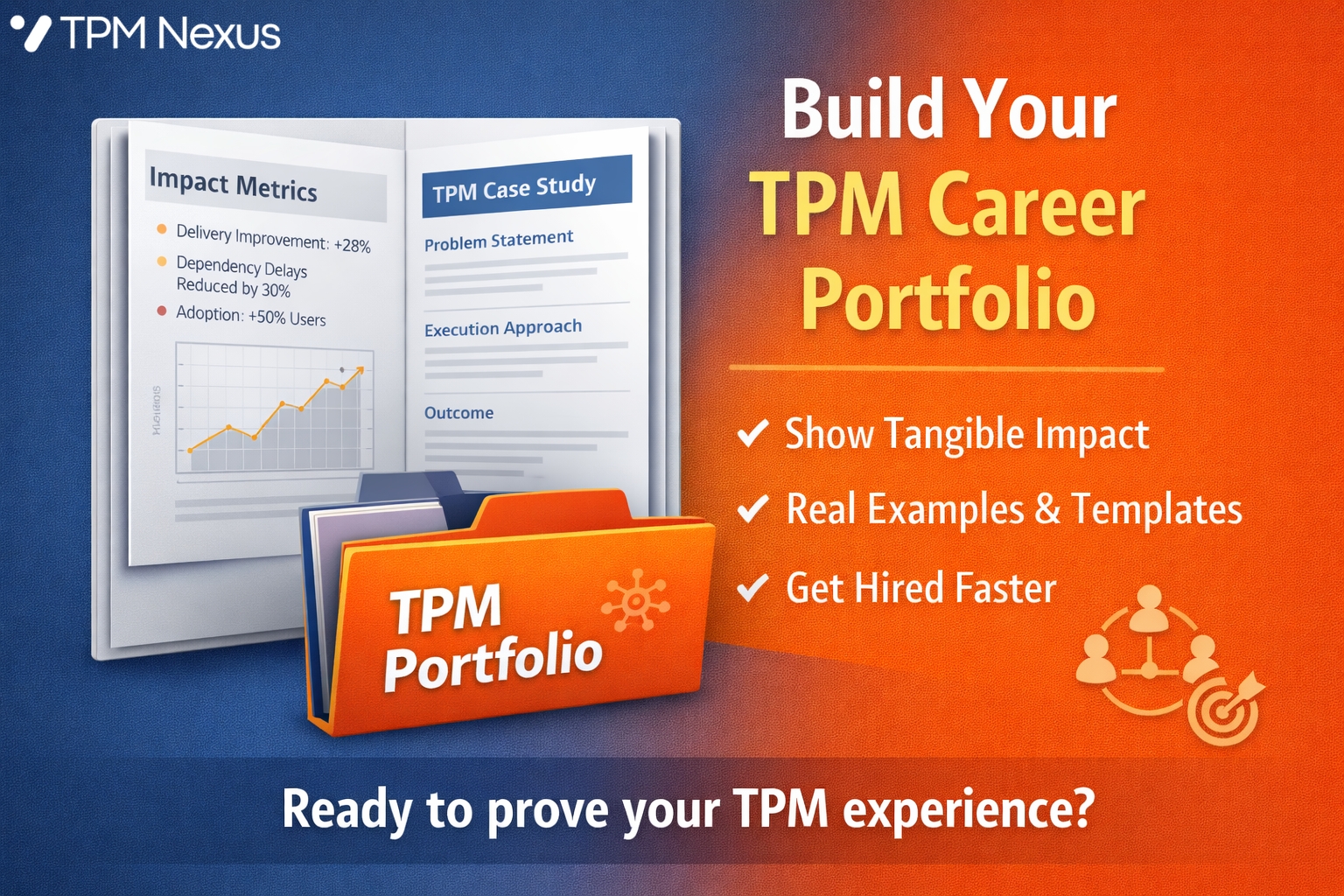
Most Technical Program Managers struggle with one problem. They have years of experience, but they cannot clearly show impact. Resumes list responsibilities. LinkedIn profiles talk about ownership. Interviews ask for proof. This is where a TPM career portfolio changes everything.
A strong portfolio does not replace your resume. It strengthens it. It shows how you think, how you execute, and how you drive outcomes. This guide explains how to build a TPM portfolio that hiring managers actually respect.
Why TPMs Need a Portfolio
TPM work is often invisible. You coordinate. You unblock. You align teams. You reduce risk before it becomes visible. None of this shows clearly on a resume. A portfolio helps you:
- Demonstrate scope and complexity
- Show decision making, not just delivery
- Prove business and engineering impact
- Stand out in senior and lead TPM interviews
For senior roles, portfolios are becoming an unspoken expectation.
What a TPM Portfolio Is (and Is Not)
A TPM portfolio is not:
- A slide deck of buzzwords
- A list of tools you used
- A copy of your resume
A TPM portfolio is:
- A collection of real programs you led
- Clear articulation of problems, decisions, and outcomes
- Evidence of scale, complexity, and leadership
Think of it as a case study library of your career.
Core Structure of a TPM Portfolio
Your portfolio should have 5 core sections.
1. Portfolio Overview
This sets context. Include:
- Your role and experience range
- Domains you have worked in (SaaS, Cloud, AI, Platform)
- Type of programs you typically lead
For example:
Technical Program Manager with 12+ years of experience leading multi-team SaaS and cloud platforms, specializing in execution clarity, dependency management, and predictable delivery.
2. Program Case Studies (Most Important Section)
Each case study should follow a consistent structure.
TPM Case Study Template
Program Context
- Product or platform name
- Business goal
- Team size and roles
- Timeline
Problem Statement
- What was broken, unclear, or risky
- Why it mattered to the business
Your Role
- What you owned directly
- What decisions you made
- What you influenced vs controlled
Execution Approach
- Planning and dependency strategy
- Risk management
- Stakeholder alignment
- Tools and artifacts used
Outcome and Impact
- Delivery results
- Metrics (time, cost, quality, adoption)
- What changed because of your work
Key Learnings
- What you would repeat
- What you would improve next time
3. Impact Metrics Section
This is where most TPM portfolios fail. Avoid vanity metrics. Focus on:
- Delivery predictability improvement
- Reduction in delays or escalations
- Scale of teams or systems
- Business impact where possible
Examples:
- Improved on-time delivery from 62 percent to 90 percent
- Reduced cross-team dependency delays by 30 percent
- Enabled launch supporting 2 million monthly users
4. Artifacts and Evidence
You do not need confidential documents. You can include:
- Sanitized architecture diagrams
- Program timelines
- Risk registers
- Delivery dashboards
- Dependency maps
- Sample status reports
These show how you think, not what you shipped.
5. Leadership and Influence Examples
Senior and Lead TPM roles are judged heavily on influence. Include short examples like:
- Resolving conflict between product and engineering
- Pushing back on unrealistic scope
- Driving alignment across multiple teams
- Coaching junior TPMs or PMs
Keep these concise but specific.
Example TPM Portfolio Case Study (Short Version)
Program: Multi-Region SaaS Platform Migration
Team: 28 engineers, 5 teams
Timeline: 9 months
Problem
Frequent outages and slow release cycles due to monolithic architecture.
My Role
Owned migration plan, cross-team dependencies, and release sequencing.
Execution
- Created phased migration roadmap
- Established weekly dependency sync
- Implemented release readiness checklist
Outcome
- Zero critical outages during migration
- Release frequency improved by 40 percent
- Platform supported 3x traffic growth
Where to Host Your TPM Portfolio
Good options:
- Personal website
- Notion page
- PDF shared on request
- Private Google Drive link
Public is optional. Clarity is mandatory.
How to Use Your Portfolio in Interviews
Do not send it blindly. Use it to:
- Guide interview answers
- Reference concrete examples
- Show depth when asked open-ended questions
For example:
I documented a similar program in my portfolio. I can walk you through how I handled the tradeoffs.
This shifts the conversation in your favor.
Common Mistakes to Avoid
- Writing like a job description
- Hiding impact behind vague language
- Overloading with tools and frameworks
- Ignoring metrics
- Making it too long
Quality beats quantity.
Final Takeaway
A TPM portfolio is not about showing how busy you were. It is about showing how effective you were. If you can clearly explain:
- The problem
- Your decisions
- The impact
You are already operating at a senior level.
Built for TPMs who own outcomes, not demos. https://www.tpmnexus.pro/