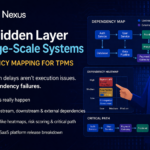
Most large-scale programs do not fail because teams cannot execute.
They fail because dependencies are not understood, not tracked, or not managed properly.
From the outside, delays look like execution issues.
Missed deadlines. Slipped releases. Last-minute escalations.
But underneath, the real problem is almost always the same:
Hidden dependencies breaking the system.
The Core Reality: Delays Are Rarely Execution Problems
Let us break a common misconception.
What leadership often assumes:
- Teams are slow
- Engineers are blocked
- Planning was weak
What is actually happening:
- Upstream APIs are not ready
- External vendors are delayed
- Data pipelines are incomplete
- Integration points are unstable
Execution is not failing.
The system around execution is failing.
Why Dependency Failures Are So Common
1. Dependencies Are Not Explicitly Mapped
Most programs track:
- Tasks
- Timelines
- Owners
But they do not track:
- Who depends on whom
- What happens if something slips
- Which dependencies are critical vs optional
As a result, risks remain invisible until it is too late.
2. Dependencies Span Multiple Boundaries
In modern systems, dependencies are not limited to one team.
They span:
- Backend services
- Frontend applications
- Data platforms
- Third-party integrations
And most importantly:
- Different teams with different priorities
This creates coordination complexity that is often underestimated.
3. No Ownership of Cross-Team Dependencies
Each team owns their deliverables.
But no one owns the dependency chain end to end.
This leads to:
- Misaligned timelines
- Conflicting priorities
- Last-minute surprises
This is exactly where TPMs add the most value.
What Dependency Mapping Actually Means
Dependency mapping is not just listing blockers.
It is about understanding the system as a network of interdependent components.
A strong TPM answers:
- What are the upstream dependencies?
- What are the downstream impacts?
- Which dependencies are critical path?
- Where are the failure points?
This is systems thinking applied to execution.
Types of Dependencies Every TPM Must Track
1. Upstream Dependencies
These are inputs your program relies on.
Examples:
- APIs from another team
- Data availability
- Infrastructure readiness
If upstream fails, your execution cannot even start.
2. Downstream Dependencies
These are systems that depend on your output.
Examples:
- Frontend consuming your backend service
- Analytics pipelines using your data
- Business teams relying on your release
If you fail, others get impacted.
3. External Dependencies
These sit outside your direct control.
Examples:
- Third-party vendors
- Payment gateways
- External APIs
These are the highest risk because control is limited.
Techniques TPMs Use to Manage Dependencies
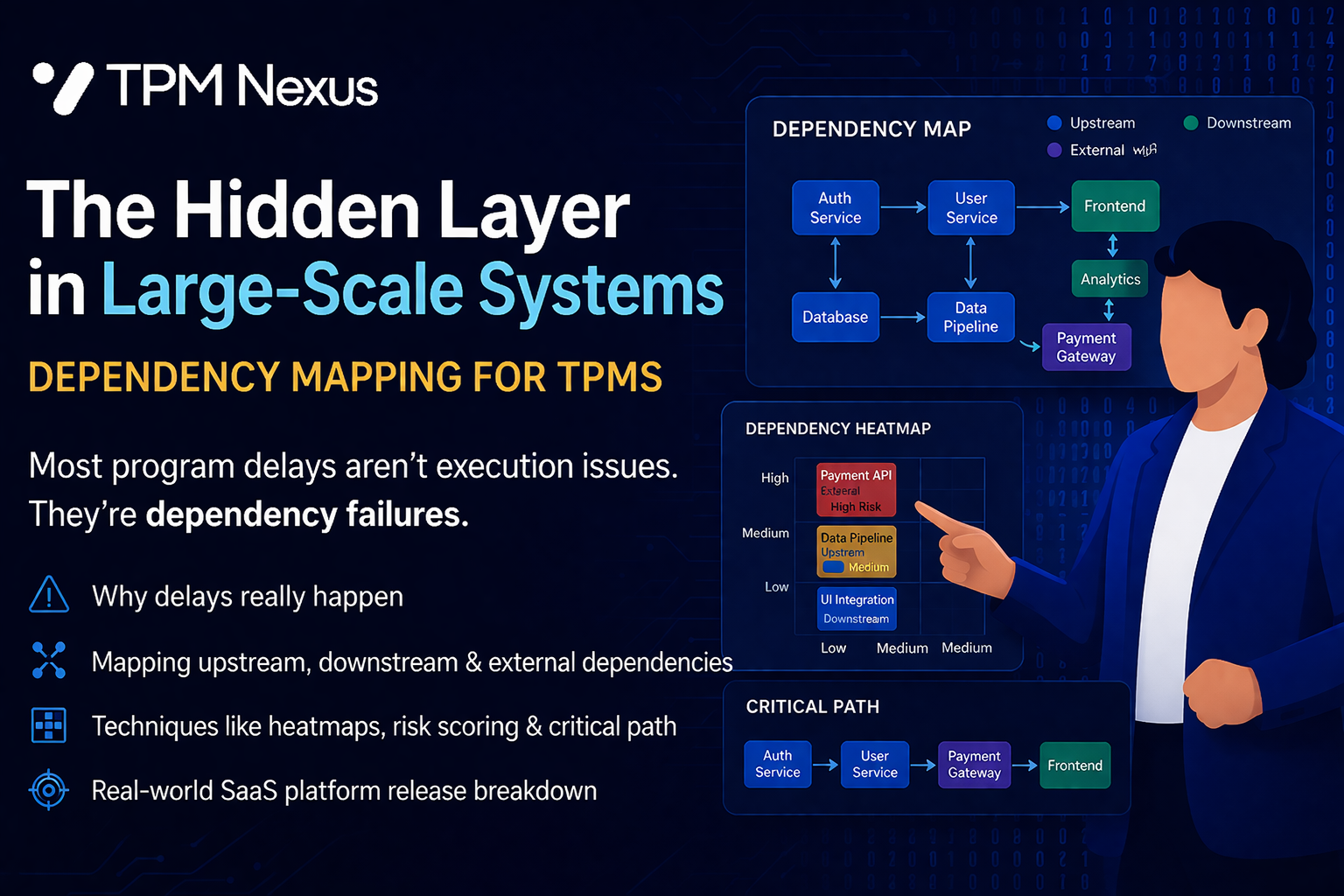
1. Dependency Heatmaps
A dependency heatmap helps visualize risk across the system.
You categorize dependencies based on:
- Criticality
- Readiness
- Risk level
Example:
| Dependency | Type | Criticality | Status | Risk |
|---|---|---|---|---|
| Payment API | External | High | Delayed | High |
| Data Pipeline | Upstream | High | In Progress | Medium |
| UI Integration | Downstream | Medium | Not Started | Medium |
This gives immediate clarity on where attention is needed.
2. Risk Scoring Framework
Not all dependencies are equal.
You can assign a simple score based on:
- Impact if delayed
- Probability of delay
- Level of control
This helps prioritize effort instead of treating everything equally.
3. Critical Path Identification
The critical path is the sequence of dependencies that directly determines your timeline.
If any element in this path slips, the entire program slips.
A TPM must:
- Identify it early
- Monitor it continuously
- Escalate proactively
4. Dependency Review Cadence
Dependencies are not static. They evolve.
Strong TPMs:
- Run weekly dependency reviews
- Track changes in status
- Re-align teams when needed
This prevents last-minute surprises.
Real-World Scenario: SaaS Platform Release Breakdown
Let us look at a realistic example.
Context
A company is launching a new SaaS feature involving:
- Backend service
- Frontend UI
- Payment integration
- Analytics tracking
Multiple teams are involved.
What Was Planned
- All teams commit to the same release date
- Individual timelines look aligned
- Execution starts smoothly
What Actually Happens
Week 2:
- Backend API schema changes
- Frontend team needs rework
Week 3:
- Payment gateway delays sandbox access
- Integration testing cannot start
Week 4:
- Analytics events are not finalized
- Data team blocks release
Final Outcome
- Release delayed by 3 weeks
- Teams blame each other
- Leadership questions execution
Root Cause Analysis
This was not an execution failure.
It was:
- No clear dependency mapping
- No visibility into critical path
- No proactive risk management
What a TPM Would Do Differently
1. Map Dependencies Early
Before execution:
- Identify all upstream, downstream, and external dependencies
- Document ownership and timelines
2. Highlight Critical Dependencies
- Payment integration
- Backend API stability
- Analytics readiness
These should be tracked more aggressively than others.
3. Create Buffer for High-Risk Areas
- External dependencies get extra buffer
- Integration phases get more time
4. Establish Cross-Team Alignment
- Shared milestones
- Joint reviews
- Clear escalation paths
5. Continuously Monitor and Adjust
- Weekly dependency tracking
- Early escalation of risks
- Dynamic re-planning
Practical TPM Playbook
1. Build a Dependency Map Before Execution
Do not start with tasks.
Start with system relationships.
2. Identify the Critical Path
Know what truly drives your timeline.
3. Assign Ownership for Every Dependency
If no one owns it, it will fail.
4. Track Dependency Health, Not Just Task Progress
A task may be on track.
But if its dependency is not, it will still fail.
5. Communicate in Terms of Impact
Do not say:
- “This is delayed”
Say:
- “This delay impacts release by 2 weeks unless mitigated”
The Real Differentiator for TPMs
Most TPMs manage tasks.
Strong TPMs manage systems.
And systems are not just code.
They are:
- teams
- dependencies
- constraints
- risks
If you can see and manage the hidden layer of dependencies, you move from coordination to true program leadership.
Final Thought
Execution is visible.
Dependencies are not.
But dependencies decide outcomes.
If you want predictable delivery in complex systems, you need predictable dependency management.
If you want to build this level of systems thinking and handle real-world program complexity:
At TPM Nexus, we focus on:
- Dependency-driven execution
- System-level thinking
- Real scenarios from large-scale programs
👉 Visit: www.tpmnexus.pro
Because the TPMs who understand dependencies are the ones who control delivery, not just track it.