Time is the hardest problem for Technical Program Managers. Not because TPMs are bad at planning. But because their calendar is rarely their own.
Back to back meetings. Ad hoc escalations. Stakeholder pings. Meanwhile, execution still needs clarity, risks still need thinking time, and decisions still need focus.
This blog breaks down how strong TPMs manage time in real life. Not theory. Not productivity hacks. Actual execution patterns that work.
Why Time Management Is Different for TPMs
TPMs do not control work. They enable it. That means:
- You are pulled into every discussion
- You are expected to know everything
- You are judged on outcomes, not busyness
Traditional time management advice fails because TPMs cannot simply block calendars and disappear.
The goal is not fewer meetings.
The goal is intentional time usage.
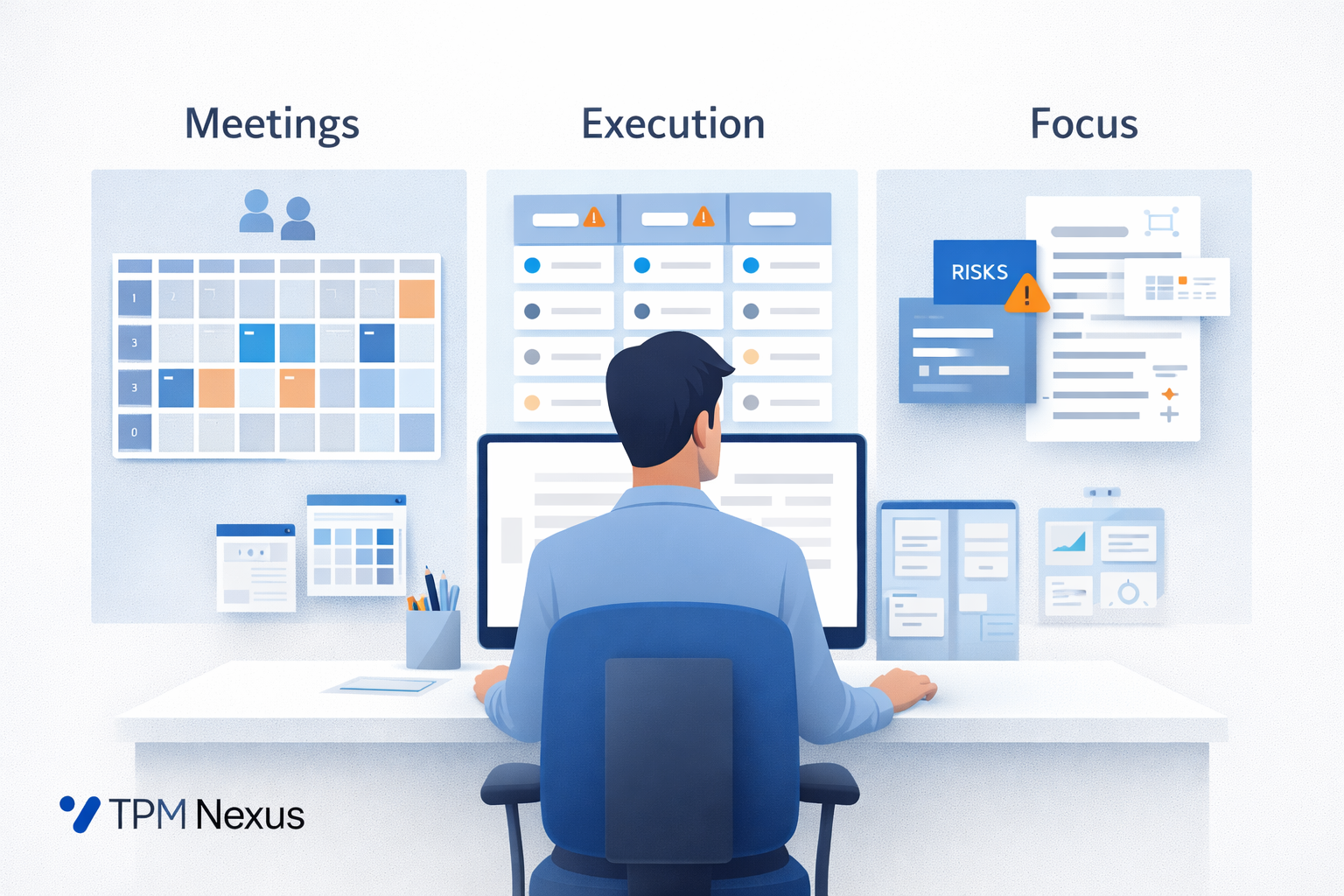
The Three Buckets of TPM Time
Every TPM role revolves around three buckets.
1. Meetings (Alignment Work)
- Planning
- Syncs
- Reviews
- Escalations
These meetings are necessary. The problem is unstructured meetings.
2. Execution (Program Control)
- Dependency tracking
- Risk management
- Status updates
- Follow-ups
This is where delivery actually moves.
3. Focus (Thinking Work)
- Anticipating risks
- Designing execution plans
- Preparing leadership communication
This is the most valuable time and the first to disappear. Strong TPMs protect all three deliberately.
Real Life TPM Example
Let us look at a real scenario.
Context
A Senior TPM managing a SaaS platform with 6 engineering teams across time zones.
Problem
Calendar was full. Work felt reactive. Risks were caught late.
What Changed
The TPM restructured time using simple rules.
- All recurring meetings were reviewed
- Any meeting without a clear outcome was declined or shortened
- Focus blocks were added three times a week, clearly labeled as risk review or planning
- Execution tasks were grouped into two daily windows instead of being spread all day
Result
- Fewer escalations
- Better preparedness in leadership reviews
- Reduced context switching
- More predictable delivery
Nothing fancy. Just discipline.
Practical TPM Time Management Framework
Rule 1. Meetings Must Earn Their Place
Before accepting or creating a meeting, ask:
- What decision is expected?
- Who actually needs to attend?
- Can this be async?
If there is no outcome, it is not a meeting. It is noise.
Rule 2. Separate Execution Time from Focus Time
Do not mix them.
Execution time is reactive.
Focus time is proactive.
Batch execution tasks like:
- Status updates
- Follow-ups
- Jira reviews
Protect focus time for:
- Risk anticipation
- Dependency planning
- Leadership communication prep
Rule 3. Design Your Week, Not Your Day
Daily planning fails for TPMs because interruptions are guaranteed.
Weekly planning works better.
At the start of the week:
- Identify key delivery risks
- Identify critical decisions needed
- Block focus time around them
Let everything else flex.
Rule 4. Use Meetings to Reduce Future Meetings
Good meetings reduce future meetings.
Use them to:
- Clarify ownership
- Lock decisions
- Surface risks early
If meetings do not reduce uncertainty, they are failing.
Common TPM Time Management Mistakes
- Attending every meeting to stay visible
- Responding instantly to every message
- Treating deep thinking as optional work
- Measuring productivity by calendar fullness
Busy TPMs are common. Effective TPMs are rare.
What Great TPM Time Management Looks Like
- Calm, not rushed
- Prepared, not reactive
- Clear on priorities, not overwhelmed
- Trusted by teams and leadership
This is not about working longer hours.
It is about working intentionally.
Final Takeaway
TPM time management is not about controlling your calendar.
It is about controlling attention.
Meetings align people.
Execution moves work.
Focus prevents failure.
Balance all three, and your impact compounds.
Built for TPMs who own outcomes, not demos. https://www.tpmnexus.pro/