Gen AI and Agentic AI programs do not introduce new leadership principles. They remove the safety nets that previously hid weak ones.
In traditional software delivery, leadership gaps can stay invisible for years. Deterministic systems absorb indecision. Processes mask ownership gaps. Timelines flex enough to hide hesitation.
AI systems do not allow that. When you run real Gen AI and Agentic AI programs, leadership is tested continuously. Under uncertainty. Under scrutiny. Under failure. The role of a TPM stops being about coordination and becomes about judgment.
This is where many experienced TPMs realize something uncomfortable. AI did not make delivery harder. It made leadership deficiencies visible faster.
Decision Latency Under Uncertainty
In Gen AI programs, waiting is rarely neutral. Model behavior is probabilistic. Data quality is uneven. Vendor capabilities evolve weekly. Requirements shift as users learn what is possible. There is almost never complete information.
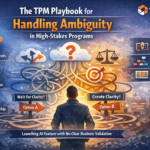
In this environment, decision latency becomes the most expensive leadership failure. The most common pattern looks like this:
- Teams ask for more data
- Leaders ask for more validation
- TPMs wait for consensus
Meanwhile, cost accrues, scope drifts, and trust erodes. Senior TPM leadership shows up in how decisions are made, not how accurate they are. The job is not to be right. It is to move the system forward with bounded risk. Strong TPM leaders:
- Make reversible decisions quickly
- Escalate irreversible ones early
- State assumptions explicitly
- Accept that learning happens after commitment, not before
Gen AI punishes indecision because uncertainty never fully resolves. TPMs who wait for clarity become bottlenecks. TPMs who act with intent become stabilizers.
Ownership Clarity When Systems Fail
Agentic systems fail in ways that are hard to localize.
- An agent takes an action that causes harm.
- The model behaved “as designed.”
- The tool responded correctly.
- The data was incomplete but valid.
Who owns the outcome? In these moments, leadership is not defined by who is technically responsible. It is defined by who steps forward.
- Weak leadership hides behind structure.
- Strong leadership absorbs ambiguity.
- Senior TPMs do not ask, “Whose fault is this?”
- They ask, “Who owns resolution and learning?”
Ownership clarity matters because:
- Escalation speed depends on it
- Rollback authority depends on it
- Trust depends on it
In AI programs, TPMs often become the de facto owners of system failure, even without formal authority. That is not a burden. It is a leadership signal. The TPM who can calmly say, “This is our failure, here is what we are doing next,” becomes indispensable.
Trust, Calm, and Influence Without Authority
Gen AI incidents are emotionally charged. They involve:
- Executive attention
- Reputational risk
- Legal and compliance anxiety
- Public visibility
In these moments, technical explanations alone are insufficient. Leadership presence matters. Senior TPMs bring calm to unstable systems. They do this by:
- Communicating clearly without speculation
- Framing trade-offs honestly
- Slowing the room down when panic accelerates
- Making progress visible even when answers are incomplete
Influence without authority becomes critical because AI programs cut across too many domains for formal control to work. TPMs must align engineering, product, legal, security, finance, and leadership without owning any of them.
- Trust is built through consistency.
- Calm is built through preparation.
- Influence is built through credibility earned in hard moments.
AI systems amplify noise. TPM leadership dampens it.
How AI Amplifies Leadership Gaps
Gen AI does not tolerate performative leadership. Gaps that AI exposes quickly:
- Leaders who avoid decisions
- Leaders who over-index on optimism
- Leaders who rely on process instead of judgment
- Leaders who disappear during failure
Because AI systems behave unexpectedly, teams look upward more often. When leadership is absent or unclear, teams slow down. They hedge. They protect themselves.
This is why AI programs often feel harder than traditional programs, even with similar scope. The system is not just testing engineering. It is testing leadership maturity.
TPMs who previously succeeded through coordination alone struggle here. TPMs who lead through clarity, accountability, and composure thrive.
What Senior TPM Leadership Actually Looks Like in AI Programs
Senior TPM leadership in Gen AI is quieter than people expect. It is not about:
- Being the most technical person
- Owning every decision
- Having all the answers
It is about:
- Setting decision boundaries
- Designing for failure
- Making trade-offs explicit
- Protecting the system from wishful thinking
Senior TPMs:
- Push back on unsafe autonomy
- Slow launches when failure modes are unclear
- Make cost, risk, and latency visible early
- Align leadership expectations with operational reality
They treat AI programs as living systems, not delivery checklists. Most importantly, they take responsibility for outcomes, not just execution. That shift is what separates senior TPM leadership from functional TPM work.
The Leadership Lesson AI Forces Early
AI does not change leadership principles. It removes the delay between weakness and consequence. In deterministic systems, poor leadership can survive for a long time. In Gen AI and Agentic AI systems, it cannot.
- Decision quality matters sooner.
- Ownership matters louder.
- Calm matters more.
TPMs who grow into senior leadership through AI programs do so not because they mastered new tools, but because they strengthened timeless leadership muscles under pressure. That is the lasting value of running Gen AI programs.
- Not technical expertise.
- Leadership maturity, earned the hard way.
Built for TPMs who own outcomes, not demos https://www.tpmnexus.pro