A few years ago, being a Program Manager mostly meant being organized.
If you could run meetings, track timelines, maintain status reports, and keep projects moving, you were considered good at the job.
That world is changing very quickly.
Today, execution environments are more complex than ever. Teams move faster, priorities shift weekly, AI is changing workflows, and uncertainty has become normal across engineering organizations.
In that kind of environment, process alone is no longer enough.
In fact, some of the most process-heavy Program Managers struggle the most when real execution pressure appears. Because eventually every program reaches a moment where templates stop helping and judgment becomes the only thing that matters.
That is the difference between a traditional PM and a next-generation Program Manager.
The old model focused on process management.
The new model is centered around clarity, influence, decision-making, and execution leadership.
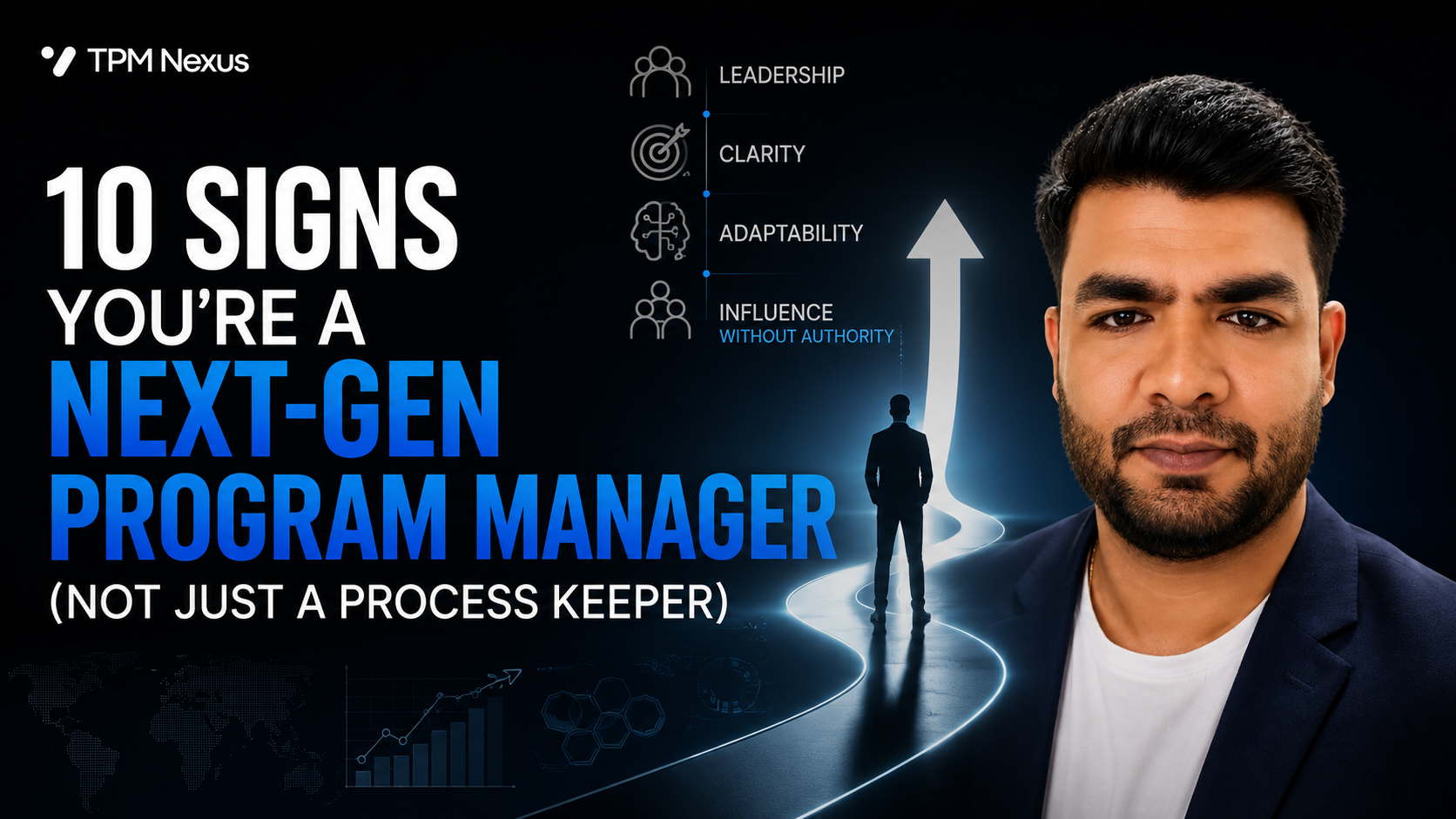
Here are 10 signs you are operating at that next level.
1. You walk into chaos and create clarity, not more process
Every large program eventually becomes messy. Priorities conflict, dependencies break, stakeholders disagree, and information becomes fragmented.
Average PMs respond by adding more process.
Strong PMs simplify the situation.
Instead of overwhelming teams with additional tracking layers, they identify the real problem, align the right people quickly, and create execution clarity. Teams leave conversations feeling calmer, not more confused.
That ability becomes incredibly valuable during high-pressure execution cycles.
2. You know who the real decision-maker is before the meeting even starts
Org charts rarely reflect how decisions actually happen.
Experienced Program Managers understand this quickly.
They know which stakeholder has formal authority and which person actually influences outcomes behind the scenes. They understand political dynamics, decision patterns, and hidden blockers long before escalation becomes visible to everyone else.
That awareness prevents weeks of unnecessary delay.
Because in large organizations, execution is often less about process and more about alignment.
3. You escalate early, even when it feels uncomfortable
One of the biggest mistakes inexperienced PMs make is waiting too long before escalating risk.
Usually it happens because they hope the issue will resolve quietly. Sometimes it is fear of appearing negative. Sometimes it is simply optimism.
But experienced Program Managers understand something important.
Bad news does not improve with time.
Strong PMs surface risks early while there is still room to respond. They would rather create temporary discomfort now than allow the entire program to suffer later.
That mindset protects execution far more than optimism ever will.
4. You can translate between engineer-speak and executive-speak fluently
One of the most underrated PM skills is translation.
Engineering teams think in systems, constraints, dependencies, and technical trade-offs. Executives think in timelines, business impact, risk exposure, customer outcomes, and strategic priorities.
If those two worlds cannot communicate clearly, execution breaks down very quickly.
Great Program Managers act as translators between both environments. They can explain technical complexity in business language without oversimplifying it, and they can bring business urgency back to engineering teams without creating chaos.
That bridge-building skill becomes critical in large-scale programs.
5. Your risk log reflects reality, not optimism
Every PM has seen this before.
A risk register filled with generic statements that nobody truly believes.
“Minor delay possible.”
“Dependency risk under monitoring.”
“Mitigation in progress.”
On paper, everything looks controlled.
Meanwhile, everyone informally knows the release is in trouble.
Strong Program Managers do not use risk management as a reporting exercise. They use it as a decision-making tool. Their risk logs reflect operational reality honestly, even when leadership may not want to hear it.
That honesty creates better decisions earlier.
6. You have said “we are not on track” before someone else had to say it for you
This is one of the clearest signs of execution maturity.
Weak PMs wait until failure becomes obvious.
Strong PMs recognize trajectory problems early.
They understand that execution issues rarely appear suddenly. Small signals usually appear weeks earlier:
- Dependencies start slipping
- Scope increases quietly
- Team velocity changes
- Decision cycles slow down
Experienced Program Managers notice those patterns quickly and address them before the situation becomes irreversible.
That level of awareness builds long-term trust with leadership teams.
7. You build trust during calm periods so you can spend it during crises
Trust is one of the most valuable execution assets inside any organization.
However, many PMs only try to build relationships when they urgently need support.
That rarely works.
The best Program Managers consistently build credibility before problems appear. They communicate clearly, follow through reliably, and create confidence over time.
Then, when real crises happen, teams cooperate faster because trust already exists.
Execution during difficult moments becomes significantly easier when relationship equity has already been built.
8. You influence without authority, and people barely notice you are doing it
Most Program Managers do not directly manage the teams they depend on.
That means authority alone cannot drive execution.
Influence becomes the real operating system.
Strong PMs understand how to align people without forcing them. They shape conversations, frame priorities correctly, reduce resistance, and create momentum naturally.
The interesting part is that the best influence often feels invisible. Teams feel aligned without feeling controlled.
That is a very advanced leadership skill.
9. You know when to follow process and when to abandon it
Process matters.
But blind process adherence becomes dangerous in fast-moving environments.
Next-generation PMs understand that frameworks are tools, not laws.
Sometimes process protects stability. Other times it slows down execution unnecessarily.
Experienced Program Managers know when structure is helping the team and when it is becoming overhead. They are comfortable adapting operating models based on context instead of forcing rigid execution patterns everywhere.
That flexibility becomes increasingly important in AI-driven environments where uncertainty is much higher.
10. You make AI work for you and focus your energy on what AI cannot do
This may become the biggest differentiator over the next few years.
Many traditional PM activities are already becoming partially automated:
- Status summaries
- Meeting notes
- Documentation
- Reporting
- Coordination workflows
The checkbox PM role is slowly disappearing.
But judgment-driven leadership is becoming more valuable.
The strongest next-generation Program Managers are not competing against AI. They are using AI to remove low-value operational work so they can focus on higher-level execution problems:
- Decision-making
- Stakeholder alignment
- Risk management
- Organizational influence
- Strategic clarity
Those are deeply human skills.
And they are becoming more important, not less.
The Bigger Shift Happening Right Now
Program Management is evolving away from process administration and toward execution leadership.
That shift is already happening inside high-performing organizations.
Teams no longer need someone who simply tracks tasks. They need people who can navigate ambiguity, align complex organizations, make difficult decisions early, and create clarity under pressure.
That requires judgment.
Not just process knowledge.
The checkbox PM is becoming obsolete.
The judgment-driven PM is just getting started.
And the Program Managers who develop operational thinking, execution maturity, and influence will become significantly more valuable in the AI era than those who only rely on frameworks and templates.
Because eventually, every organization reaches moments where process stops being enough.
That is when real Program Managers stand out.
If you want to learn how modern AI and execution-driven Program Managers actually operate in real environments: www.tpmnexus.pro