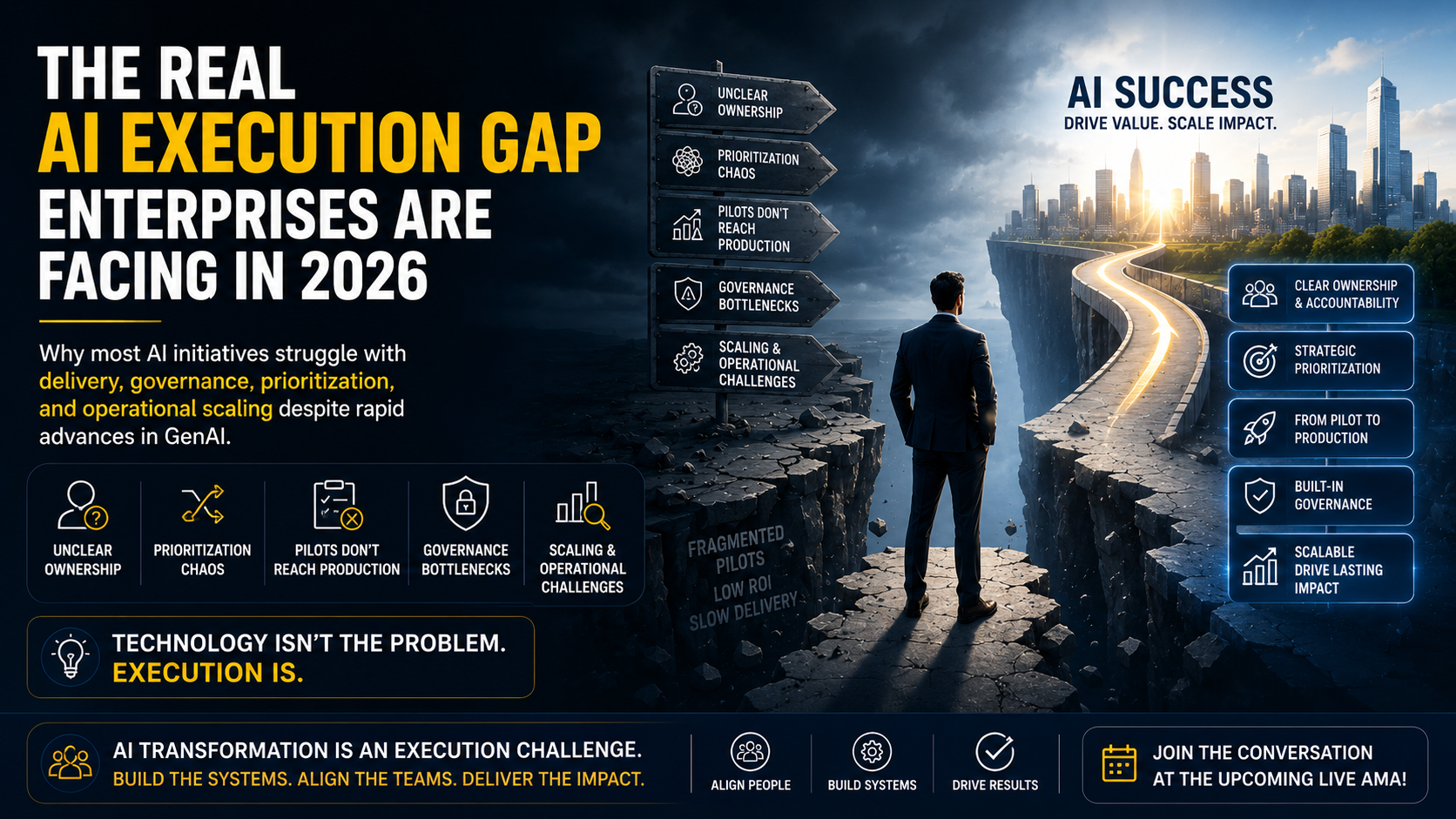
Why most AI initiatives struggle with delivery, governance, prioritization, and operational scaling despite rapid advances in GenAI
The AI execution gap is becoming one of the biggest operational challenges enterprises are facing in 2026.
Over the last two years, enterprise AI adoption has accelerated faster than most organizations expected.
Every leadership meeting now includes conversations around:
- GenAI adoption
- AI copilots
- workflow automation
- Agentic AI
- productivity gains
- internal AI platforms
- AI transformation strategies
On the surface, it looks like organizations are moving quickly.
However, behind the scenes, many AI initiatives are struggling operationally.
Not because the models are weak.
Not because the technology is unavailable.
The real challenge is execution.
This enterprise AI execution gap is growing rapidly as organizations struggle with governance, prioritization, delivery alignment, and operational scaling.
AI Innovation Is No Longer the Biggest Barrier
Most organizations already have access to:
- powerful foundation models
- enterprise AI platforms
- cloud AI infrastructure
- API ecosystems
- vector databases
- orchestration frameworks
- AI development tools
The technology barrier has reduced significantly.
Therefore, the differentiator is no longer model access.
The real differentiator is execution maturity.
The companies that succeed with AI over the next few years will not necessarily be the ones with the best models.
Instead, they will be the organizations that can operationalize AI effectively across teams, systems, governance processes, and delivery environments.
The AI Execution Gap Behind Enterprise AI Programs
Many AI initiatives start with excitement and strong executive sponsorship.
However, problems begin during execution.
Teams quickly encounter challenges that traditional delivery systems were never designed to handle.
Unclear Ownership
One of the most common enterprise AI execution challenges is ownership confusion.
Who owns the initiative?
- Product?
- Engineering?
- Data science?
- Platform teams?
- Security?
- Compliance?
- Operations?
AI programs are deeply cross functional.
Without clear ownership structures, decision making slows down rapidly.
As a result, organizations experience:
- delivery ambiguity
- duplicated experimentation
- conflicting priorities
- governance delays
- unclear accountability
Traditional organizational structures often struggle to support AI delivery execution effectively.
AI Prioritization Chaos
Many enterprises now have dozens of AI ideas competing simultaneously.
Leadership wants:
- internal copilots
- AI automation
- customer support AI
- AI analytics
- Agentic workflows
- productivity platforms
- recommendation systems
However, engineering capacity remains limited.
The result becomes:
- fragmented execution
- context switching
- shallow experimentation
- unfinished pilots
- delivery instability
Organizations often underestimate how much operational coordination AI programs actually require.
Without structured prioritization frameworks, AI adoption becomes reactive instead of strategic.
This is another major contributor to the growing AI execution gap.
AI Pilots Rarely Reach Production
This is becoming one of the biggest enterprise patterns.
AI demos look impressive.
Production delivery becomes difficult.
Why?
Because production AI systems require much more than model integration.
They require:
- governance
- observability
- monitoring
- security reviews
- evaluation systems
- prompt management
- operational support
- feedback loops
- compliance readiness
- reliability controls
Most organizations underestimate the transition from experimentation to operational production systems.
As a result, many pilots never scale successfully.
The AI Governance Problem Enterprises Are Facing
AI governance is becoming one of the largest execution bottlenecks in enterprise environments.
Organizations are increasingly concerned about:
- hallucinations
- data leakage
- compliance exposure
- intellectual property risks
- biased outputs
- security vulnerabilities
- regulatory implications
However, governance processes themselves are still immature in many companies.
This creates a difficult balance:
- move fast
vs - remain compliant and secure
In reality, governance cannot be treated as a final review step.
It must become part of the AI delivery lifecycle itself.
Organizations that ignore governance early often slow down later during scaling and production deployment.
Why Traditional Delivery Models Struggle with AI Execution
Traditional software delivery assumes predictable behavior.
AI systems do not always behave predictably.
That changes execution dynamics significantly.
AI introduces:
- probabilistic outputs
- changing model behavior
- evaluation complexity
- prompt sensitivity
- evolving vendor ecosystems
- unpredictable edge cases
Therefore, organizations must rethink:
- release planning
- testing approaches
- QA strategies
- risk management
- operational monitoring
- stakeholder communication
AI execution is not simply another software project.
It requires new operational thinking.
The Growing Role of PMs, TPMs & Engineering Leaders
AI adoption is no longer only an engineering challenge.
It is increasingly becoming an execution leadership challenge.
PMs, TPMs, Engineering Managers, and technology leaders now play a critical role in:
- execution alignment
- prioritization
- governance coordination
- dependency management
- stakeholder communication
- delivery structure
- operational scaling
Organizations that ignore execution leadership in AI programs often experience:
- delivery confusion
- uncontrolled experimentation
- scaling failures
- poor ROI realization
Execution maturity is becoming a competitive advantage.
Agentic AI Will Increase Execution Complexity Further
Many organizations are now moving beyond basic GenAI implementations toward Agentic AI systems.
This introduces even greater operational complexity.
Agentic systems create new questions around:
- autonomy boundaries
- orchestration
- decision validation
- monitoring
- failure recovery
- governance
- human oversight
- escalation handling
As a result, the AI execution gap may widen further over the next few years.
Organizations that build strong operational foundations early will move significantly faster than competitors later.
Enterprises That Will Overcome the AI Execution Gap
The next phase of enterprise AI success will not be determined only by access to technology.
It will depend on:
- operational maturity
- execution discipline
- governance readiness
- cross functional coordination
- prioritization quality
- scalable delivery systems
AI transformation is becoming less about experimentation.
Instead, it is becoming more about sustainable execution.
That is the real AI execution gap many enterprises are now facing.
The AI industry is still heavily focused on innovation headlines.
However, inside enterprises, the real challenge is execution reality.
The companies that solve execution problems early will gain a major advantage:
- faster delivery
- better adoption
- stronger governance
- scalable AI systems
- clearer business outcomes
AI execution maturity is quietly becoming one of the most important organizational capabilities of this decade.
Join My Upcoming LinkedIn Live AMA
If you are working on AI initiatives, AI delivery, GenAI adoption, or enterprise AI transformation, I am hosting a live AMA focused entirely on real execution challenges organizations are facing in 2026.
AI Program Execution AMA for PMs, TPMs & Engineering Leaders
📅 28 May 2026
🕢 7:30 PM IST
We will discuss:
- AI execution bottlenecks
- governance challenges
- scaling AI initiatives
- stakeholder alignment
- prioritization frameworks
- delivery realities
- Agentic AI readiness
- enterprise operational challenges
Join the event here:
https://www.linkedin.com/events/7460572002647719936
FAQs
Why do most AI initiatives fail in enterprises?
Most AI initiatives fail because of execution problems such as unclear ownership, governance gaps, prioritization chaos, and operational scaling challenges.
What are the biggest AI execution challenges in 2026?
The biggest AI execution challenges include governance, stakeholder alignment, delivery coordination, production scaling, and operational monitoring.
Why do AI pilots fail to reach production?
Many AI pilots fail because organizations underestimate production requirements such as monitoring, security, evaluation systems, governance, and operational support.
How should enterprises scale AI initiatives?
Enterprises should scale AI initiatives through strong governance, clear ownership, prioritization frameworks, and cross functional operational alignment.
What role do TPMs play in AI delivery?
TPMs help coordinate execution, manage dependencies, align stakeholders, reduce delivery chaos, and improve operational scaling across AI programs.