Building an AI feature is relatively easy.
Knowing whether it is good enough to ship, safe enough to scale, and valuable enough to keep is much harder.
This is where AI evaluation becomes a core Product Management responsibility.
Traditional software can often be tested with deterministic inputs and expected outputs. AI products are different. The same prompt can produce different responses, and a response can be technically correct while still being irrelevant, poorly grounded, too slow, or useless to the user.
For an AI Product Manager, evaluation therefore needs to go beyond model accuracy.
A practical framework is:
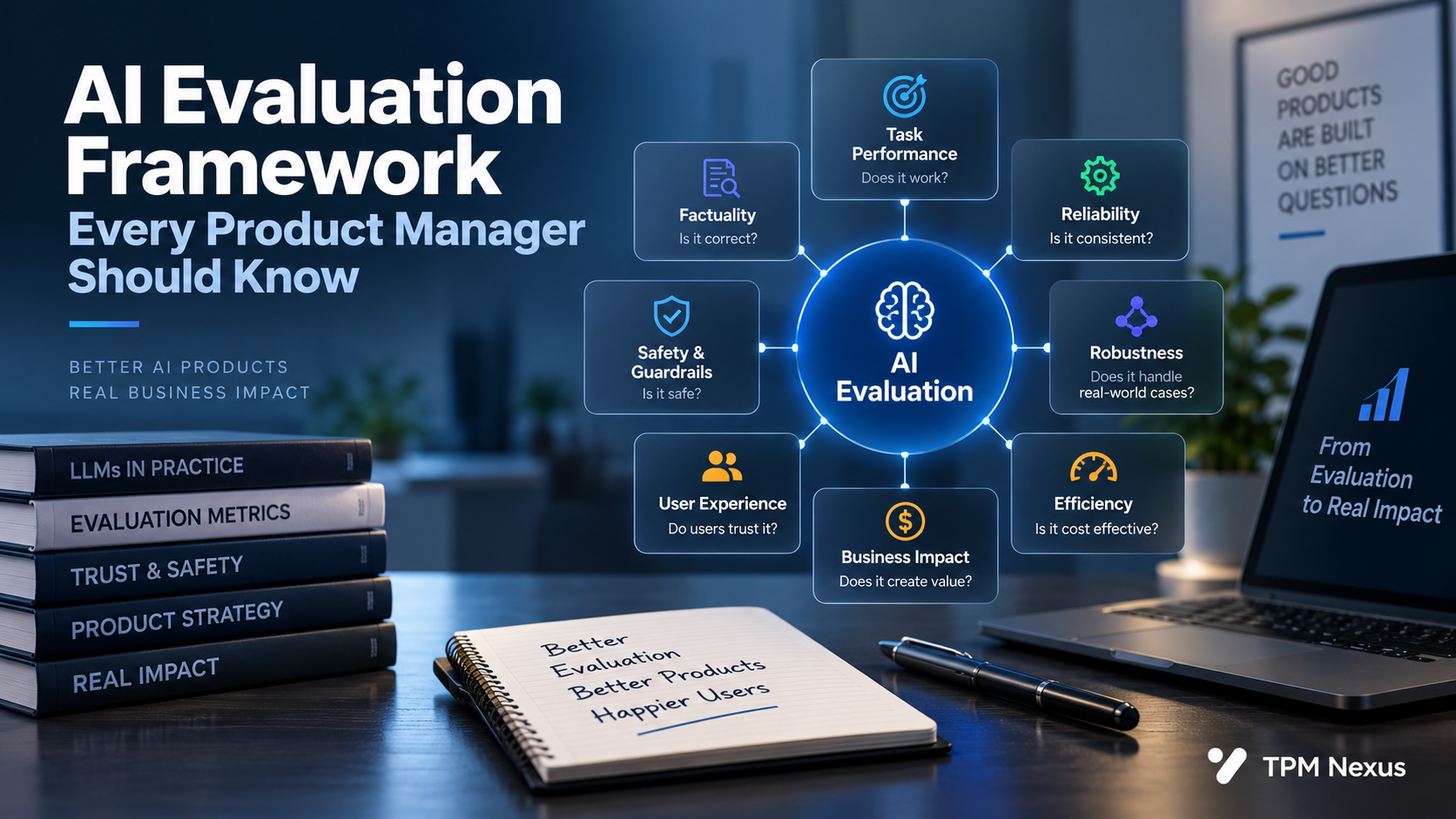
Quality → Experience → Workflow → Reliability → Economics → Business Impact
1. Start With the Product Outcome
Before choosing evaluation metrics, define what success means.
Do not start with:
“How accurate is our model?”
Start with:
“What should the user be able to accomplish better because of this AI product?”
For example, consider an AI customer-support assistant.
The intended outcome might be:
Reduce average agent handling time while maintaining answer quality.
That immediately creates multiple dimensions to evaluate:
- Answer quality
- Relevance
- Groundedness
- Task completion
- Time saved
- Human intervention
- Customer satisfaction
- Cost per interaction
The evaluation framework should follow the product outcome.
2. AI Quality Metrics
The first layer evaluates the quality of the AI output.
Accuracy
Does the AI produce the correct answer or result?
This is important for factual or structured tasks.
But accuracy can be difficult to define for open-ended AI experiences.
Relevance
Does the response actually address the user’s request?
An answer can be factually correct but irrelevant to the user’s intent.
Groundedness
Is the response supported by the information available to the AI?
This becomes particularly important for RAG-based enterprise applications.
Completeness
Does the response contain the information required to complete the task?
Consistency
Does the system behave reasonably consistently across similar inputs?
These metrics help answer:
“Is the AI producing useful outputs?”
But they are only the first layer.
3. Evaluate the User Experience
A technically strong AI feature can still fail if users do not find it useful.
Track metrics such as:
AI Adoption
What percentage of eligible users actually use the feature?
Repeat Usage
Do users come back after their first interaction?
User Satisfaction
Do users perceive the AI output as useful?
Task Completion
Can users successfully complete the intended task?
These metrics help identify a common problem:
The AI works, but users do not want to use it.
That is a product problem, not simply a model problem.
4. Measure Workflow Impact
This is where AI Product Management becomes particularly interesting.
Suppose an AI assistant generates a summary in five seconds.
That sounds impressive.
But what if the user still spends ten minutes checking the summary and manually entering the information into another system?
The feature may have excellent response metrics while creating little workflow value.
Measure:
Time Saved
How much time does AI remove from the workflow?
Automation Rate
What percentage of eligible steps can AI complete without manual intervention?
Human Intervention Rate
How often does a person need to correct, review, or complete the AI-generated work?
Task Completion Rate
How often does the complete workflow reach the intended outcome?
The question becomes:
“Did AI actually reduce the work?”
5. Evaluate Reliability
AI products need to be evaluated as systems, not just models.
For an AI Agent, for example, the workflow may involve:
LLM → Retrieval → Tool → API → Database → LLM
A failure anywhere in that chain can affect the final outcome.
Track:
Latency
How long does the AI take to respond or complete the task?
Reliability
How consistently does the system remain available and functional?
Tool Success Rate
How often do AI-initiated tool calls succeed?
Failure Rate
How often does the AI fail to complete the requested task?
Recovery Rate
When something fails, how often can the system recover successfully?
This is especially important for agentic products.
An agent that occasionally produces an imperfect answer is different from an agent that occasionally performs the wrong action.
6. Evaluate Trust and Safety
Enterprise AI introduces another layer of evaluation.
Ask:
- Does the AI respect user permissions?
- Does it expose sensitive information?
- Does it provide unsupported claims?
- Can users understand important decisions?
- Does it request approval for high-risk actions?
- Can actions be audited?
Useful measures can include:
- Policy violation rate
- Unsafe response rate
- Permission violation rate
- Human escalation rate
- Audit coverage
The exact metrics should depend on the risk profile of the product.
A marketing copy assistant and an AI system handling financial operations should not have the same evaluation threshold.
7. Measure AI Economics
AI introduces variable costs that traditional software products may not have.
A single user request might involve:
- Multiple LLM calls
- Embedding generation
- Retrieval
- Tool calls
- Infrastructure
- Storage
- Monitoring
For AI Agents, this becomes even more important.
Instead of measuring only:
Cost per API call
consider:
Cost per completed task
For example:
An agent costs ₹2 per request.
That number alone tells us very little.
If it completes a task that previously required 20 minutes of employee time, the economics may be attractive.
If it produces an answer that still requires 15 minutes of manual verification, the economics may look very different.
8. Connect Metrics to Business Outcomes
This is the layer many AI products miss.
A complete evaluation framework should connect:
AI Quality
↓
User Behavior
↓
Workflow Improvement
↓
Business Outcome
For example:
Better retrieval
- Better answers
- Higher task completion
- Less manual effort
- Lower operating cost
That is much more meaningful than reporting:
“Our AI has 94% accuracy.”
Accuracy is a product input.
Business value is the outcome.
9. Build an AI Evaluation Scorecard
A practical AI Product Manager scorecard can look like this:
| Dimension | Example Metrics |
|---|---|
| Quality | Accuracy, relevance, groundedness, completeness |
| Experience | Adoption, repeat usage, satisfaction |
| Workflow | Task completion, time saved, automation |
| Reliability | Latency, failure rate, tool success |
| Trust & Safety | Policy violations, escalations, permission errors |
| Economics | Cost per interaction, cost per task |
| Business | Revenue, retention, productivity, cost reduction |
The important part is not tracking every metric.
It is choosing the metrics that reflect the product’s actual job.
10. Evaluation Should Continue After Launch
One of the biggest mistakes is treating evaluation as a pre-launch activity.
AI products operate in changing environments.
- Models change.
- User behavior changes.
- Data changes.
- Prompts change.
- Knowledge bases change.
- Tools change.
New failure patterns appear.
Therefore:
Build → Evaluate → Launch → Monitor → Learn → Improve
should be a continuous loop.
For production AI products, create evaluation datasets from real interactions.
Classify failures.
Track trends.
Review edge cases.
Feed those learnings back into the product roadmap.
A Practical AI Evaluation Framework
For an AI Product Manager, I use a simple sequence:
01. Define the outcome
What should improve?
02. Define the task
What exactly is the AI helping the user accomplish?
03. Define quality
What makes the output good?
04. Define experience
Will users actually use and trust it?
05. Define workflow impact
Does it reduce effort or improve completion?
06. Define reliability
Can it perform consistently in production?
07. Define economics
Is the AI solution financially sustainable?
08. Define business impact
What measurable business result should change?
This creates a much stronger evaluation strategy than focusing on model benchmarks alone.
The Product Manager’s Role in AI Evaluation
AI evaluation should not belong only to ML Engineers or Data Scientists.
The Product Manager needs to define:
- What success means
- Which failures matter most
- Which metrics represent user value
- What quality threshold is acceptable
- Where human review is required
- When the product is ready to scale
The technical team can tell us whether the model improved.
The Product Manager needs to determine whether the product improved.
That distinction matters.
Final Takeaway
The biggest mistake an AI Product Manager can make is asking only:
“How accurate is our AI?”
A better set of questions is:
- Does it produce quality outputs?
- Do users trust and adopt it?
- Does it improve the workflow?
- Does it behave reliably?
- Is it economically sustainable?
- Does it create measurable business value?
That is what turns AI evaluation from a model-testing exercise into a Product Management discipline.
The goal is not to build an AI system that scores well in a benchmark.
The goal is to build an AI product that performs well in the real world.