Retrieval Augmented Generation, or RAG, has become one of the most important architectures for building enterprise AI products.
But for an AI Product Manager, understanding RAG is not about learning how to configure a vector database or build a retrieval pipeline.
The more important question is:
When should a product use RAG, how should it work, and how do you know whether it is actually delivering value?
This guide explains RAG from an AI Product Management perspective, from the basic architecture to product decisions, evaluation, user experience, cost, security, and enterprise implementation.
What Is Retrieval Augmented Generation?
Retrieval Augmented Generation is an approach that allows an AI application to retrieve relevant information from external knowledge sources and provide that information to a Large Language Model before generating an answer.
A traditional LLM interaction can look like:
User → LLM → Response
The model generates the response primarily from what it learned during training and whatever context is provided in the current interaction.
A RAG based system adds a retrieval layer:
User Query → Retrieval → Relevant Context → LLM → Response
The key idea is simple.
Do not expect the model to know everything. Give it the information it needs when it needs it.
This becomes particularly useful when an AI product needs access to:
- Internal company documentation
- Product documentation
- Customer information
- Policies and procedures
- Knowledge bases
- Support articles
- Contracts and business documents
- Frequently changing information
Why Do AI Products Need RAG?
Large Language Models are extremely capable, but they have an important limitation.
They do not automatically have access to your private or constantly changing business information.
Imagine an enterprise support assistant.
A customer asks:
“What is the refund policy for my current subscription?”
The answer may depend on:
- The current refund policy
- The customer’s subscription
- Their purchase date
- Their contract
- Their account status
- Their permissions
A general purpose LLM cannot reliably answer this from its pretrained knowledge.
RAG allows the product to retrieve the relevant information and provide it to the model.
That changes the problem from:
“Does the model know the answer?”
to:
“Can the system retrieve the right information and give it to the model?”
That is a much more useful product question.
How Does RAG Work?
A typical RAG system can be understood through several stages.
1. User Query
Everything starts with the user’s request.
For example:
“What are the cancellation terms for our enterprise plan?”
The system needs to understand what the user is actually asking for.
In more sophisticated products, query understanding may include identifying intent, entities, filters, or additional context.
2. Knowledge Sources
The AI product needs access to relevant information.
These sources could include:
- PDFs
- Product documentation
- Databases
- Internal knowledge bases
- Websites
- Support articles
- CRM systems
- Enterprise applications
- APIs
This is where an important product decision begins.
What should the AI actually know?
Connecting every possible data source is rarely the right answer.
The goal is not maximum information.
The goal is relevant information.
3. Document Processing
Enterprise information is rarely stored in a format that can simply be passed directly to an LLM.
Documents may contain:
- Long paragraphs
- Tables
- Headings
- Metadata
- Multiple topics
- Repeated information
- Structured and unstructured content
The system therefore needs to process the source material.
A common approach is to split documents into smaller sections, often called chunks.
For example:
Enterprise Refund Policy
        ↓
Document Processing
        ↓
Chunk 1
Chunk 2
Chunk 3
Chunk 4
        ↓
Embeddings
        ↓
Vector Database
The way information is chunked can significantly influence retrieval quality.
4. Embeddings
An embedding represents information as a numerical vector.
The purpose is to capture semantic relationships between pieces of information.
For example, these two questions are different in wording:
“How can I cancel my subscription?”
and
“What is the process for terminating an account?”
A semantic retrieval system can recognize that they are related even though the exact words differ.
The documents and user query can be represented as vectors.
The system then searches for content that is semantically relevant.
5. Vector Database
The resulting embeddings can be stored in a vector database.
When the user submits a question, the system converts the query into an embedding and searches for similar information.
Conceptually:
User Query
↓
Query Embedding
↓
Similarity Search
↓
Relevant Documents
Vector databases are therefore one component of a RAG architecture.
They are not the product itself.
That distinction is important for Product Managers.
6. Retrieval
The system retrieves the information most relevant to the user’s query.
Suppose the user asks:
“What is our refund policy?”
The system may retrieve:
- Current refund policy
- Subscription cancellation rules
- Refund eligibility criteria
- Refund processing timeline
The quality of this step is critical.
If retrieval returns irrelevant or outdated information, the LLM can still produce a very convincing answer.
That creates one of the most important principles in RAG:
Wrong context can produce a confidently wrong answer.
7. Augmentation
The retrieved information is then added to the prompt or context sent to the LLM.
Conceptually:
User Question
Retrieved Information
↓
LLM Context
The model now has access to information that was not necessarily part of its original training knowledge.
8. Generation
The LLM uses the user’s question and retrieved context to generate the final response.
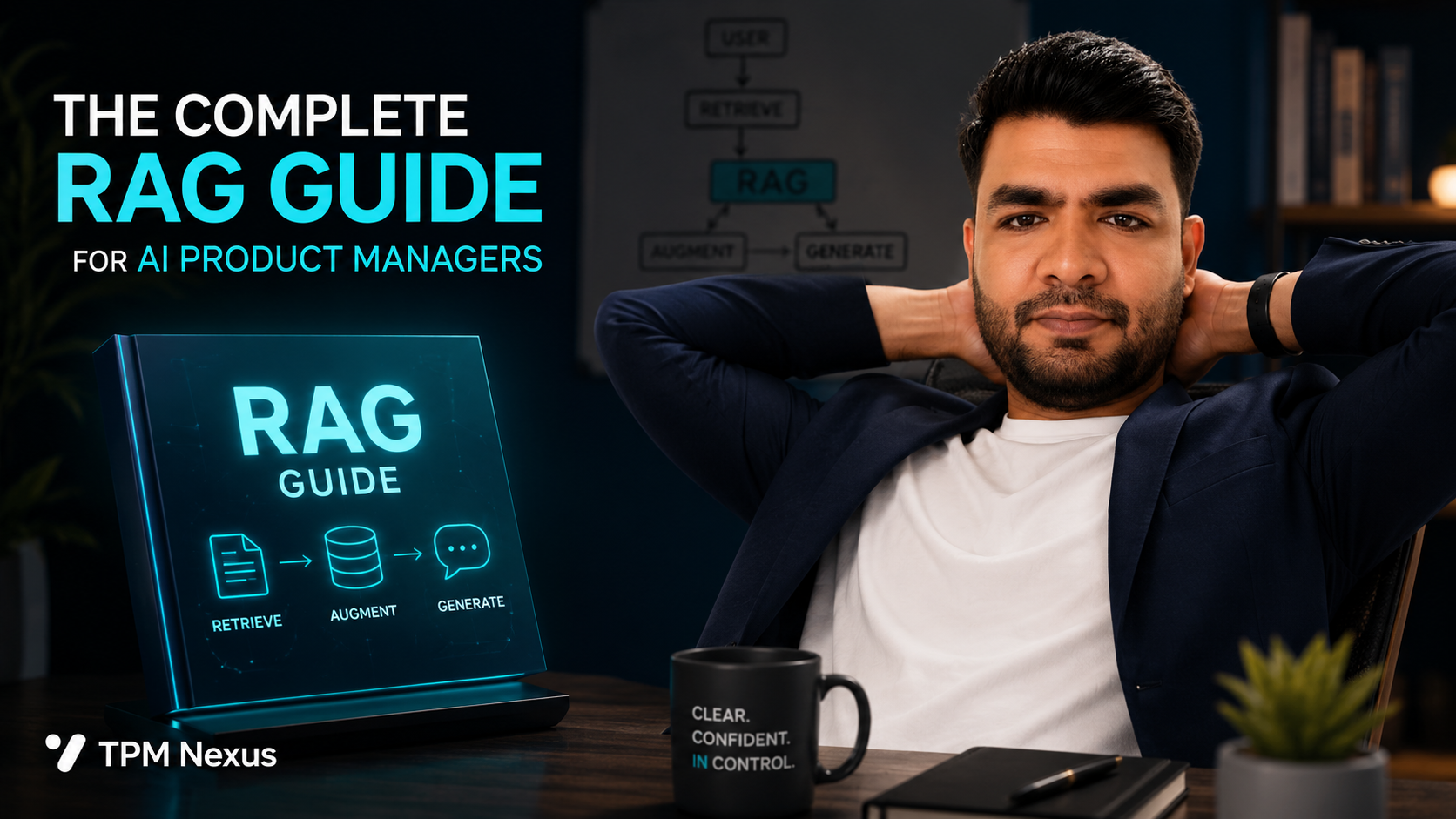
The complete flow becomes:
User Query
↓
Retrieve Relevant Information
↓
Add Context
↓
LLM
↓
Generated Response
This is the basic RAG pattern.
RAG vs Fine Tuning
This is one of the most common architectural questions AI Product Managers encounter.
“Should we use RAG or fine tuning?”
The answer depends on the problem.
RAG is generally useful when:
- Information changes frequently
- The AI needs private company data
- Responses depend on documents
- Users need current information
- The knowledge source can be updated independently
- You want to provide supporting sources
Fine tuning can be useful when:
- You need to change model behavior
- You need consistent output patterns
- You have specialized training examples
- You want the model to follow a particular style or task pattern
A simple way to think about it:
RAG changes what information the model can access.
Fine tuning changes how the model behaves.
They solve different problems.
RAG Is Not a Hallucination Solution by Itself
A common misconception is:
“If we add RAG, hallucinations are solved.”
Not necessarily.
RAG can provide better context, but the system can still fail.
For example:
Poor retrieval → Poor context → Poor answer
The model may also misinterpret retrieved information or generate unsupported conclusions.
Therefore, reliable RAG requires evaluation across the entire pipeline.
What Should AI Product Managers Measure?
Traditional product metrics are not enough for RAG applications.
You need to measure both AI quality and product outcomes.
Retrieval Metrics
Ask:
- Did the system retrieve the right information?
- Was the relevant document included?
- Was irrelevant information retrieved?
- How much context was required?
Generation Metrics
Evaluate:
- Answer accuracy
- Groundedness
- Relevance
- Completeness
- Hallucination rate
Product Metrics
Then connect AI performance to actual product outcomes:
- User adoption
- Task completion
- Resolution rate
- Time saved
- User satisfaction
- Repeat usage
- Escalation rate
This distinction matters.
An AI system can have technically impressive evaluation scores and still fail to create meaningful product value.
The Enterprise RAG Challenge
Enterprise RAG becomes significantly more complicated because information is rarely simple.
An enterprise may have hundreds or thousands of documents spread across multiple systems.
Some information may be:
- Public
- Internal
- Confidential
- Customer specific
- Role specific
- Outdated
- Contradictory
This introduces several product and architecture considerations.
1. Data Freshness
A RAG system is only as useful as the information it retrieves.
If a policy changed yesterday but the knowledge base still contains last year’s policy, the system can generate an answer that sounds correct but is outdated.
Product teams therefore need to define:
How quickly should changes become available to the AI?
That is a product requirement, not just an engineering detail.
2. Access Control
Suppose an employee asks:
“Show me the details of customer ABC’s contract.”
The system should not retrieve confidential information simply because that information exists.
The retrieval layer needs to respect:
User → Role → Permissions → Accessible Data
Enterprise AI therefore needs to consider authorization throughout the retrieval process.
3. Data Quality
RAG does not magically improve bad data.
If your knowledge base contains:
- Duplicate documents
- Conflicting policies
- Outdated information
- Missing metadata
- Poorly structured content
the AI system inherits those problems.
This leads to an important product principle:
AI quality often starts with information quality.
RAG and AI UX
RAG also changes the user experience.
Consider two AI assistants.
Assistant A
“You are eligible for a refund.”
Assistant B
“You are eligible for a refund based on the Enterprise Refund Policy updated on August 12.”
Assistant B provides more context and potentially more confidence.
This is why features such as:
- Citations
- Source links
- “Why this answer?”
- Confidence indicators
- Feedback controls
- Human escalation
can become important parts of the AI product experience.
The product should make it easier for users to understand where the answer came from and when they should trust it.
RAG Architecture: What Should Product Managers Understand?
You do not need to become an ML engineer to work effectively with RAG.
But you should understand the major components.
A simplified architecture looks like this:
                Enterprise Data
                      |
                      ↓
              Document Processing
                      |
                      ↓
                  Chunking
                      |
                      ↓
                 Embeddings
                      |
                      ↓
               Vector Database
                      |
                      |
User Query → Retrieval Layer
                      |
                      ↓
              Relevant Context
                      |
                      ↓
                    LLM
                      |
                      ↓
                AI Response
As an AI Product Manager, you should be able to explain what each component does and understand its product implications.
The Most Important RAG Product Decisions
When designing a RAG based AI product, I would ask these questions early.
1. What problem are we solving?
Do not start with:
“We should build RAG.”
Start with:
“What user problem requires access to external knowledge?”
2. What information does the AI need?
Identify the minimum useful knowledge required.
More information does not necessarily mean better answers.
3. How frequently does that information change?
This determines how the knowledge pipeline needs to operate.
4. Who can access the information?
Define authorization requirements before implementation.
5. What happens when no relevant information exists?
This is often overlooked.
The AI should have a defined fallback behavior.
Sometimes the correct response is:
“I do not have enough information to answer that.”
That can be better than generating an unsupported answer.
6. How will we evaluate it?
Define evaluation before launch.
Do not wait until users complain about incorrect answers.
7. What is the business outcome?
Ultimately, RAG is not the goal.
The goal might be:
- Reduce support resolution time
- Improve employee productivity
- Reduce manual research
- Increase self service
- Improve customer experience
- Reduce operational cost
The architecture should support the outcome.
Common RAG Mistakes
Mistake 1. Assuming RAG Automatically Creates Accuracy
RAG improves access to relevant information.
It does not guarantee correct answers.
Mistake 2. Adding Too Much Context
More context can increase:
- Latency
- Cost
- Noise
- Confusion
The objective is relevant context, not maximum context.
Mistake 3. Ignoring Data Freshness
A technically sophisticated RAG system can still fail because the underlying information is outdated.
Mistake 4. Measuring Only LLM Quality
Do not measure only:
“Does the answer sound good?”
Measure the complete experience.
Mistake 5. Ignoring Permissions
Enterprise AI cannot treat every document as universally accessible.
Mistake 6. Building Before Validating the Use Case
RAG is not automatically the right architecture for every AI feature.
First validate the user problem.
Then determine whether retrieval is actually required.
RAG Product Evaluation Framework
A useful way to think about RAG evaluation is across five layers.
Layer 1. Retrieval
Did we find the right information?
Layer 2. Context
Did we provide the model with useful context?
Layer 3. Generation
Did the model produce a grounded answer?
Layer 4. Experience
Can the user understand and trust the response?
Layer 5. Business Outcome
Did the AI actually improve the user’s workflow?
This creates a much better evaluation model than simply asking:
“Is the LLM accurate?”
When Should You Use RAG?
RAG is particularly attractive when your AI product needs:
Current knowledge
Information changes regularly.
Private knowledge
The product needs company or customer specific information.
Traceability
Users need to understand where answers came from.
Large knowledge bases
The information is too large or dynamic to rely on model memory.
Enterprise workflows
The AI needs to work with existing business information and systems.
When RAG May Not Be Necessary
Not every AI feature needs RAG.
For example, if your product simply needs:
- Text summarization
- Writing assistance
- Brainstorming
- Rewriting
- General content generation
and does not require external or private information, a standard LLM interaction may be sufficient.
The architecture should follow the problem.
Not the other way around.
RAG Is a Product Decision
This is probably the most important takeaway for AI Product Managers.
RAG is often discussed as an engineering architecture.
But the decision to use RAG should begin with product questions.
What information does the user need?
Where does that information live?
How current does it need to be?
Who is allowed to access it?
What happens when the information is missing?
How will we measure whether the AI actually helped?
These questions determine whether RAG is appropriate and what the system needs to deliver.
Final Takeaway
Building a RAG application is relatively easy compared with building a reliable RAG product.
The difficult part is not connecting an LLM to a vector database.
The difficult part is designing a system that consistently delivers:
Relevant context + reliable retrieval + grounded generation + useful user experience + measurable business value.
That is where AI Product Management becomes important.
The strongest AI Product Managers do not need to design every component of the architecture themselves.
They need to understand enough about the architecture to make better decisions about customer problems, product requirements, tradeoffs, evaluation, cost, risk, and outcomes.
The model generates the answer.
The product determines whether that answer is actually useful.
Frequently Asked Questions
What is RAG in AI?
RAG, or Retrieval Augmented Generation, is an AI architecture that retrieves relevant information from external knowledge sources and provides it to an LLM as context before generating a response.
Is RAG better than fine tuning?
Neither is universally better. RAG is generally suited to applications that need current or private information. Fine tuning is more appropriate when the goal is to influence model behavior or specialized task performance.
Does RAG eliminate hallucinations?
No. RAG can improve grounding by providing relevant context, but poor retrieval, incomplete information, or incorrect generation can still lead to hallucinations.
Why is RAG important for enterprise AI?
Enterprise AI often needs access to private, changing, customer specific, and permission controlled information. RAG provides a way to connect LLMs with that external knowledge.
What should an AI Product Manager know about RAG?
An AI Product Manager should understand the RAG architecture, retrieval quality, data freshness, embeddings, vector databases, context, evaluation, security, latency, cost, user experience, and business metrics.
Follow us on LinkedIn: TPM Nexus