Everyone is Learning AI. But Very Few Are Learning to Lead It.
Artificial Intelligence has become the most talked about technology of this decade.
Every day, thousands of professionals enroll in courses on ChatGPT, Claude, Gemini, Microsoft Copilot, Cursor, and prompt engineering. Social media is filled with tutorials on writing better prompts, generating content in seconds, and automating repetitive tasks.
These are valuable skills.
Learning AI tools can significantly improve individual productivity. They help us write faster, analyze data more efficiently, prepare presentations, summarize meetings, and automate routine work.
However, there is one question that receives far less attention.
Will learning AI tools alone prepare you to lead AI initiatives inside an enterprise?
The answer is no.
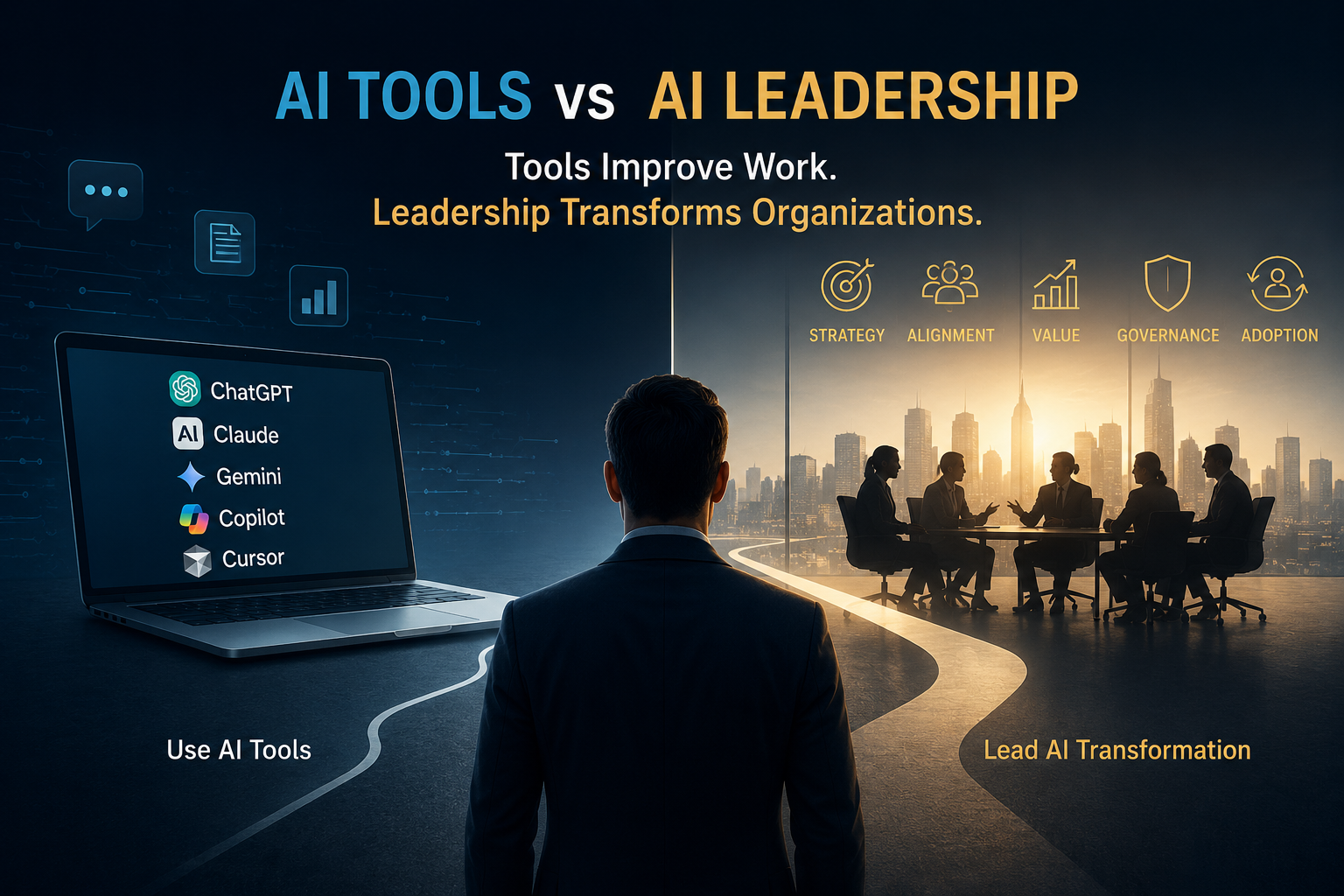
Organizations are not looking for people who can simply use AI tools. They are looking for leaders who can identify business opportunities, prioritize AI investments, align stakeholders, manage risks, drive adoption, and deliver measurable business outcomes.
That is the difference between an AI user and an AI leader.
As AI becomes embedded into every business function, the professionals who create the greatest impact will not be those who know the most prompts. They will be the ones who know how to translate AI into business value.
The AI Skills Boom
Over the last two years, AI education has exploded.
Professionals are investing time in learning:
- ChatGPT
- Claude
- Gemini
- Microsoft Copilot
- Cursor
- Prompt Engineering
- AI Content Creation
- AI Automation
These skills are useful because they improve individual productivity.
- A Product Manager can create user stories in minutes.
- A Technical Program Manager can summarize meeting notes instantly.
- An Engineering Manager can draft technical documentation more efficiently.
- A Marketing professional can generate campaign ideas within seconds.
The productivity gains are real.
However, these are individual capabilities.
Enterprise AI transformation is something entirely different.
The challenge is no longer about using AI.
The challenge is about implementing AI across an organization in a way that creates measurable business value.
Why Enterprise AI Projects Struggle
One of the biggest misconceptions about AI is that technology is the hardest part.
It is not.
Most enterprise AI initiatives struggle because of business and organizational challenges rather than technical limitations.
Common reasons include:
Unclear Business Objectives
Organizations often begin with a technology instead of a business problem.
Questions such as “How can we use Generative AI?” are far less effective than asking “Which business process should we improve?”
Successful AI initiatives always begin with a clearly defined business objective.
Lack of Executive Alignment
AI impacts multiple departments.
- Product.
- Engineering.
- Operations.
- Security.
- Legal.
- Compliance.
Without executive sponsorship and cross functional alignment, AI initiatives often lose momentum.
Poor Data Quality
AI systems are only as effective as the data they rely on.
Incomplete, outdated, or inconsistent data leads to unreliable results and low user confidence.
Low User Adoption
Even technically successful AI solutions can fail if employees do not trust or use them.
User adoption requires training, communication, and continuous feedback.
Weak Governance
Organizations must establish clear policies around:
- Privacy
- Security
- Responsible AI
- Regulatory compliance
- Human oversight
Ignoring governance creates unnecessary business risk.
No Business Metrics
Many AI projects celebrate technical achievements while failing to measure business outcomes.
The real questions should be:
- Did customer satisfaction improve?
- Was manual effort reduced?
- Did revenue increase?
- Were operational costs lowered?
- Did decision making become faster?
These are the metrics that matter.
AI Tools vs AI Leadership
The distinction is important.
| AI Tool User | AI Leader |
|---|---|
| Learns prompts | Defines AI strategy |
| Uses ChatGPT | Identifies business opportunities |
| Automates personal work | Transforms enterprise workflows |
| Focuses on productivity | Focuses on business outcomes |
| Experiments with AI | Builds scalable AI capabilities |
| Learns the latest tools | Develops long term organizational capability |
Both roles are valuable.
However, they create very different levels of impact.
Learning AI tools helps you become more efficient.
Learning AI leadership helps you become more influential.
Five Capabilities Every AI Leader Needs
1. Business Strategy
Every AI initiative should solve a meaningful business problem.
Leaders must understand customer needs, market trends, operational challenges, and organizational priorities before recommending AI solutions.
Technology should always support strategy, not replace it.
2. Product Thinking
AI leaders identify use cases based on business value rather than technical novelty.
They ask questions such as:
- Which customer problem are we solving?
- How will success be measured?
- What is the expected return on investment?
- Which initiatives should be prioritized?
3. Technical Understanding
AI leaders do not need to become machine learning engineers.
They should, however, understand the fundamentals.
This includes:
- Large Language Models
- Retrieval Augmented Generation
- AI Agents
- APIs
- Data architecture
- Security considerations
- AI limitations
This knowledge enables better decision making and communication with engineering teams.
4. Program Leadership
Enterprise AI initiatives involve multiple teams.
Success depends on managing:
- Stakeholders
- Dependencies
- Risks
- Budgets
- Timelines
- Governance
- Communication
Strong execution often determines whether an AI initiative succeeds or fails.
5. Change Management
People rarely resist technology.
They resist uncertainty.
AI leaders build confidence by:
- Communicating clearly
- Training employees
- Demonstrating value
- Addressing concerns
- Measuring adoption
Technology creates possibilities.
Leadership creates adoption.
Why This Matters for Product and Program Leaders
Product Managers, Technical Product Managers, Technical Program Managers, Engineering Managers, and Delivery Managers are uniquely positioned to lead AI transformation.
These roles already operate at the intersection of business and technology.
- They understand customers.
- They work with engineering teams.
- They manage stakeholders.
- They prioritize initiatives.
- They drive execution.
Adding AI leadership capabilities to these existing strengths creates a significant competitive advantage.
Organizations increasingly need professionals who can bridge strategy, technology, and execution.
The Future Belongs to AI Leaders
Every organization will eventually have access to powerful AI models.
The technology itself will become widely available.
Competitive advantage will not come from having access to AI.
It will come from knowing how to use AI responsibly, strategically, and effectively.
The professionals who thrive over the next decade will be those who can answer questions such as:
- Which business problems should AI solve?
- Which initiatives should we prioritize?
- How do we measure business value?
- How do we scale AI responsibly?
- How do we bring people along during transformation?
These are leadership questions.
Not technology questions.
Final Thoughts
- Learning ChatGPT is useful.
- Learning prompt engineering is valuable.
- Learning the latest AI tools will certainly improve your productivity.
But productivity alone will not prepare you to lead enterprise AI transformation.
The future belongs to professionals who combine business strategy, product thinking, technical understanding, execution excellence, governance, and change management into a single leadership capability.
That is the difference between using AI and leading AI.
At TPM Nexus, we believe the next generation of Product Managers, Program Managers, Engineering Leaders, and Business Executives will be defined not by how many AI tools they know, but by how effectively they can lead AI driven transformation.
The question is no longer whether AI will change the way we work.
The real question is whether we are preparing ourselves to lead that change.