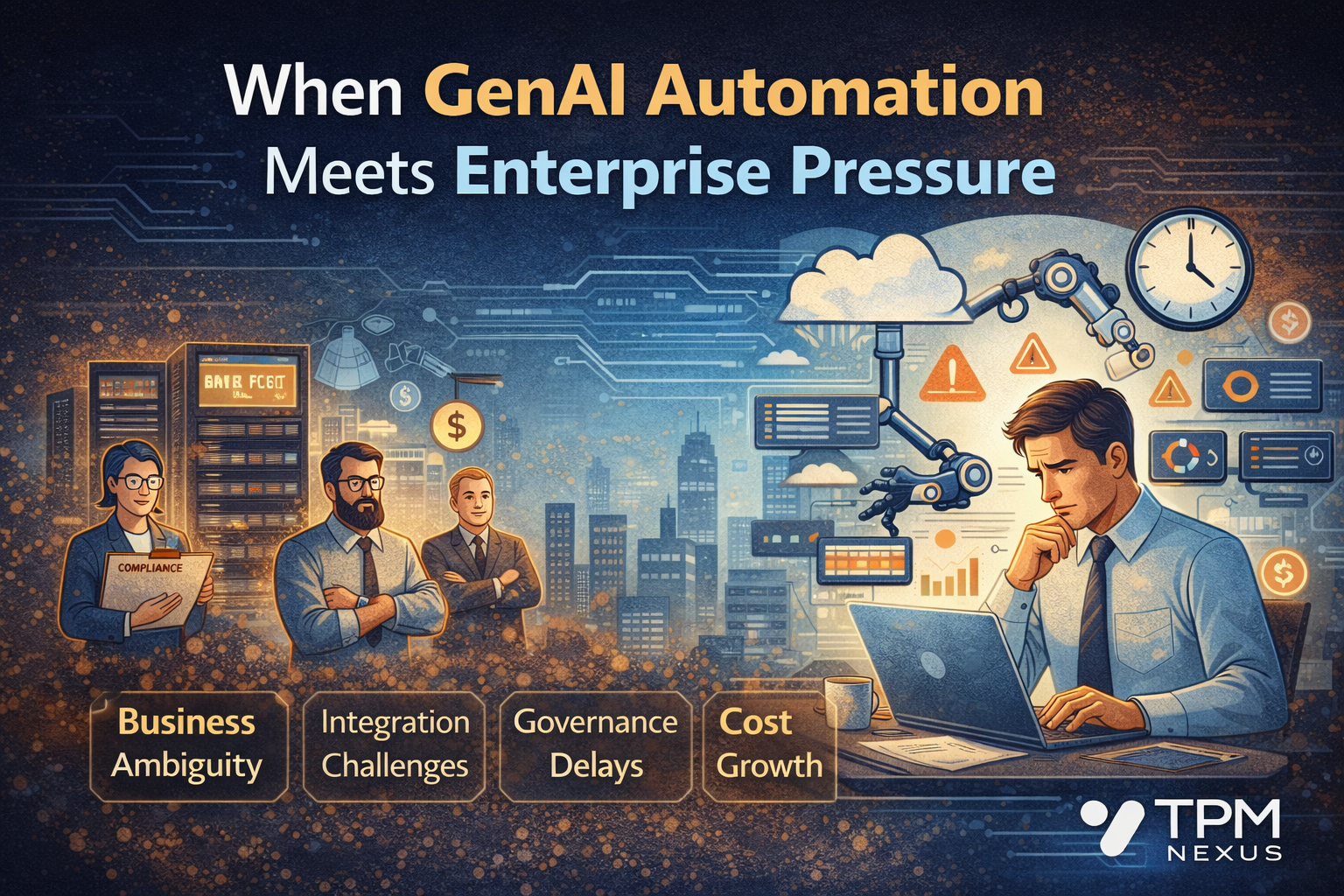
Most GenAI programs do not fail because of the model. They fail because the system around the model was not ready.
Over the last few years, I have worked on AI automation programs where the goal was clear. Reduce manual effort. Improve turnaround time. Increase conversion. Do it safely. Do it at scale.
On slides, everything looks simple. In reality, once traffic hits production, pressure exposes everything.
This blog is about what really happens when GenAI automation moves from idea to enterprise rollout.
The Project Context
Let me share a real type of program I led. We were building an AI powered automation feature for a high volume workflow. The goal was to reduce manual review effort by 40 percent and improve response time by 30 percent. The system looked like this:
- Input data coming from multiple upstream systems
- AI model generating a recommendation
- Business rules validating output
- Operations team reviewing flagged cases
- Dashboard tracking impact
The POC worked well. Accuracy looked strong in test data. Stakeholders were excited.
Then we moved toward production. That is when real execution started.
Pressure Point 1. Business Definition Was Not Deep Enough
In early discussions, success was defined as “automation rate”. That sounded reasonable. But once we went deeper, questions started coming:
- Should all cases be treated equally
- What about high value transactions
- What about sensitive customer segments
- What is acceptable error rate per category
We realized that 90 percent accuracy was not enough information. If the 10 percent error happened mostly in high risk cases, the business exposure was too high. We had to redesign rollout logic:
- High risk cases always go to manual review
- Medium risk cases need additional validation
- Low risk cases can be auto processed
Lesson learned: Average accuracy is not a business metric. Error distribution matters more than headline numbers.
Pressure Point 2. Integration Took Longer Than the Model
The model took a few weeks to test and finalize. Integration took months. Why? Because upstream data was messy. We found:
- Missing fields in some regions
- Inconsistent data formats
- Old records with different schema
- Unexpected null values
The model was not the problem. The data quality was. We had to:
- Standardize input format
- Add validation layers
- Create fallback logic
- Build clear logging
Most TPMs underestimate this part. AI projects are integration heavy. If you estimate only model effort, you will miss timelines.
Pressure Point 3. Governance Arrived Late
Security and compliance were not blocking us. They just were not deeply involved early. When we presented for production approval, new questions came:
- How is PII handled
- Where are logs stored
- How long is data retained
- What happens if model output is challenged
We had answers. But not in structured documentation. This delayed rollout by several weeks. After that experience, I changed the approach.
Now, risk stakeholders join early design sessions. Not to approve. To shape guardrails. When they understand the logic early, reviews become faster.
Pressure Point 4. Cost Grew After Launch
Initial cost estimates were based on expected traffic and prompt size. But in real usage:
- Traffic grew faster than forecast
- Prompts became longer as features expanded
- Retry logic increased API calls
- More monitoring required extra infrastructure
Cost per transaction slowly increased. Executives started asking hard questions.
Is ROI still strong.
Is scaling safe.
If you do not monitor cost daily in early stages, it can surprise you. AI cost is not static. It evolves with usage patterns.
Where Most TPMs Miscalculate Effort
From my experience, most TPMs miscalculate in three areas:
- They focus too much on model selection
- They underestimate data preparation work
- They treat governance as final approval instead of early design input
GenAI programs are system programs. The model is one component. Data, workflows, risk, cost, monitoring are equally important.
What Worked for Us
After going through these pressures, we refined our execution approach. We now ensure five things exist before rollout:
- Clear business risk definition
- Data readiness validation
- Measured model evaluation on real cases
- Documented risk control and fallback plan
- Real time monitoring for cost and output drift
When these five areas are structured early, production rollout becomes smoother. Not perfect. But controlled.
Final Reflection
GenAI automation looks impressive in demos. Enterprise execution is different. Pressure reveals gaps:
- Unclear ownership
- Hidden data issues
- Weak monitoring
- Loose cost tracking
If you are a TPM moving into GenAI programs, your strength will not come from knowing the best model. It will come from building strong execution structure.
Think in systems, trade offs, and exposure. That is how GenAI programs survive enterprise pressure.
If you are running or planning a GenAI rollout, I would love to hear your experience. What surprised you most when you moved from POC to production.
Built for GenAI TPMs who own outcomes, not demos https://www.tpmnexus.pro