Artificial Intelligence projects rarely fail because the model is weak. Most of the time, projects struggle because the program structure around the vendor is weak.
Many organizations today rely on AI vendors for things like document processing, chatbots, recommendation systems, fraud detection, or automation tools. Vendors promise powerful models and fast implementation. Leadership often expects quick results.
This is where the Technical Program Manager becomes critical.
A TPM does not just manage timelines. A TPM protects the organization from unclear scope, weak delivery structure, and vendor over-promises. When AI vendors are involved, these risks become even bigger because the technology itself is complex and sometimes unpredictable.
Over the years, many AI programs have struggled not because the vendor was bad, but because the program structure was weak from the beginning.
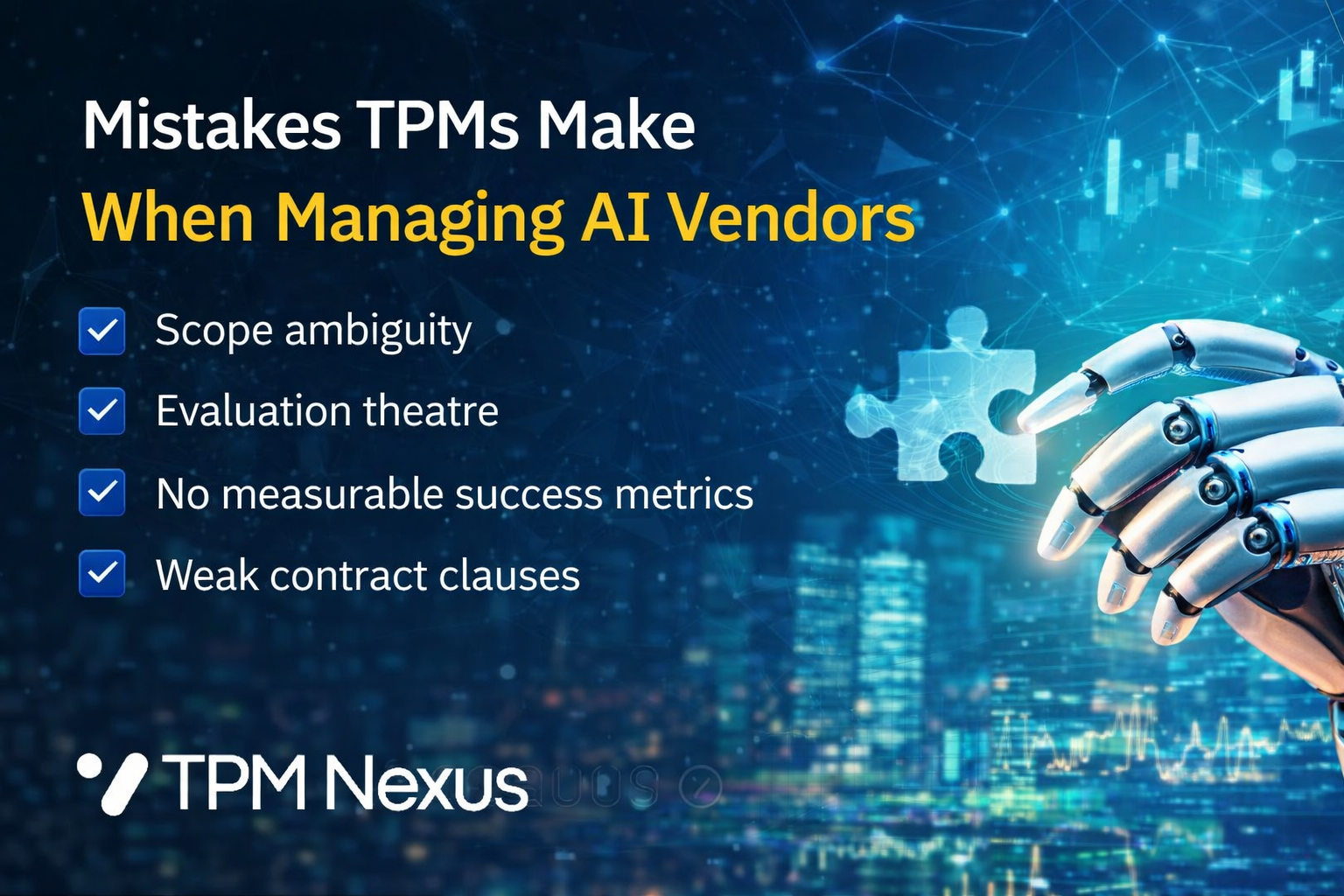
Let us look at the most common mistakes TPMs make when managing AI vendors, and how to avoid them.
1. Scope Ambiguity
One of the biggest mistakes TPMs make is starting an AI engagement without clearly defining the scope.
In traditional software projects, scope is easier to define. For example:
- Build a login system
- Create a reporting dashboard
- Develop an API service
But AI systems behave differently. AI outputs are probabilistic, not deterministic. This means the system may give different results for similar inputs.
If the scope is vague, vendors often deliver something that technically works, but does not solve the business problem.
Example
A financial services company hired an AI vendor to automate invoice processing.
The vendor promised that their AI model could extract fields from invoices automatically.
However, the scope defined in the contract only said:
“AI system should extract invoice information.”
No one defined:
- What fields are required
- Accuracy expectations
- Document formats supported
- Edge cases like handwritten invoices
After delivery, the system extracted some data but failed in many cases. The vendor said the model was working as expected because the scope never defined exact success criteria.
The TPM had to spend months redesigning the program.
What TPMs should do instead
A good TPM should convert vague goals into structured scope.
Define clearly:
- Input types
- Output format
- Data quality expectations
- Edge cases
- System integration boundaries
For example:
Instead of saying:
“Extract invoice data”
Define:
- Extract Vendor Name, Invoice Number, Invoice Date, Total Amount
- Accuracy target 95 percent on structured invoices
- Support PDF and scanned image formats
- Response time under 3 seconds
Clear scope protects the organization and prevents confusion later.
2. Evaluation Theatre
Another common mistake is something called evaluation theatre.
This happens when companies spend weeks or months running vendor demos and proof of concepts that look impressive but do not reflect real production conditions.
The vendor shows polished demos with perfect inputs. Leadership sees strong results and assumes the technology works well.
But once the system goes into production, the performance drops sharply.
Why this happens
Most vendor demos use clean curated datasets.
Real business environments contain messy data:
- Poor scans
- Incomplete documents
- Noisy user inputs
- Edge cases
AI systems often perform very differently in these real conditions.
Real example
A large e-commerce company evaluated an AI chatbot vendor.
During the demo:
- The chatbot answered questions correctly
- Response time was fast
- Accuracy looked above 90 percent
But the demo used only 20 curated customer queries.
After launch, real users started asking thousands of different questions. The chatbot struggled with many variations and started giving wrong answers.
Customer support tickets increased instead of decreasing.
The program team realized the evaluation process had not simulated real user behavior.
What TPMs should do instead
A TPM should design realistic evaluation frameworks.
Instead of relying on demos, create structured testing:
- Use historical production data
- Include edge cases
- Include failure scenarios
- Run large scale testing
For example:
Test the chatbot with 5,000 historical customer queries, not just a small demo set.
This approach reveals the real performance of the AI system.
3. No Measurable Success Metrics
Many AI vendor programs fail because success is never clearly defined.
Leadership says things like:
- Improve automation
- Reduce manual effort
- Improve customer experience
These goals sound good, but they are not measurable.
Without measurable metrics, vendors can claim success even if the business impact is minimal.
Example
A healthcare company hired an AI vendor to automate medical claim classification.
The vendor built a machine learning model that categorized claims into different buckets.
After deployment, the vendor said the project was successful because the model accuracy was 92 percent.
But the business team noticed something important.
Manual review workload had not reduced much.
Why?
Because the remaining 8 percent errors were happening in high risk claims, which still required manual verification.
So even with 92 percent accuracy, the business benefit was small.
What TPMs should define early
A TPM should define success metrics that reflect real business outcomes.
Examples include:
- Reduction in manual processing time
- Increase in automation rate
- Reduction in customer handling time
- Cost reduction per transaction
For example:
Instead of saying:
“Improve claim classification accuracy”
Define:
- 70 percent claims should be auto approved without manual review
- Average claim processing time should reduce from 3 days to 6 hours
Now the program has a clear target.
4. Weak Contract Clauses
This is one of the most overlooked areas.
Many TPMs focus on delivery timelines and technical discussions but ignore the strength of the vendor contract.
Weak contracts create major problems later.
AI systems are not simple products. They evolve over time.
Without clear contract clauses, organizations face issues such as:
- Vendor lock-in
- Hidden costs
- Lack of model transparency
- No support for performance issues
Example
A retail company integrated an AI recommendation engine from a vendor.
The system worked well initially.
But after six months:
- Model performance dropped
- Customer behavior had changed
- Recommendations were no longer relevant
The company asked the vendor to retrain the model.
The vendor responded that retraining was not included in the contract.
Retraining required additional payment.
Because the contract did not clearly define model lifecycle management, the company had to renegotiate at a higher cost.
What TPMs should ensure in contracts
TPMs should work closely with legal and procurement teams.
Important clauses should include:
Model performance commitments
For example
Minimum accuracy or performance thresholds.
Model retraining policy
Define when and how retraining will happen.
Data ownership
Ensure the organization owns the training data.
Exit strategy
Ability to migrate to another vendor if needed.
Support SLAs
Define response time and resolution expectations.
Strong contracts reduce long term risk.
Why This Matters for Leadership
AI programs often receive large budgets and leadership attention.
But many failures happen not because the model is weak, but because program governance is weak.
This is where TPM leadership becomes critical.
A strong TPM does not just track timelines. A strong TPM builds the execution framework around AI systems.
That includes:
- Defining clear scope
- Designing realistic evaluation processes
- Setting measurable success metrics
- Structuring strong vendor agreements
When these elements are handled properly, AI programs have a much higher chance of delivering real business impact.
Final Thought
AI vendors bring valuable technology. But technology alone does not guarantee success.
The real difference comes from how the program is structured and managed.
For TPMs working in AI programs, vendor management is not just procurement work. It is program architecture.
The TPM must ensure that:
- the problem is clearly defined
- the evaluation is realistic
- success metrics are measurable
- vendor agreements protect the organization
When these foundations are strong, AI programs move from experiments to real business outcomes.
And that is where TPM leadership truly matters.
Learn how real AI programs are executed in organizations. Visit www.tpmnexus.pro