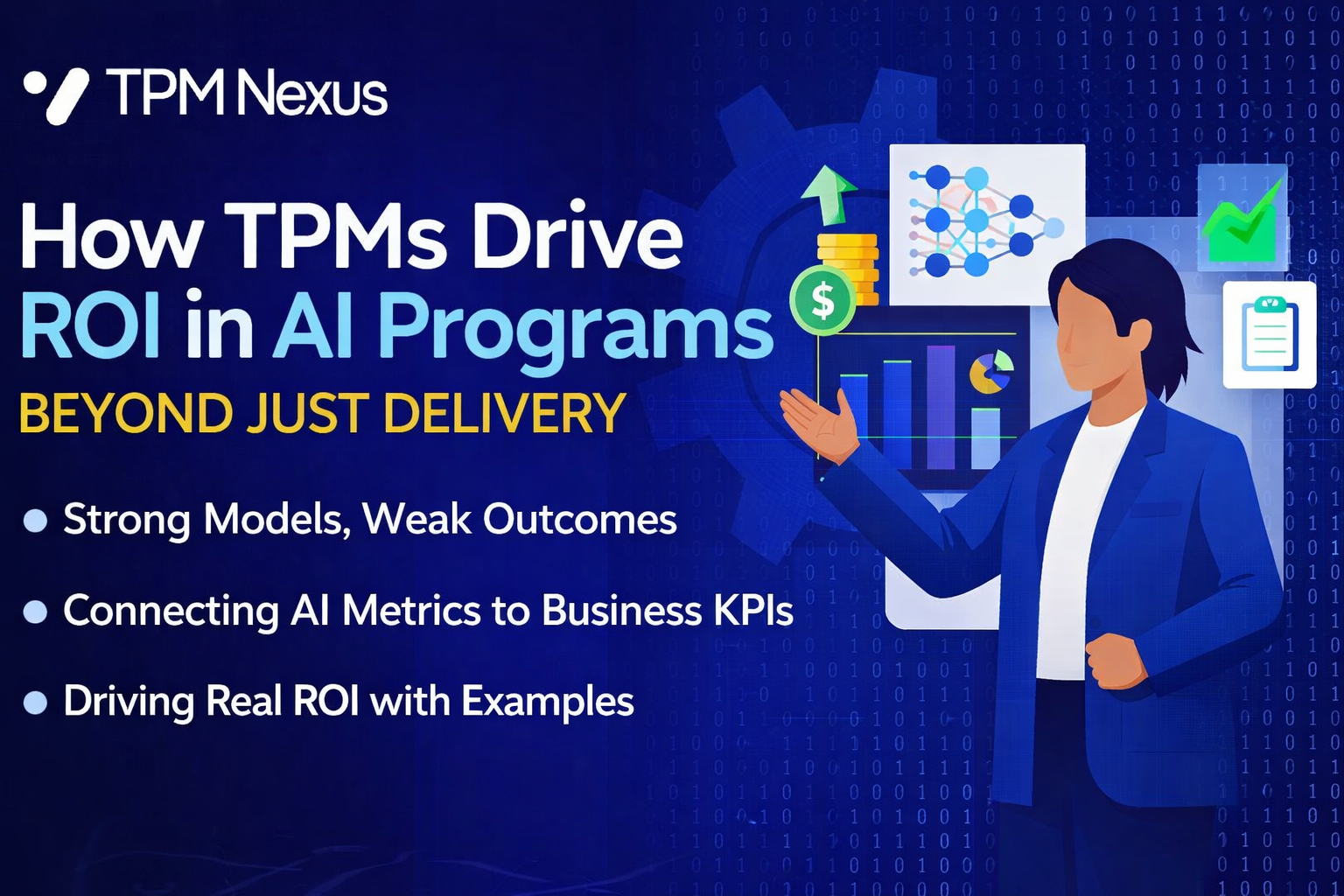
Most AI programs do not fail because the model is bad. They fail because the business does not see meaningful impact.
You will often see this pattern. The model accuracy is high. The engineering effort is solid. The system is deployed.
And yet, leadership asks a simple question:
“What did this actually improve?”
This is where the role of a Technical Program Manager changes.
Not just delivery. Ownership of outcomes.
The Core Problem: Strong Models, Weak Outcomes
AI programs often get stuck in what can be called output success vs outcome failure.
What teams celebrate:
- Model accuracy improved from 82 percent to 91 percent
- Pipeline latency reduced by 30 percent
- Feature successfully deployed to production
What the business cares about:
- Did conversion increase?
- Did cost reduce?
- Did user behavior change?
There is a disconnect.
And that disconnect is exactly where TPMs need to step in.
Why AI Programs Fail to Show ROI
1. Metrics Are Technical, Not Business-Aligned
Teams track:
- Precision, recall
- F1 scores
- Latency
But these do not directly translate to:
- Revenue
- Retention
- Cost efficiency
Without that mapping, success remains invisible.
2. Problem Framing Is Weak
Many AI programs start with:
“Let us apply AI here”
Instead of:
“What business problem are we solving, and how will we measure success?”
This leads to solutions that are technically impressive but commercially irrelevant.
3. No Clear Baseline or Control Group
Without a baseline:
- You cannot measure improvement
- You cannot prove impact
Without A B testing:
- You cannot isolate the effect of AI
Result:
No credible ROI narrative
4. Ownership Gap Between Teams
- Data science owns the model
- Engineering owns deployment
- Product owns requirements
But no one owns business impact end to end
This is where TPMs become critical.
The TPM Shift: From Delivery to ROI Ownership
A strong TPM does not stop at “feature shipped”.
They ask:
- What is the expected business impact?
- How will we measure it?
- When will we know if it worked?
This requires moving from execution tracking to impact orchestration.
Defining Measurable Success Metrics
TPMs act as the bridge between technical metrics and business KPIs.
Step 1: Start with Business Outcomes
Examples:
- Increase checkout conversion by 5 percent
- Reduce customer support cost by 20 percent
- Improve content engagement by 15 percent
Step 2: Map to System-Level Metrics
| Business KPI | System Metric |
|---|---|
| Conversion | Recommendation relevance score |
| Cost | Cost per inference |
| Experience | Latency, response time |
Step 3: Define Leading and Lagging Indicators
- Leading indicators: latency, prediction accuracy
- Lagging indicators: revenue, retention
Both are required.
Leading indicators tell you if you are on track.
Lagging indicators prove impact.
Connecting Engineering Output to Business KPIs
This is where most programs break.
TPMs need to create a clear traceability chain:
Model Improvement → System Behavior Change → User Experience Shift → Business Impact
Example:
- Model improves recommendation accuracy
- Users see more relevant suggestions
- Click-through rate increases
- Conversion improves
If any link in this chain is weak or missing, ROI will not show up.
Real Example: AI Automation That Failed to Drive Revenue
Let us take a practical scenario.
Problem Statement
A company builds an AI system to automate customer support responses.
Execution Success
- 60 percent of queries are now auto-resolved
- Response time reduced significantly
- Support team workload reduced
Everything looks successful.
But Business Impact?
- Revenue remains unchanged
- Customer satisfaction does not improve
- Repeat purchase rate stays flat
What Went Wrong
1. Wrong Success Metric
Focus was on:
- Automation rate
Instead of:
- Customer satisfaction
- Retention
2. Poor Problem Selection
The automated queries were:
- Low-value
- Non-revenue impacting
High-value customer issues still required manual intervention.
3. No KPI Mapping
There was no clear connection between:
- Faster response time
and - Revenue growth
What a TPM Would Do Differently
1. Redefine Success Metrics
Instead of:
- Percent automation
Focus on:
- Customer satisfaction score
- Repeat purchase rate
- Resolution quality
2. Prioritize High-Impact Use Cases
- Identify queries that affect churn or revenue
- Focus automation efforts there
3. Introduce Measurement Framework
- A B testing between AI vs human responses
- Track downstream impact on behavior
4. Create Feedback Loops
- Collect user feedback post interaction
- Feed that back into model improvement
Practical TPM Playbook for Driving ROI
1. Define ROI Before Execution Starts
- What does success look like in business terms
- How will it be measured
2. Establish Baselines
- Current conversion, cost, or engagement levels
- Without this, improvement cannot be proven
3. Align Stakeholders Early
- Product, engineering, data science, business
- Everyone should agree on success metrics
4. Track Metrics at Multiple Layers
- Model level
- System level
- Business level
5. Drive Continuous Evaluation
- Post-launch is where real work starts
- Measure, learn, iterate
The Real Differentiator for Senior TPMs
Execution is expected.
Delivery is table stakes.
The real differentiator is this:
Can you connect complex systems to measurable business outcomes?
- That is what leadership values.
- That is what drives promotions.
- That is what builds credibility.
Final Thought
AI is powerful.
But without clear ownership of impact, it becomes expensive experimentation.
TPMs sit at the intersection of:
- systems
- stakeholders
- strategy
And that puts them in the best position to answer the only question that matters:
“Did this actually move the business?”
If you are serious about moving from execution-focused TPM to impact-driven TPM, this is exactly the shift you need to make.
At TPM Nexus, we go deep into:
- How to think in systems, not just tasks
- How to connect architecture to business outcomes
- How to position yourself for senior TPM roles
If you want to learn this in a structured way:
👉 Visit: www.tpmnexus.pro
Because in today’s world, TPMs who can prove impact are the ones who stand out.