Ambiguity is not an exception in large programs.
It is the default state.
And this is where the real difference shows up.
Junior TPMs struggle with ambiguity.
Mid-level TPMs try to manage it.
Senior TPMs create clarity out of it.
If you want to operate at a higher level, you need a structured way to handle ambiguity. Not avoid it.
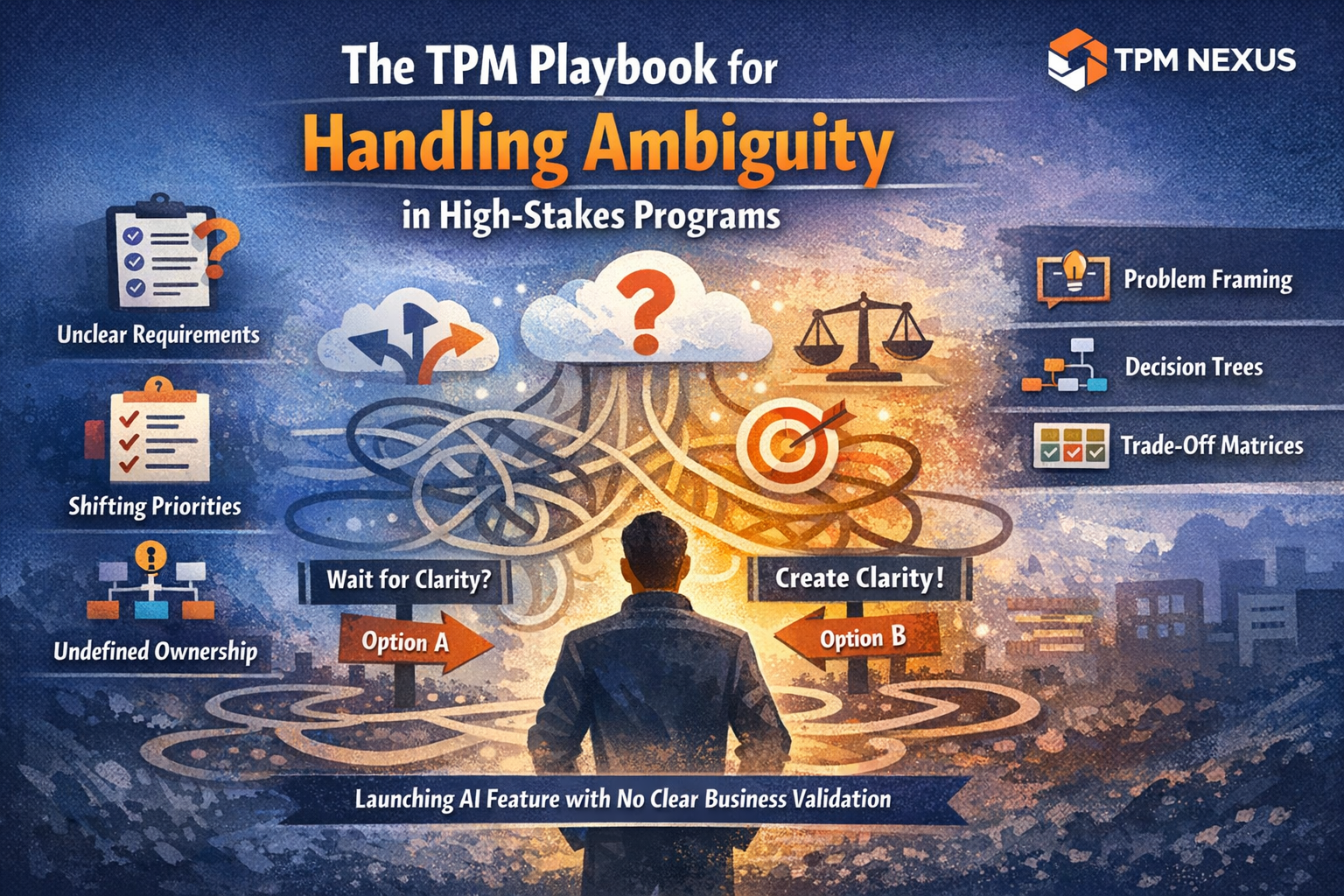
What Ambiguity Actually Looks Like in Programs
Ambiguity is not always obvious. It shows up in subtle ways.
Common forms of ambiguity
- Requirements are not clearly defined
- Priorities keep changing
- Ownership is unclear across teams
- Success metrics are missing or vague
- Stakeholders are not aligned
At first glance, everything seems “in progress”.
But underneath, there is no real clarity.
Why Ambiguity Is Dangerous
Ambiguity does not just slow things down.
It creates misaligned execution.
Different teams:
- Interpret requirements differently
- Work toward different goals
- Make conflicting decisions
Result:
- Rework
- Delays
- Friction between teams
And eventually, leadership sees it as an execution failure.
Why Most Teams Get Stuck
1. Waiting for Clarity Instead of Creating It
Teams assume:
- Product will define everything
- Leadership will make decisions
So they wait.
But in complex programs, clarity rarely comes fully defined.
2. Over-Reliance on Product or Leadership
TPMs often step back and say:
- “This is a product decision”
- “We are waiting for leadership input”
This creates bottlenecks.
Senior TPMs do not wait.
They structure the problem and drive decisions forward.
3. Jumping to Solutions Too Early
Teams often start building before understanding:
- What problem are we solving
- What success looks like
This leads to:
- Misaligned solutions
- Rework later
The TPM Role in Ambiguity
A TPM is not just a coordinator.
A TPM is a clarity creator.
That means:
- Structuring undefined problems
- Driving alignment across teams
- Enabling decisions
You are not expected to have all answers.
But you are expected to create a path to answers.
TPM Frameworks to Reduce Ambiguity
This is where structure matters.
1. Problem Framing Before Solutioning
Before anything starts, define:
- What exactly is the problem?
- Why does it matter?
- Who is impacted?
Example:
Instead of:
- “Build an AI recommendation system”
Define:
- “Improve product discovery to increase conversion by 10 percent”
This shifts focus from solution to outcome.
2. Define Success Metrics Early
Ambiguity reduces when success is clear.
Define:
- What metric will move
- By how much
- In what timeline
Without this:
- Teams will move in different directions
3. Create Decision Trees
When multiple paths exist, structure decisions.
Example:
- Option A: Faster delivery, lower accuracy
- Option B: Slower delivery, higher accuracy
Lay out:
- Trade-offs
- Risks
- Impact
This helps stakeholders make informed decisions faster.
4. Use Trade-Off Matrices
Every program has constraints.
You cannot optimize everything.
A simple matrix:
| Option | Time | Quality | Cost | Risk |
|---|---|---|---|---|
| A | Low | Medium | Low | Medium |
| B | High | High | High | Low |
This creates clarity in complex decisions.
5. Establish Ownership Clearly
Ambiguity increases when ownership is unclear.
Define:
- Who owns what
- Who is accountable
- Who is consulted
This avoids confusion later.
Real Scenario: Launching an AI Feature Without Clear Validation
Context
A company wants to launch a new AI-powered feature.
Initial direction:
- “Let us use AI to improve user experience”
Sounds good. But unclear.
What Happens Without TPM Intervention
- Product defines high-level idea
- Engineering starts building
- Data team experiments with models
But:
- No clear success metric
- No validation of business impact
- No alignment across teams
After months:
- Feature is built
- Impact is unclear
What a TPM Does Differently
Step 1: Frame the Problem
Instead of vague direction:
Define:
- What user problem are we solving?
- What behavior are we trying to change?
Step 2: Define Success Metrics
Example:
- Increase user engagement by 15 percent
- Improve retention by 10 percent
Step 3: Align Stakeholders
Bring together:
- Product
- Engineering
- Data science
- Business
Ensure:
- Everyone agrees on goals
- Everyone understands trade-offs
Step 4: Structure Execution
- Define phases
- Identify dependencies
- Set checkpoints
Step 5: Enable Decision-Making
When ambiguity arises:
- Present options
- Highlight trade-offs
- Drive decisions
Final Outcome
- Clear direction
- Aligned teams
- Measurable impact
Not just a shipped feature.
A successful program.
Practical TPM Playbook
1. Do Not Wait for Clarity
If things are unclear, that is your starting point.
2. Always Start With “Why”
Before “what” and “how”.
3. Structure the Problem
Break ambiguity into smaller, solvable parts.
4. Drive Alignment Continuously
Not just once. Alignment evolves.
5. Communicate in Terms of Decisions
Not just updates.
The Real Differentiator
Most TPMs manage execution when things are clear.
Senior TPMs operate when:
- things are unclear
- direction is missing
- stakes are high
That is where leadership is required.
Final Thought
Ambiguity is not a blocker.
It is an opportunity.
The TPM who can create clarity in ambiguity is the TPM who leads high-stakes programs.
If you want to build this level of structured thinking and operate confidently in ambiguous environments:
At TPM Nexus, we focus on:
- Handling real-world program complexity
- Structured decision-making frameworks
- Transitioning into senior TPM roles
👉 Visit: www.tpmnexus.pro
Because in complex programs, clarity is not given. It is created.