1. Introduction: The Performance Gap
In the world of AI execution, there is a recurring paradox: the more structured a project looks on paper, the more likely it is to suffer a predictable failure. Organizations follow the standard path, Idea to Proof of Concept (PoC), then Pilot, and finally Production, yet the transition to live environments remains where most initiatives collapse.
Consider the reality of SupportX. Handling over 9,000 daily customer tickets under intense operational pressure, the organization viewed automation not as a luxury, but as an urgent necessity to mitigate increasing response delays. However, execution fails when technical structure is missing. The disconnect between a controlled PoC and the messy reality of a high-stakes support environment is where the performance gap widens. As a Technical Program Manager (TPM), your mission is to identify these risks early and ensure that the program is built on operational reality rather than technical optimism.
2. Lesson 1: The Foundation is Not the Model, It’s the Data
The common pitfall in AI strategy is prioritizing model selection over data validation. The critical reality is that AI systems do not understand intent; they learn patterns. If your data reflects inconsistency or confusion, the AI will simply replicate and amplify those flaws. Success is determined by the foundation beneath the model.
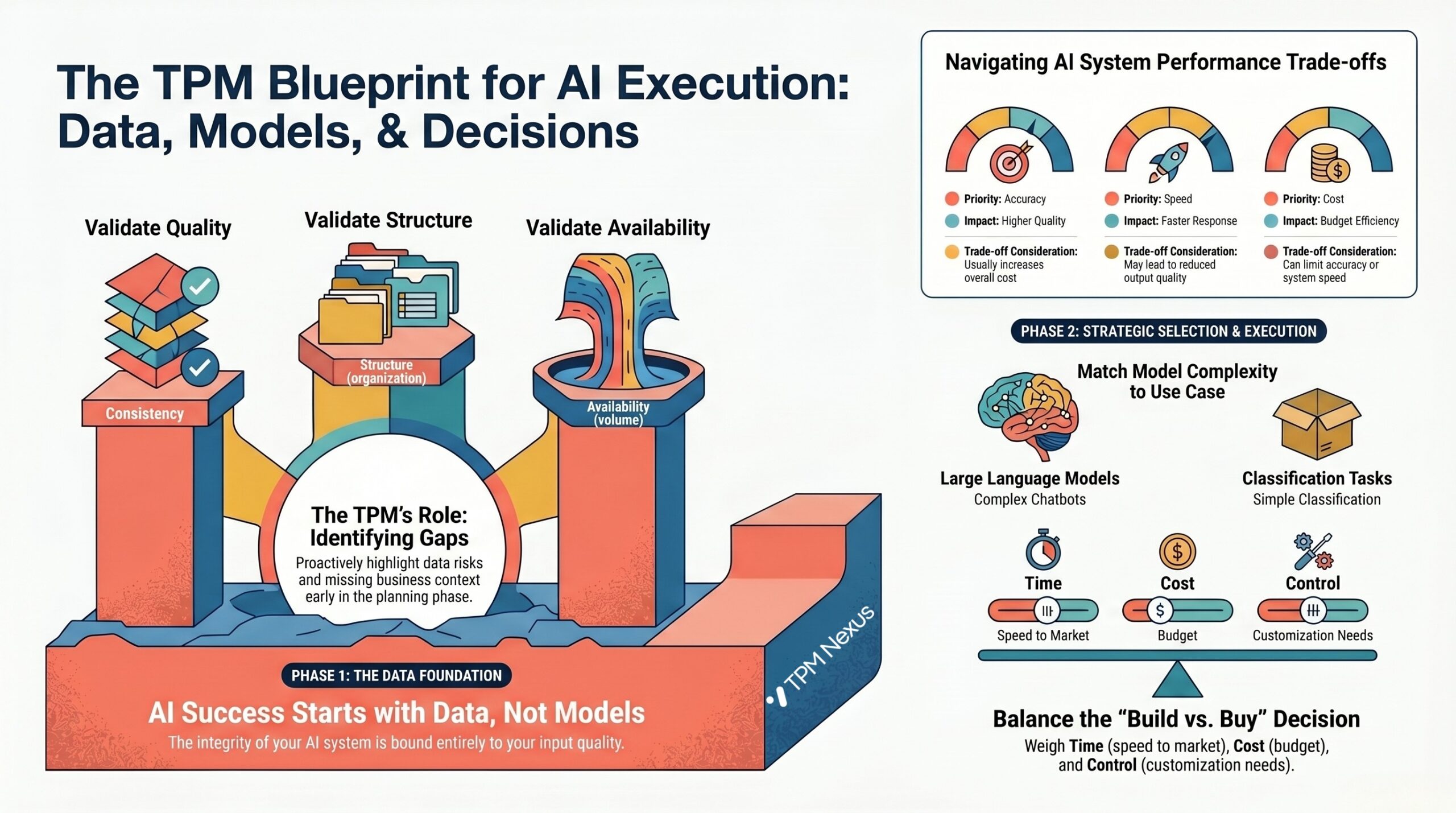
To ensure clarity before execution, a TPM must validate three specific pillars of data readiness:
- Quality: Is the data correct and consistent?
- Structure: Is the data organized in a way that makes it highly usable for an AI system?
- Availability: Is there sufficient volume to cover real-world business scenarios?
“The integrity of your AI is completely bound to your data.”
Teams often chase the newest LLM because it feels like progress, but if the data is weak, the most sophisticated model in the world will still produce poor results.
3. Lesson 2: Why “PoC Success” is a Dangerous Metric
A successful Proof of Concept is often a false signal. PoCs usually succeed because they utilize “clean,” selected data in a controlled environment. However, once the system hits the “Real Data Reality” of production, it encounters missing context, outdated responses, and human inconsistency.
Take the SupportX refund query as a prime example. In a training set, you might find that one agent tells a customer a refund takes five days, while another says seven, and a third tells them to check with their bank. When an AI is trained on this inconsistent data, it cannot provide a single, reliable answer. The resulting “failure” is rarely a technical glitch in the model; it is a failure to account for the messiness of real-world inputs. When the system becomes inconsistent, customer trust evaporates, and the project is labeled a failure.
4. Lesson 3: Stop Over-Engineering for Simple Tasks
Effective TPM thinking requires matching the model to the problem complexity. Choosing a heavy Large Language Model (LLM) for a simple classification task is not just inefficient, it is a failure of resource allocation that builds unnecessary technical debt and cost.
The Use Case Fit framework provides the necessary guardrails:
- High Complexity: Interactive chatbots and nuanced reasoning require the capabilities of an LLM.
- Low Complexity: Tasks like ticket categorization or basic routing should rely on simpler ML models.
The goal is to identify the simplest model that can solve the problem. Over-engineering a solution adds complexity without adding measurable business value.
5. Lesson 4: Navigating the Impossible Trinity (Accuracy, Cost, Speed)
Every AI system involves an inherent compromise between accuracy, cost, and speed. You cannot maximize all three simultaneously. Increasing accuracy usually increases cost; reducing latency often reduces output quality.
A TPM’s role is to define the Fit Zone the point where technical performance aligns with business requirements. Instead of chasing technical perfection, you must answer strategic questions:
- What level of accuracy is “good enough” to drive a business outcome?
- What level of cost is sustainable for this specific use case?
- What level of delay can the end users actually tolerate?
Optimizing for the business outcome rather than the highest possible benchmark score is what separates a successful program from a theoretical exercise.
6. Lesson 5: The “Buy then Build” Strategy for Rapid Validation
When deciding whether to build a custom solution or buy an existing API, you must balance three factors: Time, Cost, and Control. While “building” offers maximum customization, it consumes significant time and effort.
For an organization like SupportX, the most effective execution strategy is to focus on speed first and optimization later. By starting with an external API, the team can validate the use case quickly and learn from real usage without an massive upfront investment. Once the value is proven and the data requirements are fully understood, the organization can then move toward a custom solution. This approach reduces risk by securing validation before committing to long-term technical debt.
“Strong TPMs start with data, not model.”
7. Conclusion: Execution as a Connected Flow
Successful AI delivery is a blueprint of three sequential elements: Data → Model → Decision.
Data defines your core capability. The model enables the solution. The decision drives the execution path. If any link in this chain is weak, the entire program will struggle to scale. The role of the TPM is to ensure this flow is connected, highlighting risks early and prioritizing business impact over technical noise.
As you evaluate your next initiative, move past the assumption that your data is ready just because it exists. Ask yourself: Is your data actually usable for AI, or are you just assuming it is because it is sitting in a database? The answer to that question will determine whether your project succeeds in production or joins the list of predictable failures.
Learn how real AI programs are executed in production: www.tpmnexus.pro