If you already have experience in Product Management, Program Management, or Technical Program Management, moving into AI Product Management does not mean starting your career from zero.
You already understand many of the fundamentals: customer problems, product requirements, stakeholder alignment, prioritisation, delivery, and business outcomes. These capabilities remain valuable when building products that use AI.
The challenge is understanding what changes when AI becomes part of the product.
An AI Product Manager must make decisions about model capabilities, data quality, AI user experience, evaluation, reliability, governance, and the economics of AI-powered features. Traditional product management experience provides a strong foundation, but it does not automatically prepare you for every AI-specific decision.
This AI Product Manager roadmap for 2027 is designed for experienced professionals who want a practical path into AI Product Management. Rather than treating AI as a checklist of courses and certifications, it focuses on the capabilities you need to develop, the decisions you need to practise, and the evidence you need to demonstrate.
What Is an AI Product Manager Roadmap?
An AI Product Manager roadmap is a structured plan for developing the knowledge, skills, and practical experience required to manage products that use artificial intelligence.
For experienced PMs, the roadmap should build on existing product management capabilities while addressing gaps in AI fundamentals, AI product strategy, AI UX, evaluation, and governance.
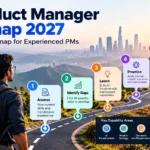
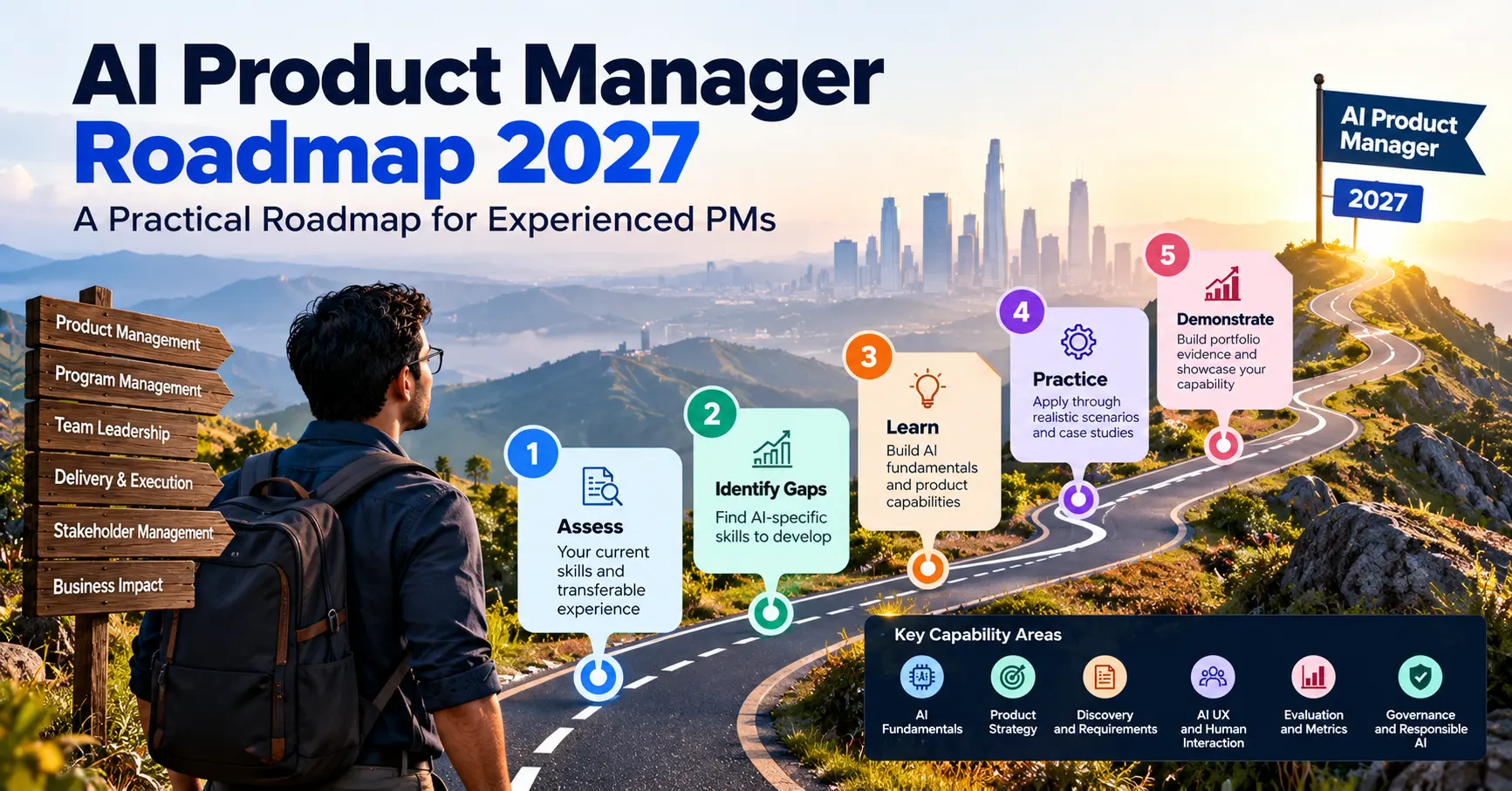
A practical roadmap follows five stages:
- Assess: Understand your current capabilities and experience.
- Identify gaps: Determine which AI-specific skills you need to develop.
- Learn: Build the knowledge required to make informed AI product decisions.
- Practice: Apply that knowledge to realistic AI product scenarios.
- Demonstrate: Produce evidence of your ability to manage AI products.
This sequence matters because learning about AI is not the same as demonstrating AI Product Management capability.
You may understand what a large language model is, for example, but still struggle to decide whether an LLM is appropriate for a particular product problem, how to evaluate its outputs, or when a human should review its recommendations.
The roadmap should help you move from conceptual understanding to practical product judgement.
Why Experienced PMs Need a Different AI Product Manager Roadmap
A beginner’s AI learning path often starts with general technology concepts and gradually introduces applications. An experienced PM already has a different starting point.
You may have spent years defining product requirements, managing delivery risks, conducting discovery, working with engineering teams, and making trade-offs between business value and technical constraints.
Those skills do not disappear when you move into AI Product Management.
The real challenge is learning how to apply them in a product environment where outputs can be probabilistic, data quality affects performance, and evaluation requires more than checking whether a feature works as expected.
Consider a Product Manager who has successfully delivered a customer support platform.
That experience may transfer directly to an AI-powered support assistant. The PM already understands customer journeys, support workflows, escalation processes, and service metrics.
However, the AI version introduces additional questions:
- How will the team measure answer quality?
- What happens when the assistant generates an incorrect response?
- How should the system behave when it lacks sufficient information?
- Which requests require human intervention?
- How will the team monitor quality after deployment?
- Does the AI solution improve the overall customer experience enough to justify its cost?
The existing experience remains useful. The new capability lies in making these additional decisions.
The objective is not to replace your existing PM skills. It is to extend them for AI-powered products.
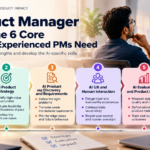
The Six Core Capability Areas in an AI Product Manager Roadmap
Before planning your learning activities, understand the capabilities you need to develop.
1. AI fundamentals
You do not need to become a machine learning engineer to work effectively as an AI Product Manager. You do need enough technical understanding to make informed product decisions and communicate effectively with engineering and data teams.
Focus on:
- The differences between traditional software, machine learning, and generative AI.
- How large language models (LLMs) work at a conceptual level.
- The strengths and limitations of generative AI.
- Common AI patterns, including retrieval-augmented generation (RAG) and AI agents.
- The role of training data, inference, context windows, and model selection.
- The practical trade-offs between quality, latency, and cost.
Do not stop at definitions. Learn when a particular capability is useful and when a simpler approach may be more appropriate.
For example, an AI agent may be useful for a workflow involving multiple steps and tool interactions. A deterministic workflow may be easier to test and operate when the sequence is predictable.
The product manager’s responsibility is to understand the trade-off, not to select the most sophisticated technology.
2. AI product strategy
AI product strategy begins with identifying where AI can create meaningful customer or business value.
Learn to evaluate potential use cases based on:
- Customer need and problem severity.
- Expected business impact.
- Technical feasibility.
- Data availability and quality.
- Reliability requirements.
- Implementation and operating costs.
- Risk and governance requirements.
Suppose a company wants to introduce AI into its internal knowledge management process.
The first question should not be which model to use. It should be whether employees have a significant information retrieval problem, whether existing search tools are insufficient, and whether an AI solution can improve the outcome.
This is where traditional product discovery and prioritisation skills remain valuable. The additional challenge is assessing AI-specific feasibility, quality, and operational risk.
3. AI product discovery and requirements
AI product discovery requires understanding both the user problem and the conditions under which the AI solution will succeed or fail.
Traditional requirements often define expected features and user interactions. AI product requirements must also account for uncertain outputs, missing information, and failure conditions.
For example, an AI knowledge assistant should not simply be required to answer employee questions. Its requirements may also specify that it must reference approved sources, communicate uncertainty, and avoid answering when sufficient evidence is unavailable.
Practise defining:
- User problems and intended outcomes.
- AI-specific functional requirements.
- Expected behaviour and failure behaviour.
- Human review and escalation paths.
- Acceptance criteria.
- Edge cases and evaluation scenarios.
The goal is to make AI behaviour testable and understandable to the teams building the product.
4. AI UX and human interaction
AI products introduce interaction patterns that differ from conventional software.
Users may need to review generated content, provide feedback, correct outputs, clarify ambiguous requests, or decide whether to trust a recommendation.
An effective AI Product Manager should understand:
- How to communicate uncertainty.
- When to provide supporting evidence or citations.
- How users can correct or regenerate outputs.
- When human approval is necessary.
- How to design fallback behaviour.
- How to avoid encouraging users to over-trust AI-generated results.
Imagine an AI assistant that recommends product features based on customer feedback. The interface should help the PM understand which evidence supports the recommendation, what assumptions were made, and where human judgement is still needed.
The quality of the experience depends on more than the model’s output. It also depends on how the product helps users interpret and act on that output.
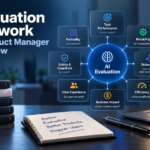
5. AI evaluation and product metrics
This is one of the most important areas to develop.
For conventional software, teams can often verify whether a feature behaves according to defined rules. AI outputs may vary, and an answer that sounds convincing may still be incorrect.
AI Product Managers need to understand how quality is evaluated before and after launch.
Learn to work with:
- Representative evaluation datasets.
- Test cases covering common and difficult scenarios.
- Factual correctness and relevance.
- Groundedness when outputs depend on supplied evidence.
- Safety and failure rates.
- Latency and cost per task.
- User corrections and human intervention.
- Production monitoring and regression testing.
For example, an AI summarisation feature should not be evaluated only on whether it produces a readable summary. The team should also assess whether important information is preserved, unsupported claims are avoided, and the output helps users complete the intended task.
Product metrics should connect technical performance to customer outcomes. A lower response time is useful only if the quality and usefulness of the result remain acceptable.
6. AI governance and responsible product delivery
AI governance covers the policies, controls, and responsibilities needed to develop and operate AI products appropriately.
The exact requirements depend on the product, organisation, data, industry, and applicable regulations.
An AI Product Manager should understand the product implications of:
- Data privacy and access controls.
- Security and information protection.
- Bias and fairness where relevant.
- Transparency and explainability requirements.
- Human oversight.
- Risk assessment.
- Monitoring and incident management.
- Regulatory and organisational obligations.
You do not need to replace legal, security, privacy, or compliance specialists. You need to recognise when their expertise is required and translate relevant requirements into product decisions.
This capability becomes particularly important in enterprise environments, where the consequences of incorrect outputs or inappropriate data access can be significant.
A Practical 90-Day AI Product Manager Roadmap for 2027
A 90-day plan provides a useful starting point for experienced PMs. The timeline is illustrative. Your pace will depend on your existing knowledge, available time, and the complexity of the AI product scenarios you want to practise.
Days 1 to 15: Assess your starting point
Begin by separating your existing strengths from your AI-specific gaps.
Review your experience across product discovery, prioritisation, stakeholder management, requirements, delivery, risk management, and metrics.
Then assess your understanding of AI fundamentals, model limitations, AI UX, evaluation, and governance.
Create a capability map with three categories:
- Transferable: Skills you already use effectively.
- Developing: Areas where you understand the concepts but need practical experience.
- Priority gap: Capabilities that currently limit your ability to make AI product decisions.
For example, you may be strong in stakeholder management and roadmap planning but need more experience defining evaluation criteria for AI-generated outputs.
That is a more useful starting point than assuming you need to relearn everything.
Deliverable: A personal AI PM capability assessment and prioritised learning plan.
Days 16 to 35: Build practical AI fundamentals
Focus on concepts that directly influence product decisions.
Study LLMs, generative AI, RAG, AI agents, data quality, inference costs, latency, and model limitations. Use practical examples to understand the differences between these approaches.
For each concept, answer three questions:
- What problem does this capability solve?
- What are its limitations and trade-offs?
- What product decision would require me to understand it?
For example, when studying RAG, understand how retrieving relevant information can support grounded responses, why retrieval quality matters, and what happens when the source documents are incomplete or outdated.
Avoid spending the entire period collecting courses or watching demonstrations without applying the concepts.
Deliverable: A concise AI fundamentals reference organised around product decisions.
Days 36 to 55: Practise AI product discovery and requirements
Choose one realistic product problem.
Examples include an internal knowledge assistant, an AI customer support assistant, or a tool that summarises customer feedback.
Work through the problem as if you were the product manager responsible for delivering it.
Define:
- The target user and problem statement.
- The intended business outcome.
- The proposed AI use case.
- The alternatives considered.
- The AI product requirements.
- The expected behaviour and failure conditions.
- The risks and assumptions that need validation.
Then identify what evidence you would need before approving a pilot.
Deliverable: An AI product opportunity assessment and requirements document.
Days 56 to 75: Practise evaluation, UX, and governance
Continue with the same product scenario.
Define a representative set of test cases. Include successful interactions, ambiguous inputs, missing information, and relevant failure scenarios.
Determine how the team would assess output quality, user experience, cost, and reliability. Identify the controls and human review requirements appropriate to the use case.
You do not need to build a sophisticated evaluation platform. The purpose is to demonstrate that you can think systematically about product behaviour and quality.
Deliverable: An AI evaluation plan, UX considerations, and a risk and governance checklist.
Days 76 to 90: Build evidence of your capability
Bring the work together into a coherent AI PM portfolio case study.
Your case study should explain:
- The problem you selected and why it matters.
- The users and business outcomes.
- The AI approach and alternatives considered.
- The requirements and product decisions.
- The evaluation strategy.
- The risks and governance considerations.
- The success metrics.
- The assumptions that still require validation.
Be transparent about what you actually built, tested, or validated. A well-reasoned product case study does not need fabricated usage numbers or claimed business results.
If you have not implemented the product, present it as a proposed solution and explain how you would validate it.
Deliverable: One structured AI PM portfolio case study that demonstrates your reasoning and product judgement.
How to Know Whether You Are Making Progress
Completing a roadmap is not the same as becoming ready for an AI PM role.
Measure progress through the decisions you can make and the evidence you can produce.
Use this checklist to review your development:
- Can I explain when AI is appropriate for a product problem and when it is not?
- Can I evaluate an AI use case beyond its technical novelty?
- Can I define requirements for uncertain outputs and failure conditions?
- Can I propose an evaluation strategy with relevant quality metrics?
- Can I identify important UX, data, and governance considerations?
- Can I explain trade-offs involving quality, latency, cost, and reliability?
- Can I connect AI performance to user and business outcomes?
- Can I present a realistic AI product case study and defend my decisions?
If you can explain these decisions clearly and support them with practical work, you have stronger evidence of capability than a list of completed courses alone.
Common Mistakes Experienced PMs Should Avoid
Treating AI learning as a certification checklist
Certifications can help structure learning, but they do not automatically demonstrate that you can manage AI products.
What to do instead: Apply the concepts to realistic product problems and document your decisions.
Trying to learn every AI technology
You do not need to master every model, framework, or AI architecture before beginning your transition.
What to do instead: Focus on the capabilities relevant to the product problems you want to manage. Expand your technical knowledge as your work requires it.
Ignoring existing strengths
Experienced PMs sometimes underestimate how much their existing experience can contribute to AI Product Management.
What to do instead: Identify transferable capabilities and focus your learning effort on the gaps that matter most.
Building a portfolio without explaining decisions
A polished mock-up does not necessarily demonstrate product judgement.
What to do instead: Explain the problem, alternatives, assumptions, trade-offs, evaluation criteria, and risks behind your proposed solution.
Confusing technical knowledge with readiness
Understanding LLMs or RAG is useful, but AI PM readiness also requires product strategy, evaluation, UX, governance, and business judgement.
What to do instead: Build capability across the full product lifecycle.
What Experienced PMs Should Do Next
If you are planning your transition into AI Product Management in 2027, begin with your current capabilities rather than a generic learning plan.
Use the following sequence:
- Assess your transferable product and delivery skills.
- Identify the AI-specific gaps that affect your target role.
- Learn the concepts required to make better product decisions.
- Practise those decisions through realistic scenarios.
- Build portfolio evidence that explains your approach and trade-offs.
This approach helps you focus your effort where it matters most.
The objective is not to become an AI expert in every technical domain. It is to become a product manager who can make informed decisions about AI capabilities, customer value, product quality, risk, and business outcomes.
Frequently Asked Questions
What is the best AI Product Manager roadmap for 2027?
A practical roadmap starts with a capability assessment, followed by AI fundamentals, product strategy, AI discovery and requirements, evaluation, UX, and governance. Experienced PMs should then apply these skills to realistic product scenarios and build portfolio evidence.
Can an experienced Product Manager become an AI Product Manager?
Yes. Existing experience in discovery, prioritisation, stakeholder management, delivery, and product metrics can transfer to AI Product Management. The transition requires developing additional capabilities in areas such as AI fundamentals, evaluation, AI UX, and governance.
Do I need to learn coding to become an AI Product Manager?
You do not necessarily need to become a software developer. However, you should understand AI concepts and technical trade-offs well enough to work with engineering and data teams, evaluate feasibility, and make informed product decisions. The technical depth required varies by role.
How long does it take to transition into AI Product Management?
There is no universal timeline. It depends on your existing product experience, AI knowledge, available learning time, and ability to demonstrate relevant capability. A 90-day plan can provide structure for focused learning and portfolio development, but it does not guarantee job readiness or a role change.
What should an AI Product Manager portfolio include?
A strong portfolio case study should include the problem statement, target users, business objectives, AI use case, product requirements, evaluation strategy, UX considerations, governance risks, success metrics, and the reasoning behind key trade-offs. Clearly distinguish proposed solutions from work that has actually been built or validated.
Take the Free AI PM Quick Check
Understanding the AI Product Manager roadmap is the first step. The next is determining which capabilities you already have and where you need to focus your development.
TPM Nexus is designed for experienced Product Managers, Program Managers, and Technical Program Managers exploring a transition into AI Product Management.
Start with the free AI PM Quick Check to get a preliminary view of your readiness and identify areas to develop.
Take the free assessment at TPM Nexus.