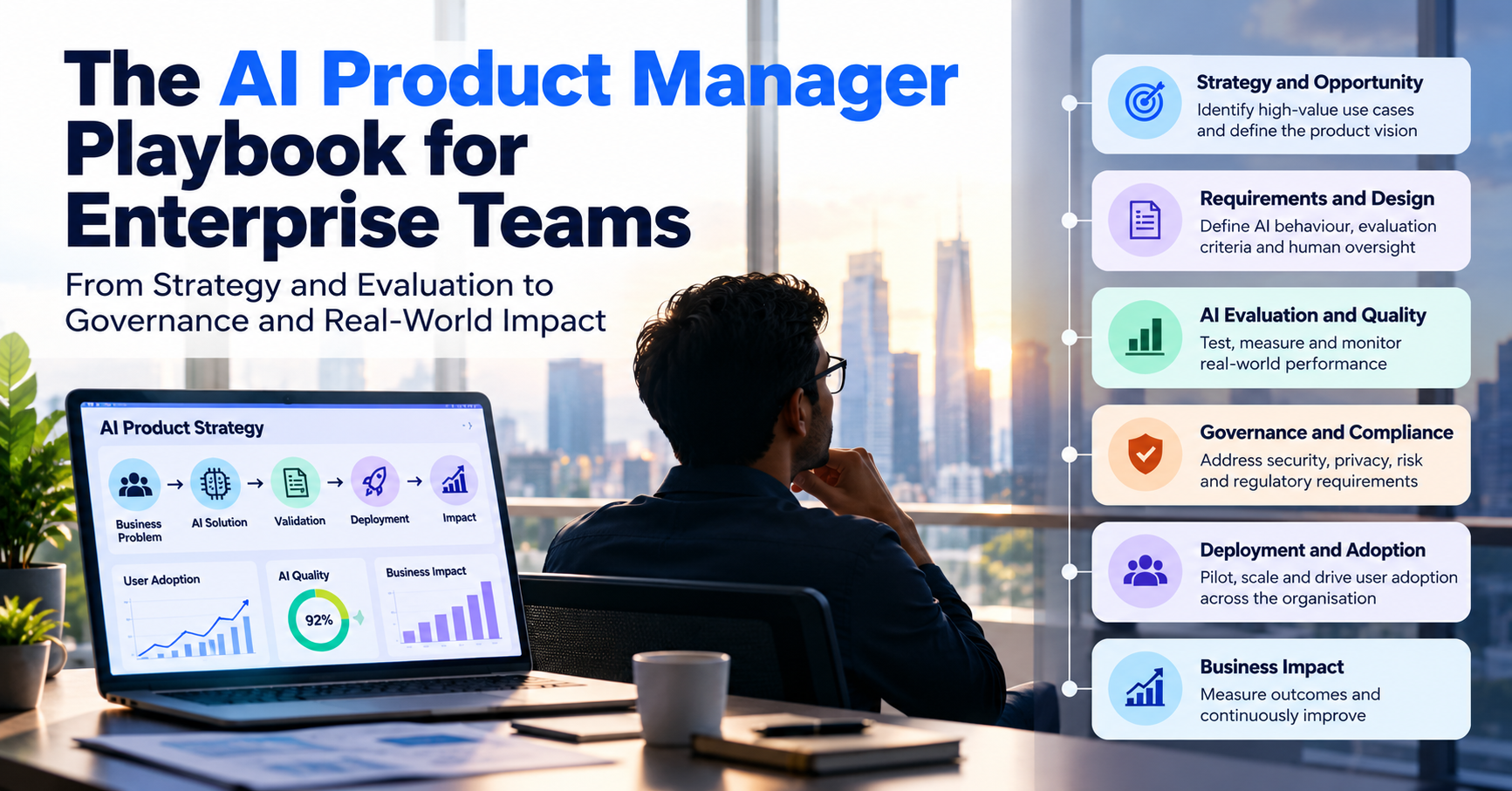
Enterprise AI product management is not simply about adding an AI feature to an existing product. It is about identifying the right business problem, deciding where AI creates measurable value, managing technical and operational risks, and making sure the solution works reliably within a complex organisation.
That complexity changes the product manager’s job.
An AI feature that performs well in a prototype may struggle when connected to enterprise data, used by hundreds of employees, or introduced into a regulated workflow. A technically impressive solution may also fail if employees do not trust it, business leaders cannot measure its value, or the organisation cannot support it in production.
Enterprise teams therefore need a practical way to take AI products from opportunity identification to adoption and continuous improvement.
This playbook covers the core responsibilities, decision frameworks, delivery practices, and evaluation methods that AI Product Managers need when working with enterprise teams.
1. What Does an AI Product Manager Do in an Enterprise?
An AI Product Manager connects business objectives, customer needs, AI capabilities, engineering constraints, and organisational requirements.
The role is broader than defining features or writing product requirements. It involves deciding whether AI is appropriate for a problem, determining how the solution should behave, establishing how quality will be measured, and aligning stakeholders around business outcomes.
Typical responsibilities include:
- Identifying enterprise workflows where AI could solve a meaningful problem.
- Validating customer needs and business opportunities.
- Defining the product vision, strategy, roadmap, and success criteria.
- Working with engineering and data teams to evaluate technical feasibility.
- Defining AI quality, evaluation, and human oversight requirements.
- Addressing security, privacy, governance, and compliance needs with the relevant experts.
- Coordinating pilots, deployment, adoption, and feedback.
- Measuring business impact and deciding what to improve next.
The exact responsibilities depend on the organisation. A PM working on an internal knowledge assistant may focus on information retrieval, employee adoption, and access controls. A PM working on an AI-powered customer service platform may focus on response quality, escalation behaviour, customer experience, and operational cost.
The common responsibility is to make sound product decisions under uncertainty.
2. Start With the Business Problem, Not the AI Capability
One of the first decisions is whether AI is the right approach.
Enterprise teams often encounter opportunities through executive requests, innovation programmes, vendor demonstrations, or internal experiments. These can generate useful ideas, but an available AI capability does not automatically justify a product investment.
Start by understanding the underlying problem.
Ask five questions:
- Who experiences the problem?
- How is the problem handled today?
- What makes the current process ineffective, expensive, slow, or difficult?
- What outcome would make the solution valuable?
- Can AI improve that outcome enough to justify its cost and risk?
Example: An enterprise knowledge assistant
Imagine employees spend time searching internal policies, technical documentation, and process guidelines.
A proposed solution is an AI assistant that answers questions using approved internal documents.
Before defining features, the product manager should investigate:
- Which employee groups need the information?
- Which documents are authoritative and current?
- How often do employees fail to find the correct answer?
- What happens when the assistant provides an incorrect response?
- Which documents require restricted access?
- How will employees verify the answer?
- What evidence would demonstrate an improvement over the current process?
This investigation may reveal that document quality, search relevance, or access permissions are bigger problems than the choice of AI model.
That finding can change the product scope significantly.
Product principle: Define the business outcome first. Select the AI approach only after understanding the problem, constraints, and alternatives.
3. Build an AI Product Opportunity Assessment
Not every AI opportunity deserves a place on the roadmap. Enterprise teams need a consistent way to compare opportunities before committing engineering resources.
A practical assessment can evaluate six dimensions.
| Dimension | Key question |
|---|---|
| Business value | What measurable business outcome could improve? |
| User need | How frequently and severely do users experience the problem? |
| Technical feasibility | Can the available models, data, and systems support the required behaviour? |
| Data readiness | Is the necessary data available, appropriate, reliable, and accessible? |
| Risk and governance | What could go wrong, and what controls are needed? |
| Operational readiness | Can the organisation monitor, maintain, support, and improve the solution? |
Use these dimensions to compare opportunities, identify assumptions, and determine what evidence is missing.
For example, an AI use case may have substantial potential value but depend on incomplete data or require a level of accuracy that has not yet been demonstrated. It may be worth investigating, but it should not automatically move into full-scale development.
Separate desirability, feasibility, and viability
The traditional product management questions remain useful:
- Desirability: Do users need this solution?
- Feasibility: Can the team build and operate it?
- Viability: Does it make business sense?
Enterprise AI adds further considerations around safety, governance, data access, reliability, and human oversight.
A useful opportunity assessment makes these trade-offs visible before the team commits to a solution.
4. Translate the Opportunity Into AI Product Requirements
AI product requirements must describe more than what a user sees on the screen.
They should define the intended behaviour, acceptable quality, failure conditions, and operational constraints of the AI capability.
For a conventional feature, a requirement might specify that a user can search documents and receive results.
For an AI-powered knowledge assistant, the requirements may also need to address:
- Whether answers must be grounded in approved sources.
- How source references are displayed.
- What happens when relevant evidence is missing.
- How restricted information is handled.
- Whether the assistant should refuse certain requests.
- How uncertain answers are communicated.
- When a request should be escalated to a human.
- How response quality will be tested and monitored.
Define expected behaviour and failure behaviour
AI systems can produce plausible but incorrect outputs. Requirements should therefore cover both successful and unsuccessful situations.
Consider these examples:
| Scenario | Expected product behaviour |
|---|---|
| Sufficient evidence is available | Provide a relevant answer with supporting sources |
| Evidence is incomplete | Communicate uncertainty or request clarification |
| No reliable answer is available | Avoid inventing an answer and explain the limitation |
| User lacks document access | Do not reveal restricted information |
| The request needs human judgement | Route it to an appropriate person or process |
These are illustrative requirements. The actual behaviour should depend on the product, risk level, user needs, and enterprise policies.
Define measurable acceptance criteria
Avoid requirements such as “the AI should provide accurate answers.”
Instead, specify how accuracy will be evaluated, which scenarios will be tested, what level of performance is acceptable, and how failures will be handled.
The appropriate thresholds should be established with engineering, business owners, risk specialists, and other relevant stakeholders. They should not be selected arbitrarily.
5. Design an AI Evaluation Strategy Before Launch
Evaluation is a core product management responsibility because AI quality cannot be established through a successful demonstration alone.
A small set of impressive examples may conceal failures across different user groups, data types, or edge cases.
Enterprise teams need a repeatable evaluation process.
Build an evaluation dataset
Start with representative examples drawn from the intended workflow. Include common requests, difficult cases, ambiguous inputs, and scenarios where the system should not answer.
For a knowledge assistant, the evaluation set might include:
- Frequently asked policy questions.
- Questions involving multiple documents.
- Questions with incomplete or conflicting evidence.
- Requests for restricted information.
- Questions for which no supported answer exists.
- Queries using unfamiliar terminology or ambiguous language.
The dataset should be reviewed for quality, appropriate data handling, and relevance to actual user behaviour.
Measure multiple dimensions of quality
Depending on the use case, the evaluation framework may include:
| Evaluation dimension | What it measures |
|---|---|
| Task success | Whether the system completes the intended task |
| Factual correctness | Whether the answer is factually correct |
| Groundedness | Whether claims are supported by the supplied evidence |
| Relevance | Whether the response addresses the user’s request |
| Safety | Whether the system follows required safety constraints |
| Latency | How long users wait for a result |
| Cost | The cost of generating or completing an output |
| Human intervention | How frequently people must correct or take over |
No single metric is sufficient for every product. A system used for high-impact decisions may require stricter evaluation and more human oversight than a low-risk summarisation tool.
Evaluate changes continuously
Model changes, prompt changes, retrieval updates, and data changes can affect product behaviour.
Run regression evaluations before releasing significant changes. Monitor production performance after deployment and investigate failures that affect users or business outcomes.
An AI product manager should ensure that evaluation is connected to release decisions, not treated as a one-time technical exercise.
6. Build Enterprise AI Governance Into the Product Lifecycle
Enterprise AI products operate within organisational policies, contractual obligations, security requirements, and potentially applicable regulations.
Governance should be considered during discovery and design, not added as a final approval step.
The product manager does not need to replace security, legal, privacy, or compliance specialists. The responsibility is to bring the right experts into the process and translate relevant requirements into product decisions.
Key areas to address
Data privacy and access
Determine which data the product needs, who can access it, how it is processed, and what retention requirements apply.
Security
Assess access controls, authentication, authorisation, integrations, and risks such as prompt injection or unintended data disclosure where relevant.
Human oversight
Identify decisions that require human review and define how users can challenge, correct, or override AI outputs.
Transparency
Help users understand when AI is being used, what information supports its outputs, and where its limitations matter.
Monitoring and accountability
Define ownership for incidents, quality issues, model changes, and ongoing review.
Regulatory and organisational requirements
Identify which laws, industry requirements, contractual commitments, and internal policies apply to the specific product and deployment context.
A useful governance deliverable is an agreed set of requirements, owners, controls, and approval points that the team can incorporate into its delivery process.
The goal is to enable responsible delivery, not create a separate governance process that operates without connection to product development.
7. Plan the AI Product Roadmap Around Evidence
A conventional feature roadmap can be insufficient for AI products because important uncertainties may remain unresolved after initial development.
The roadmap should make space for learning, experimentation, evaluation, and operational readiness.
A practical roadmap can use four stages.
Stage 1: Discover
Understand the workflow, identify the problem, interview users, and establish the business outcome.
Outputs: Problem statement, target users, opportunity assessment, and initial success measures.
Stage 2: Validate
Test the highest-risk assumptions through prototypes, data experiments, technical evaluations, and user research.
Outputs: Evidence of user value, feasibility findings, initial evaluation results, and documented risks.
Stage 3: Pilot
Release the solution to a controlled group with defined success criteria, support processes, and monitoring.
Outputs: Usage data, user feedback, quality results, operational findings, and a recommendation on whether to expand.
Stage 4: Scale and improve
Expand only when the product meets agreed quality, business, security, and operational requirements.
Outputs: Production monitoring, adoption improvements, ongoing evaluation, and a prioritised improvement roadmap.
These stages are not necessarily linear. New evidence may require the team to revisit discovery or narrow the scope.
A product manager should be prepared to change the roadmap when the evidence changes.
8. Manage Enterprise Stakeholders and Cross-Functional Delivery
Enterprise AI products frequently involve more stakeholders than a typical feature initiative.
A product manager may need to coordinate business sponsors, end users, engineering, data science, security, legal, privacy, IT operations, procurement, and change management.
Each group evaluates the product differently.
- Business leaders want measurable business value.
- End users want a solution that fits their workflow.
- Engineering teams need clear requirements and technical constraints.
- Data teams need suitable data and evaluation methods.
- Security and privacy teams need appropriate controls.
- Operations teams need monitoring, support, and incident procedures.
- Procurement and legal teams may need vendor, contractual, and compliance reviews.
Establish decision ownership
Misalignment often occurs when stakeholders agree that AI is important but disagree about what should be built, what constitutes acceptable quality, or who can approve a release.
Clarify three things early:
- Who owns the business outcome?
- Who makes product scope and prioritisation decisions?
- Who approves technical, security, risk, and operational readiness?
A responsibility matrix can help, but it should reflect the organisation’s actual decision rights.
The product manager should create shared visibility into decisions, dependencies, risks, and unresolved assumptions.
Treat change management as part of the product
An AI product can meet its technical objectives and still fail to gain adoption.
Employees may be unsure how to use it, concerned about job impact, or uncertain about when they should trust its outputs.
Plan onboarding, training, feedback mechanisms, support, and clear usage guidance alongside the product release.
Adoption is not simply a communication task. It is part of delivering the intended product outcome.
9. Measure Business Value, Product Quality, and Adoption
Enterprise AI product success requires more than counting users or measuring model performance.
A useful measurement framework connects three levels.
Business outcomes
Examples include reduced processing time, improved service quality, lower operating costs, or faster access to information.
Choose metrics that correspond to the business problem and establish a baseline before deployment.
Product and AI quality
Examples include task success, factual correctness, groundedness, failure rates, latency, and cost per completed task.
These metrics help determine whether the product is performing as intended.
User adoption
Examples include activation, repeat usage, workflow completion, user corrections, and escalation rates.
These metrics help reveal whether the product fits the way people work.
Example: Measuring an enterprise knowledge assistant
Suppose the objective is to help employees find internal information more efficiently.
The team might measure:
- Time required to find an answer before and after deployment.
- The proportion of evaluated questions answered correctly.
- The proportion of answers supported by approved sources.
- The frequency of unsuccessful queries.
- Repeat usage by the intended employee groups.
- Cost per successful information request.
The team should interpret these metrics together. Higher usage is not necessarily a positive result if answer quality declines, and lower handling time is not valuable if users receive incorrect information.
Where possible, compare results with a baseline or suitable comparison group. Document assumptions and limitations when attributing improvements to the product.
10. Common Mistakes Enterprise AI Product Managers Should Avoid
Treating a prototype as proof of product readiness
A prototype demonstrates that something can work in a particular setting. It does not establish production reliability, security, scalability, or business value.
Better approach: Define evaluation criteria and operational requirements before moving from prototype to pilot.
Building features before validating the workflow
Teams may spend time developing sophisticated capabilities without understanding the user’s actual problem.
Better approach: Observe the workflow, test assumptions, and validate the intended outcome before expanding scope.
Measuring model quality without measuring business value
A technically strong model may not improve the customer’s workflow.
Better approach: Connect AI quality measures to user tasks and business outcomes.
Ignoring failure scenarios
Happy-path demonstrations rarely expose all the ways an AI system can fail.
Better approach: Test ambiguity, missing evidence, conflicting information, restricted data, and other relevant edge cases.
Treating governance as a late-stage approval
Late discovery of privacy, security, or regulatory constraints can force substantial redesign.
Better approach: Identify relevant controls and decision owners during discovery and incorporate them into the product lifecycle.
Assuming employees will adopt the product automatically
A useful capability may still be ignored if it does not fit existing workflows or users do not understand its limitations.
Better approach: Include user research, onboarding, feedback, and adoption measurement in the product plan.
11. The Enterprise AI Product Manager Readiness Checklist
Use this checklist when preparing for an AI product initiative or assessing whether a product team is ready to move towards a pilot.
Problem and strategy
- The target user and business problem are clearly defined.
- The expected business outcome has a baseline and measurable success criteria.
- The team has evaluated alternatives to AI.
Requirements and evaluation
- Expected AI behaviour and failure behaviour are documented.
- The team has a representative evaluation dataset.
- Quality thresholds and release criteria are agreed upon.
- Relevant edge cases and failure scenarios have been tested.
Governance and operations
- Data access, privacy, and security requirements are understood.
- Human oversight and escalation paths are defined where necessary.
- Monitoring, support, and incident ownership are clear.
- Relevant governance and approval requirements are addressed.
Delivery and adoption
- The roadmap includes validation and controlled pilot stages.
- Stakeholder decision ownership is clear.
- Users have appropriate onboarding and usage guidance.
- Adoption and business outcomes will be reviewed after launch.
A checklist cannot replace expert judgement, but it can expose gaps before they become expensive delivery problems.
12. What Recruiters Should Look for in an AI Product Manager
Recruiters hiring AI Product Managers for enterprise teams should look beyond familiarity with AI terminology or completion of technical courses.
The role requires evidence that a candidate can connect business needs to AI product decisions.
Strong candidates should be able to explain:
- How they identify and prioritise AI product opportunities.
- How they evaluate whether AI is suitable for a specific problem.
- How they translate uncertain AI behaviour into testable requirements.
- How they define evaluation methods and acceptable quality.
- How they work with engineering, data, security, and business stakeholders.
- How they address governance, human oversight, and operational readiness.
- How they measure customer adoption and business outcomes.
- How they make trade-offs when quality, cost, latency, risk, and value conflict.
Ask scenario-based interview questions
Instead of asking only, “What is retrieval-augmented generation?” or “Explain large language models,” use questions that test product judgement.
For example:
Scenario 1: Poor answer quality
An enterprise knowledge assistant generates plausible answers, but employees report incorrect information. How would you investigate the issue and decide what to do next?
Scenario 2: Conflicting stakeholder priorities
A business sponsor wants to launch quickly, while security and engineering teams raise unresolved concerns. How would you manage the decision?
Scenario 3: Weak adoption
An AI product meets its initial quality targets but employees rarely use it. How would you determine whether the problem is product value, workflow fit, trust, or onboarding?
Scenario 4: Unclear return on investment
An AI automation pilot reduces manual work in some cases but increases review effort in others. How would you assess whether the product should scale?
Ask candidates to describe their assumptions, the evidence they would seek, the trade-offs they would consider, and the metrics they would use.
This gives recruiters a stronger view of product judgement than terminology recall alone.
Final Thoughts
Enterprise AI product management requires a combination of customer understanding, product strategy, technical awareness, evaluation discipline, governance, stakeholder alignment, and commercial judgement.
The AI Product Manager does not need to replace engineering, data science, security, or legal specialists. The role is to connect their expertise to a coherent product strategy and ensure the team delivers an outcome that users and the business can trust.
For enterprise teams, the practical sequence is clear: identify the problem, validate the opportunity, define expected behaviour, evaluate quality, address risks, pilot carefully, and scale based on evidence.
For experienced Product Managers moving into AI, these responsibilities provide a useful capability map. Existing strengths in discovery, prioritisation, roadmapping, stakeholder management, and metrics remain valuable. The next step is learning how to apply those strengths to AI-specific uncertainty, evaluation, data, and governance.
The goal is not merely to understand AI. It is to make better product decisions when AI becomes part of the solution.
Take the Next Step in Your AI Product Management Journey
If you are an experienced Product Manager preparing for AI product roles, start by understanding which of your existing capabilities transfer and which AI-specific skills need further development.
TPM Nexus helps experienced product and program management professionals assess their AI PM readiness, identify capability gaps, and work towards demonstrating practical AI product management skills.
Take the free AI PM Quick Check at TPM Nexus.