If you have spent years managing products, programmes, or technology delivery, you already have skills that matter in AI Product Management. You understand customer problems, stakeholder expectations, prioritisation, delivery risks, and business outcomes.
But when AI becomes part of the product, some familiar product decisions become more complicated.
- How do you decide whether AI is the right solution?
- How do you define requirements when outputs can vary?
- How do you measure quality when an answer sounds convincing but may be incorrect?
- And how do you balance user experience, model performance, cost, and risk?
These are the questions that make AI Product Management different from conventional product management.
The AI Product Manager skills required for success are not limited to understanding large language models or knowing how to use generative AI tools. They combine traditional product management strengths with additional capabilities in AI fundamentals, product strategy, discovery, user experience, evaluation, and governance.
In this guide, I will explain the six core capability areas experienced PMs should develop, how these skills work together, and how to identify the gaps that matter most for an AI PM career transition.
What Skills Does an AI Product Manager Need?
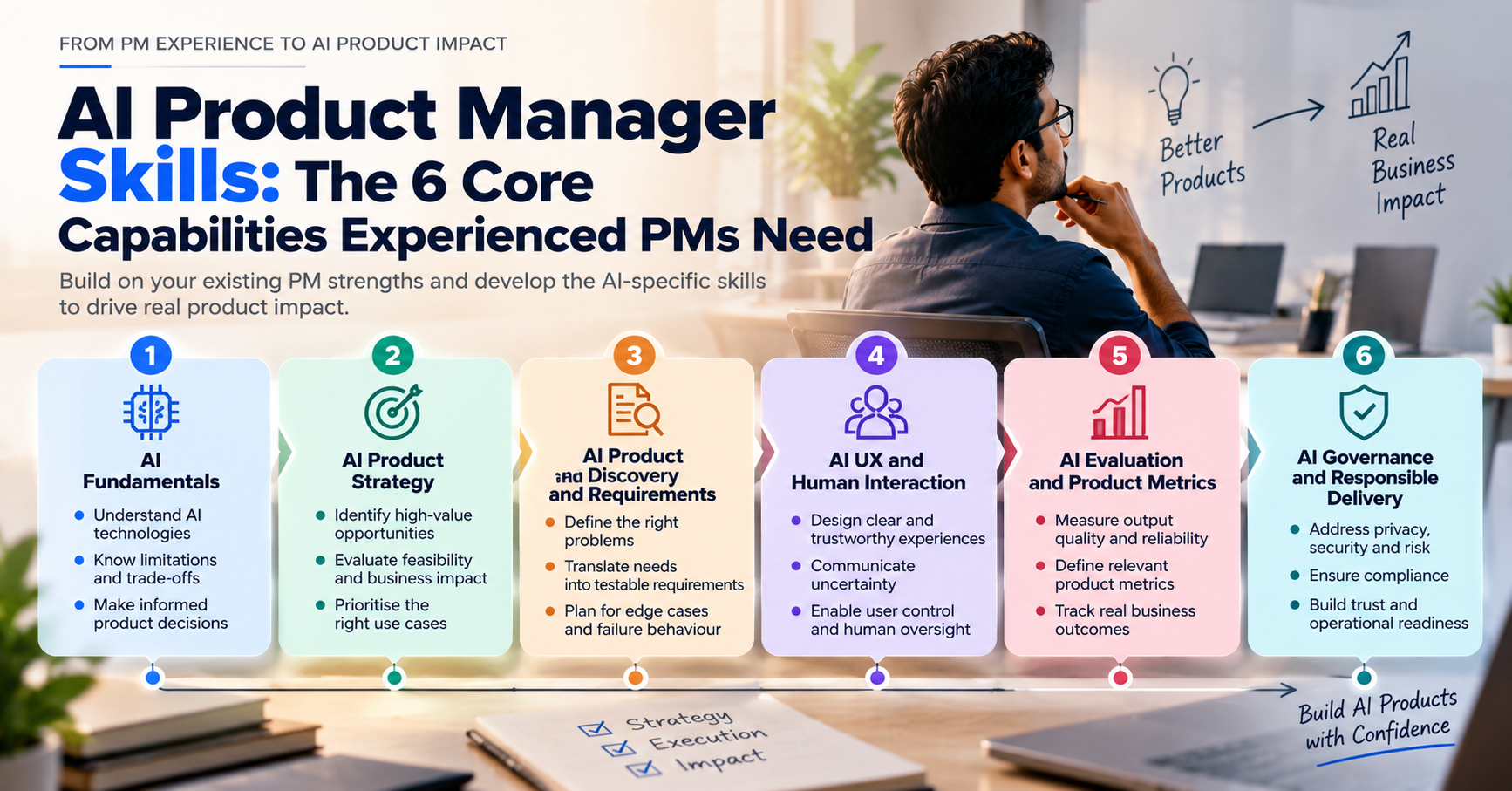
An AI Product Manager needs six core capabilities:
- AI fundamentals: Understand AI technologies, limitations, and technical trade-offs.
- AI product strategy: Identify valuable AI opportunities and evaluate business feasibility.
- AI product discovery and requirements: Translate customer problems into testable AI product requirements.
- AI UX and human interaction: Design experiences that help users understand, evaluate, and act on AI outputs.
- AI evaluation and product metrics: Measure output quality, reliability, cost, and business outcomes.
- AI governance and responsible delivery: Address privacy, security, risk, human oversight, and operational requirements.
These capabilities build on traditional product management rather than replacing it. The goal is to extend existing PM experience so you can make informed decisions throughout the AI product lifecycle.
1. AI Fundamentals: Understand the Technology Behind the Product
An AI Product Manager does not necessarily need to train models or write production machine learning code. However, technical understanding is essential for making sound product decisions.
You need to know what different AI approaches can do, where they fail, and which trade-offs matter to the customer.
What should you learn?
Start with the concepts that influence product decisions:
- Machine learning: Understand how models learn patterns from data and why their performance depends on the task and available data.
- Large language models (LLMs): Understand how LLMs generate text, their limitations, and why fluent responses are not always correct.
- Generative AI: Learn where generated text, images, code, or other outputs can create product value.
- Retrieval-augmented generation (RAG): Understand how retrieving relevant information can help an AI system answer questions using external knowledge.
- AI agents: Understand systems that use models and tools to perform multi-step tasks, including the additional reliability and control challenges they introduce.
- AI cost and performance: Understand the relationship between model quality, latency, usage, and operating cost.
The objective is not to memorise technical definitions. It is to understand when these capabilities are useful and when their limitations make another approach more appropriate.
How this skill appears in practice
Imagine a business team wants an AI assistant that answers questions about internal company policies.
A product manager with a basic understanding of LLMs might propose using a model to generate answers. A stronger AI Product Manager will ask additional questions.
Where will the information come from? How will the system identify the correct policy? What happens when two documents conflict? How will access permissions be enforced? How will users know whether an answer is supported by evidence?
These questions connect technical understanding to product requirements.
How experienced PMs can develop this skill: Study AI concepts through practical use cases. For each technology, identify the problem it solves, its limitations, the alternatives, and the product decisions it affects.
2. AI Product Strategy: Identify Where AI Creates Real Value
Understanding AI technology does not automatically mean knowing where to use it.
AI Product Managers must identify opportunities where AI can improve a customer outcome or business process enough to justify the investment, complexity, and risk.
This requires the same product strategy fundamentals experienced PMs already know, applied to a different set of technical possibilities and constraints.
What should you learn?
Develop the ability to:
- Identify customer problems that may benefit from AI.
- Evaluate the value of an AI use case against existing alternatives.
- Assess technical feasibility and data readiness.
- Prioritise opportunities based on impact, effort, risk, and uncertainty.
- Define product differentiation beyond access to a particular model.
- Evaluate the cost of delivering and maintaining an AI-powered capability.
How this skill appears in practice
Suppose a product team wants to introduce AI into a customer support workflow.
Possible opportunities include summarising conversations, suggesting responses, classifying requests, and automatically resolving selected cases.
The product manager should not assume that full automation is the best starting point. A response suggestion feature may offer meaningful value while keeping the human agent in control. More autonomous behaviour may require stronger evaluation, additional safeguards, and greater confidence in the system.
The right choice depends on the customer problem, the quality requirements, the operating environment, and the business case.
How experienced PMs can develop this skill: Select a real workflow and compare at least two possible solutions, including a non-AI alternative. Document the expected value, feasibility, risks, and evidence needed before making a recommendation.
3. AI Product Discovery and Requirements: Define the Right Problem and Expected Behaviour
Product discovery remains essential in AI. In fact, uncertainty about what the technology can reliably deliver makes discovery and requirements particularly important.
The difference is that AI requirements must address not only what the product should do, but also how it should behave when the available information is incomplete, ambiguous, or unreliable.
What should you learn?
Focus on:
- Defining the user problem and intended business outcome.
- Evaluating whether AI is appropriate for the use case.
- Translating needs into testable AI product requirements.
- Defining expected behaviour and failure behaviour.
- Identifying edge cases and assumptions.
- Establishing acceptance criteria and human intervention requirements.
How this skill appears in practice
Consider an AI feature that summarises customer interviews for product discovery.
A basic requirement might say, “The system should generate a summary of each interview.”
A more complete requirement would address whether the summary preserves important customer needs, distinguishes evidence from interpretation, avoids inventing statements, and allows the product manager to review the original source.
The second version is more useful because it defines the behaviour that matters to the user.
AI product requirements should make expectations clear enough for engineering teams to implement the solution and for the team to evaluate whether it works.
How experienced PMs can develop this skill: Write a short product requirements document for an AI use case. Include the problem statement, user journey, expected behaviour, failure scenarios, acceptance criteria, and evaluation approach.
4. AI UX and Human Interaction: Help Users Work With AI Effectively
An AI product can produce technically acceptable outputs and still deliver a poor user experience.
Users may not know when to trust a response, how to correct it, or what to do when the system cannot provide a reliable answer. The product experience must account for these situations.
What should you learn?
Develop the ability to design and evaluate:
- Clear communication of AI capabilities and limitations.
- Appropriate presentation of generated outputs.
- Source references and supporting evidence where relevant.
- Feedback, correction, and retry mechanisms.
- Uncertainty communication and fallback behaviour.
- Human approval and escalation paths.
- User control over consequential actions.
How this skill appears in practice
Imagine an AI assistant that recommends which customer problems a product team should prioritise.
A weak experience presents a ranked list without explaining why the items were selected.
A stronger experience shows the supporting customer feedback, explains the factors used to generate the recommendation, and allows the product manager to challenge or adjust the result.
The second approach helps the user apply judgement rather than treating the AI output as an unquestionable decision.
AI UX is therefore not simply about designing a chat interface. It is about helping people understand the output, judge its usefulness, and take the appropriate next action.
How experienced PMs can develop this skill: Sketch an AI interaction and explicitly design what happens when the system is uncertain, produces an incomplete answer, or recommends an action that requires human approval.
5. AI Evaluation and Product Metrics: Measure Quality, Not Just Activity
This is one of the most important AI Product Manager skills because AI products cannot be evaluated reliably through demonstrations alone.
A model may perform well on a few selected examples and fail on different users, unfamiliar inputs, or edge cases. Product teams need a repeatable way to determine whether the system meets the required quality standards.
What should you learn?
Understand how to work with:
- Evaluation datasets that represent real use cases.
- Test cases covering expected and unexpected inputs.
- Factual correctness, relevance, and groundedness.
- Safety and failure rates.
- Latency and cost per task.
- Human correction and escalation rates.
- Regression testing and production monitoring.
- Metrics connecting AI performance to customer and business outcomes.
Not every product requires the same evaluation framework. The relevant measures depend on the task, the consequences of failure, and the intended user experience.
How this skill appears in practice
Suppose an AI feature generates summaries of customer interviews.
Measuring the number of summaries generated tells you how much the feature is being used. It does not tell you whether the summaries are accurate or useful.
The product team should also assess whether important information is preserved, whether unsupported claims appear, and whether product managers can use the summaries to make better decisions.
A useful measurement framework connects three levels:
| Measurement area | Example measures |
|---|---|
| AI quality | Correctness, groundedness, relevance, failure rate |
| Product experience | Task completion, user corrections, time to complete a task |
| Business outcomes | Time saved, process efficiency, quality of decisions |
The product manager should work with engineering, data, and domain experts to define appropriate thresholds and determine what evidence is needed before release.
How experienced PMs can develop this skill: Create a small evaluation set for an AI use case. Define what a good output looks like, list common failure scenarios, and explain how you would measure quality before and after launch.
6. AI Governance and Responsible Delivery: Build Trust Into the Product
Enterprise AI products may process sensitive information, influence important decisions, or operate within regulated workflows. Governance is therefore a product consideration, not simply a final approval step.
The product manager is not expected to replace security, privacy, legal, or compliance specialists. The responsibility is to identify relevant risks, involve the right experts, and ensure that their requirements influence product decisions.
What should you learn?
Focus on:
- Data privacy and access controls.
- Security and information protection.
- Relevant bias and fairness considerations.
- Transparency and explainability requirements.
- Human oversight and escalation.
- Risk assessment and mitigation.
- Monitoring and incident management.
- Applicable regulatory and organisational requirements.
How this skill appears in practice
Consider an AI assistant that helps employees search internal documentation.
The product team needs to ensure that the assistant respects the employee’s existing access permissions. It should not reveal restricted documents simply because the underlying model can generate a response using their content.
The team should also decide how it will handle incorrect answers, monitor incidents, and update the system when source documents change.
These are product decisions because they affect requirements, user trust, system behaviour, and operational readiness.
How experienced PMs can develop this skill: Choose an enterprise AI use case and create a risk checklist covering data, security, output quality, human oversight, and production monitoring. Identify which decisions require specialist input.
How the Six AI Product Manager Skills Work Together
The six capabilities are interconnected. Strong AI Product Management requires applying them together rather than treating each as an independent subject.
Consider an AI-powered customer support assistant.
| Capability | Product decision |
|---|---|
| AI fundamentals | Which AI approach fits the support workflow? |
| AI product strategy | Which support problem should be addressed first? |
| Discovery and requirements | What should the assistant do, and when should it escalate? |
| AI UX | How will agents review and correct suggested responses? |
| Evaluation and metrics | How will the team measure response quality and business value? |
| Governance and delivery | What data controls, monitoring, and safeguards are required? |
The product manager must connect these decisions into one coherent product plan.
For example, a business case for reducing support handling time is incomplete if the proposed solution increases correction effort or introduces unacceptable response quality risks. The strategy, requirements, evaluation, UX, and governance decisions must support the same intended outcome.
This is why learning individual AI concepts is useful but insufficient. The real capability is applying them to product decisions.
How Experienced PMs Can Develop These Skills
A practical development plan should begin with your existing capabilities and focus on the gaps that matter most for your intended AI PM role.
Step 1: Assess your transferable skills
Review your experience in discovery, product strategy, prioritisation, stakeholder management, delivery, risk management, and metrics.
Identify which capabilities you can already demonstrate through previous work.
Step 2: Identify AI-specific gaps
Assess your current understanding of AI fundamentals, model limitations, AI UX, evaluation, and governance.
Distinguish between concepts you understand and decisions you can actually make in a product scenario.
Step 3: Learn through practical problems
Choose one AI use case and use it to study the concepts you need. This makes learning more relevant than collecting unrelated courses or tutorials.
Step 4: Practise product decisions
Create realistic requirements, compare alternative approaches, define evaluation criteria, and identify risks. Explain why you would make each decision.
Step 5: Build evidence of capability
Develop a portfolio case study that shows your reasoning, trade-offs, and proposed validation approach. Be clear about what you have built or tested and what remains a hypothesis.
This approach connects learning to practical capability and helps you explain your AI PM readiness during interviews.
Common Mistakes When Learning AI Product Manager Skills
Focusing only on AI tools
Knowing how to use AI assistants can improve productivity, but it does not automatically demonstrate the ability to manage AI products.
Better approach: Learn how to evaluate AI use cases, define requirements, measure quality, and make product trade-offs.
Trying to master every AI technology
The field is broad, and the most relevant technical knowledge depends on the products you want to manage.
Better approach: Build a working understanding of the major concepts, then go deeper where your target roles require it.
Ignoring transferable experience
Experienced PMs may assume that moving into AI means discarding their existing strengths.
Better approach: Map your existing skills to AI product responsibilities and focus your effort on genuine capability gaps.
Building a portfolio without showing reasoning
A prototype or mock-up does not explain whether the problem was worth solving or whether the proposed AI approach was appropriate.
Better approach: Document the problem, alternatives, assumptions, evaluation criteria, risks, and expected business outcomes.
Frequently Asked Questions
What are the most important AI Product Manager skills?
The six core capabilities are AI fundamentals, AI product strategy, AI product discovery and requirements, AI UX, AI evaluation and product metrics, and AI governance. They complement traditional product management skills such as prioritisation, stakeholder alignment, and business outcome measurement.
Do AI Product Managers need coding skills?
Not every AI Product Manager role requires coding. However, product managers need enough technical understanding to discuss feasibility, data, model behaviour, evaluation, latency, and cost with engineering teams. The depth required depends on the role and product.
Are traditional product management skills still relevant in AI?
Yes. Customer discovery, prioritisation, product strategy, stakeholder management, roadmapping, and metrics remain valuable. AI adds further considerations around uncertainty, model limitations, evaluation, data, and responsible delivery.
How can experienced PMs demonstrate AI Product Manager skills?
They can develop realistic AI product case studies that explain the customer problem, product requirements, AI approach, evaluation plan, UX considerations, risks, and success metrics. The strongest evidence explains the decisions and trade-offs, not just the final design.
How long does it take to develop AI Product Manager skills?
There is no fixed timeline. Progress depends on your existing experience, starting knowledge, learning time, and opportunities to practise. A structured plan with measurable deliverables can help you develop and demonstrate the capabilities relevant to your target roles.
Take the Free AI PM Quick Check
Understanding the AI Product Manager skills framework is a useful starting point. The next step is identifying which capabilities you already have and where you need to focus your development.
TPM Nexus is designed for experienced Product Managers, Program Managers, and Technical Program Managers exploring a transition into AI Product Management.
Take the free AI PM Quick Check to get a preliminary view of your readiness and identify areas to develop.
Visit TPM Nexus.