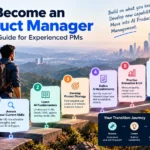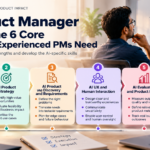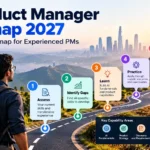
If you already have experience in Product Management, Program Management, or Technical Program Management, moving into AI Product Management does not mean starting your career from scratch.
You already understand how to identify customer problems, prioritise requirements, work with engineering teams, manage stakeholders, and deliver business outcomes. These capabilities remain relevant when building products powered by artificial intelligence.
What changes is the nature of some product decisions. You need to understand what AI can realistically do, how to evaluate its outputs, how to design experiences around uncertainty, and how to manage risks that do not appear in the same way in conventional software.
If you are researching how to become an AI Product Manager, the most useful starting point is not a long list of courses. It is a practical transition plan that builds on your existing experience and helps you develop the capabilities you are missing.
This guide explains how experienced PMs can approach that transition, what to learn, how to practise, and how to demonstrate readiness for AI Product Management roles.
What Does an AI Product Manager Do?
An AI Product Manager is responsible for defining, developing, and improving products that use artificial intelligence to solve customer problems or achieve business objectives.
The role combines traditional product management responsibilities with additional decisions about AI capabilities, data, model behaviour, evaluation, user experience, and governance.
An AI Product Manager typically needs to:
- Identify customer problems that may benefit from AI.
- Evaluate whether AI is the right solution.
- Define product strategy, requirements, and success criteria.
- Work with engineering and data teams on technical feasibility.
- Understand AI limitations and the trade-offs between quality, latency, and cost.
- Define how AI outputs will be evaluated.
- Design appropriate human oversight and failure-handling mechanisms.
- Address relevant security, privacy, and governance requirements.
- Measure product adoption and business outcomes.
Consider an AI-powered customer support assistant. A conventional product manager may already understand customer journeys, support workflows, escalation processes, and service metrics.
An AI Product Manager must also consider whether suggested responses are reliable, what happens when the system lacks sufficient information, how agents can correct outputs, and how the team will measure quality after launch.
The underlying product management skills still matter. The additional challenge is applying them to AI-specific uncertainty and constraints.
Can Experienced Product Managers Become AI Product Managers?
Yes. Experienced Product Managers can transition into AI Product Management by building on their existing capabilities and developing the AI-specific skills required by their target roles.
You do not necessarily need to become a machine learning engineer or discard your previous experience. However, product management experience alone does not automatically demonstrate readiness to manage AI products.
The important distinction is between transferable skills and new capabilities.
| Existing PM capability | Application in AI Product Management |
|---|---|
| Customer discovery | Identifying workflows where AI can create meaningful value |
| Product strategy | Evaluating AI opportunities and alternatives |
| Requirements management | Defining expected AI behaviour and failure conditions |
| Stakeholder management | Aligning product, engineering, data, security, and business teams |
| Risk management | Addressing AI quality, data, privacy, and governance risks |
| Product metrics | Connecting AI performance to user and business outcomes |
| Delivery management | Planning evaluation, pilots, deployment, and continuous improvement |
Your existing experience provides a foundation. The transition becomes more focused when you identify which capabilities transfer directly and which require additional learning or practice.
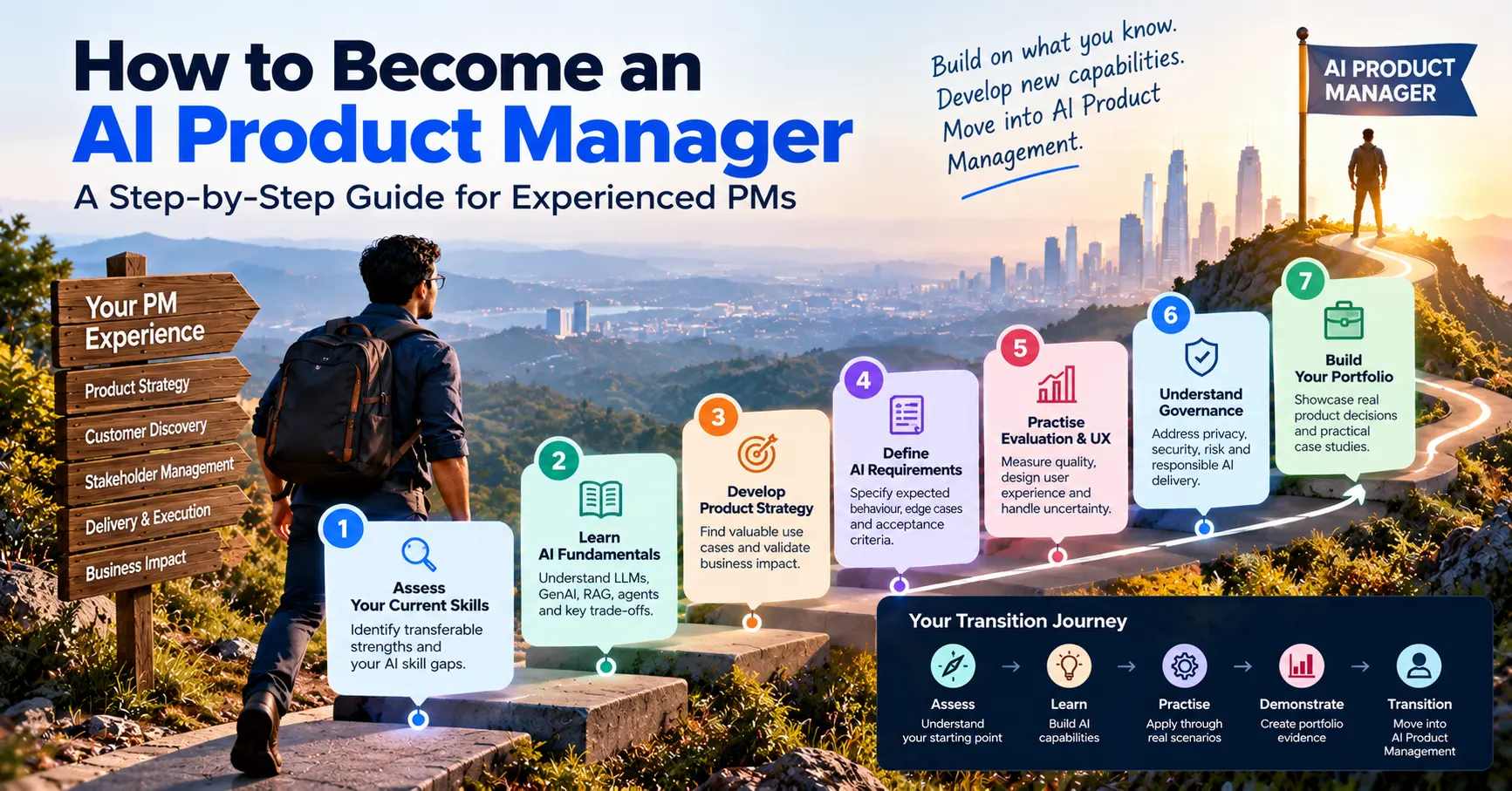
How to Become an AI Product Manager: A 7-Step Roadmap
The following roadmap is designed for experienced PMs who want to move towards AI Product Management without treating the transition as a complete career reset.
Step 1: Assess Your Existing Product Management Skills
Before choosing a course or starting a learning plan, review what you already know.
Many experienced professionals underestimate the value of their existing experience because they focus too heavily on what they do not know about AI.
Start by assessing your capabilities across:
- Product discovery and customer research.
- Product strategy and prioritisation.
- Requirements and roadmap development.
- Technical collaboration.
- Stakeholder alignment.
- Delivery and risk management.
- Metrics and business outcomes.
For each area, identify evidence from your previous work. Have you prioritised competing opportunities? Defined requirements for a complex system? Managed dependencies across engineering teams? Used product metrics to make decisions?
These examples help establish your starting point.
Then separate your skills into three categories:
- Established: Capabilities you can already demonstrate.
- Developing: Capabilities you understand but need to apply in an AI context.
- Priority gaps: Areas where limited knowledge currently prevents you from making informed AI product decisions.
For example, you may be experienced in defining acceptance criteria but unfamiliar with designing an evaluation dataset for AI-generated outputs.
That is a specific capability gap you can work on.
Your deliverable: A capability map showing your transferable strengths and the AI-specific skills you need to develop.
Step 2: Learn AI Fundamentals That Influence Product Decisions
You do not need to learn every AI technology. Focus on the concepts that help you make better product decisions and collaborate effectively with technical teams.
Start with these topics.
Large language models (LLMs)
Understand how LLMs generate responses, where they are useful, and why fluent answers are not necessarily correct.
Generative AI
Learn how generative AI can support use cases such as content creation, summarisation, information extraction, and conversational interfaces.
Retrieval-augmented generation (RAG)
Understand how retrieving relevant information from external sources can support more grounded answers. Learn why document quality, retrieval relevance, and access controls matter.
AI agents
Understand how AI systems can use tools and execute multi-step tasks. Consider the additional challenges around reliability, permissions, failure recovery, and human control.
Data, cost, and performance
Learn why data quality affects product outcomes and how model choice, usage, latency, and inference costs influence product decisions.
Do not stop at memorising definitions. For each concept, ask:
- What problem does it solve?
- What are its limitations?
- What alternatives exist?
- What product decision would require me to understand it?
For example, an AI agent may be suitable for a workflow involving multiple conditional steps. A deterministic workflow may be preferable when the process is predictable and easier to control through conventional software.
An AI Product Manager should understand the trade-off rather than automatically choosing the most sophisticated approach.
Your deliverable: A practical reference that explains major AI concepts through product use cases, limitations, and decisions.
Step 3: Develop AI Product Strategy and Discovery Skills
Knowing how AI works is only part of the role. You also need to identify where it creates enough value to justify the complexity.
Start with a real customer problem rather than a technology you want to use.
For each opportunity, investigate:
- Who experiences the problem?
- How do they solve it today?
- What makes the current approach inadequate?
- What outcome would make the solution valuable?
- Could conventional software solve the problem more simply?
- Is suitable data available?
- What happens if the AI output is incorrect?
- How will the business measure success?
Consider a product team exploring an AI assistant for internal company documentation.
The opportunity may appear straightforward: employees ask questions and receive answers. But discovery should establish whether employees struggle to find information, whether source documents are reliable, which information requires restricted access, and how much confidence users need before acting on an answer.
Those findings determine whether the proposed solution is viable and what the initial product should include.
Practise comparing possible approaches, including a non-AI alternative. Document the customer value, technical feasibility, data requirements, risks, and assumptions that need validation.
Your deliverable: An AI product opportunity assessment that explains the problem, proposed solution, alternatives, expected value, and key uncertainties.
Step 4: Learn to Define AI Product Requirements
Traditional product requirements often specify what a feature should do and how a user interacts with it.
AI product requirements must also address how the system should behave when its output is uncertain, incomplete, or incorrect.
For example, a requirement for an AI knowledge assistant should not simply state that the system must answer employee questions.
A more useful set of requirements might specify that the assistant should:
- Use approved information sources.
- Provide supporting references where appropriate.
- Avoid presenting unsupported claims as facts.
- Communicate uncertainty when evidence is insufficient.
- Respect the user’s information access permissions.
- Escalate selected requests to a human.
- Handle relevant failure scenarios predictably.
The exact requirements depend on the product and the consequences of failure.
You should also define how the team will determine whether these requirements have been met. That includes acceptance criteria, representative test cases, and agreed quality thresholds.
Your deliverable: A concise AI product requirements document covering user needs, expected behaviour, failure behaviour, acceptance criteria, and evaluation requirements.
Step 5: Develop AI Evaluation and AI UX Capabilities
These two areas are particularly important because they determine whether the AI capability is useful and trustworthy in practice.
Understand AI evaluation
AI outputs can vary, and a successful demonstration does not prove that a product is ready for release.
Learn how to evaluate:
- Factual correctness.
- Relevance to the user’s request.
- Groundedness in supplied evidence.
- Task success.
- Failure rates.
- Latency and cost.
- Human corrections and intervention.
The appropriate measures depend on the use case. A summarisation tool and a system that supports high-impact decisions will have different quality requirements.
Practise creating a small evaluation dataset with representative inputs, expected outcomes, and difficult cases. Explain how the team would use the results to decide whether the product is ready for a pilot.
Understand AI UX
Users need to understand what an AI product can do, where it may fail, and how to respond when its output is unreliable.
Learn to design experiences that support:
- Clear communication of limitations.
- Source references and supporting evidence.
- User corrections and feedback.
- Appropriate uncertainty communication.
- Human approval for consequential actions.
- Fallback behaviour when the system cannot complete a task.
For example, an AI feature that recommends product priorities should allow a PM to review the evidence behind the recommendations rather than presenting a ranked list without explanation.
Your deliverable: An evaluation plan and an AI interaction design that explain how quality will be measured and how users will review, correct, or act on outputs.
Step 6: Understand AI Governance and Responsible Delivery
Enterprise AI products often involve sensitive data, organisational policies, security requirements, and regulatory considerations.
An AI Product Manager does not need to replace legal, security, privacy, or compliance specialists. The role requires identifying relevant concerns early and ensuring they influence product requirements and release decisions.
Focus on:
- Data privacy and access controls.
- Security and information protection.
- Bias and fairness where relevant.
- Transparency and explainability requirements.
- Human oversight and escalation.
- Risk assessment and mitigation.
- Production monitoring and incident management.
- Applicable organisational and regulatory requirements.
Imagine an AI assistant that searches internal company documents. Even if it can generate a useful answer, it must not disclose information to a user who is not authorised to access the underlying documents.
The product team must translate that requirement into system behaviour, testing, monitoring, and operational controls.
Your deliverable: A risk and governance checklist that identifies key risks, proposed controls, decision owners, and unresolved questions.
Step 7: Build an AI PM Portfolio That Demonstrates Your Capability
Learning concepts is important, but employers also need evidence that you can apply them to product decisions.
A portfolio case study gives you an opportunity to demonstrate your reasoning, even if you have not yet held a formal AI Product Manager role.
Choose a realistic product problem, such as an AI support assistant, internal knowledge assistant, or customer feedback analysis tool.
Build a case study covering:
- Problem statement: What customer or business problem are you addressing?
- Target users: Who experiences the problem?
- Product strategy: Why is the opportunity worth exploring?
- AI approach: Why is the proposed approach appropriate, and what alternatives exist?
- Requirements: How should the product behave?
- Evaluation: How will you assess quality and failure scenarios?
- AI UX: How will users review and act on the outputs?
- Governance: What risks and controls matter?
- Metrics: How will you measure product and business outcomes?
- Trade-offs: What decisions would you revisit if the evidence changed?
Be clear about what you have actually built or tested. If the case study is a proposal, describe it as a proposal. Do not invent customer results, usage figures, or business outcomes.
A well-reasoned case study can demonstrate product judgement without pretending that a hypothetical product has already succeeded in the market.
Your deliverable: One complete AI PM portfolio case study that connects customer needs, AI capabilities, evaluation, governance, and business outcomes.
A Practical 90-Day Plan to Become an AI Product Manager
The seven steps above can be organised into a 90-day development plan. This is a suggested structure, not a guarantee of job readiness or a fixed career-transition timeline.
| Period | Focus | Expected output |
|---|---|---|
| Days 1 to 15 | Assess existing and AI-specific capabilities | Capability map and learning priorities |
| Days 16 to 30 | Build AI fundamentals | AI concepts reference linked to product decisions |
| Days 31 to 45 | Practise strategy and discovery | Opportunity assessment |
| Days 46 to 60 | Define requirements and AI UX | Requirements document and interaction design |
| Days 61 to 75 | Develop evaluation and governance | Evaluation plan and risk checklist |
| Days 76 to 90 | Consolidate practical work | AI PM portfolio case study |
If you already understand some AI concepts, spend less time on them and more time on the areas where you need practice.
The objective is not to complete every activity on a schedule regardless of your progress. It is to produce evidence that you can make informed AI product decisions.
How to Know Whether You Are Ready for AI Product Management
Before applying for AI PM roles, review whether you can explain and defend your decisions in a realistic product scenario.
Ask yourself:
- Can I explain when AI is appropriate and when it is not?
- Can I identify a valuable AI product opportunity?
- Can I define requirements for uncertain outputs and failure conditions?
- Can I propose an evaluation strategy with relevant metrics?
- Can I explain the product trade-offs involving quality, latency, and cost?
- Can I identify relevant UX, data, security, and governance concerns?
- Can I connect AI performance to customer and business outcomes?
- Can I demonstrate my reasoning through a practical portfolio case study?
You do not need to be an expert in every technical area. You do need to recognise the decisions that require specialist input and work effectively with the people who have that expertise.
Readiness is best understood as a set of demonstrated capabilities, not simply the number of courses completed.
Common Mistakes When Transitioning to AI Product Management
Collecting certifications without practising product decisions
Courses can provide useful structure, but completing them does not automatically prove that you can manage an AI product.
Better approach: Apply what you learn to realistic scenarios and document your decisions.
Trying to learn every AI technology
The field is broad, and different AI PM roles require different levels of technical depth.
Better approach: Build a working understanding of core concepts, then focus on the technologies relevant to your target products.
Assuming traditional PM experience is no longer valuable
Customer discovery, prioritisation, stakeholder management, and business thinking remain relevant.
Better approach: Identify your transferable capabilities and concentrate on the gaps that affect your ability to manage AI products.
Building a portfolio that shows screens but not decisions
A prototype can demonstrate an interface, but it may not show whether the problem was worth solving or whether the AI approach was appropriate.
Better approach: Explain the alternatives, assumptions, risks, evaluation criteria, and expected outcomes behind the design.
Applying before understanding your capability gaps
A broad learning plan can waste time if it ignores your existing strengths and target role requirements.
Better approach: Assess your current capabilities first and use the results to prioritise learning and practice.
Frequently Asked Questions
How do I become an AI Product Manager without an AI background?
Start by building on your existing product management experience. Learn AI fundamentals, practise AI product discovery and requirements, understand evaluation and governance, and develop a portfolio case study that demonstrates your decision-making. The amount of technical learning required depends on the roles you target.
Do I need coding skills to become an AI Product Manager?
Not every AI PM role requires coding. However, you need enough technical understanding to discuss model capabilities, data, feasibility, evaluation, latency, and cost with engineering teams. Some roles, particularly those involving technical AI platforms, may require deeper technical knowledge.
How long does it take to transition into AI Product Management?
There is no universal timeline. Your starting knowledge, previous experience, learning time, and opportunities to practise all affect progress. A 90-day plan can provide structure, but completing it does not guarantee a job or establish readiness for every AI PM role.
What should I learn first for an AI PM career?
Begin with the AI concepts that influence product decisions, including LLMs, generative AI, model limitations, RAG, and the economics of AI products. In parallel, identify how your existing product management skills transfer and which capabilities you need to develop next.
How can experienced PMs demonstrate AI Product Manager readiness?
Build a practical case study that explains the problem, target users, AI approach, requirements, evaluation strategy, UX, governance, and success metrics. Be explicit about what you have tested and what remains a hypothesis. This provides a concrete basis for discussing your product judgement in interviews.
Take the Free AI PM Quick Check
If you already have experience in Product Management, Program Management, or Technical Program Management, your next step is to understand what transfers to AI Product Management and where you need to develop additional capabilities.
TPM Nexus is designed to help experienced professionals assess their AI PM readiness, identify capability gaps, and work towards demonstrating practical AI product management skills.
Start with the free AI PM Quick Check to get a preliminary view of your readiness.
Visit TPM Nexus.