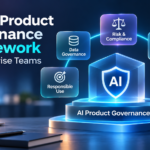
A practical framework for building, deploying, monitoring, and scaling enterprise AI products with the right balance of innovation, trust, security, and accountability.
Enterprise AI is moving from experimentation into business-critical operations.
Organizations are introducing Generative AI, AI copilots, Retrieval-Augmented Generation (RAG), intelligent automation, and AI agents across customer support, finance, HR, operations, sales, and internal knowledge management.
The technology is becoming increasingly capable. But as AI becomes part of everyday business operations, a more important question emerges:
How do we ensure that enterprise AI products remain secure, reliable, accountable, and aligned with business objectives throughout their lifecycle?
Consider an enterprise AI assistant connected to internal company information.
Employees can use it to retrieve documents, summarize discussions, generate recommendations, and answer business questions.
The product creates immediate value.
However, what happens if an employee retrieves information they are not authorized to access? What happens when the assistant generates an incorrect answer? Who is accountable when an AI agent performs an unintended action? How does the organization detect a change in output quality after a model update?
These are product governance questions.
They cannot be addressed through model selection or prompt engineering alone.
They require a structured approach that connects product management, engineering, security, data governance, legal, compliance, and business operations.
In this article, I will outline a practical AI Product Governance Framework that enterprise teams can use throughout the product lifecycle.
The objective is not to introduce more approval layers.
It is to establish clear controls, ownership, and decision-making processes so that teams can innovate responsibly without creating unnecessary delivery friction.
1. What Is AI Product Governance?
AI Product Governance is the set of principles, policies, processes, controls, and accountability mechanisms used to manage an AI product throughout its lifecycle.
It ensures that an AI product is:
- Aligned with a legitimate business purpose.
- Designed around clearly defined users and use cases.
- Secure in its handling of data and information.
- Evaluated for accuracy, reliability, and safety.
- Transparent about its capabilities and limitations.
- Supported by appropriate human oversight.
- Monitored after deployment.
- Accountable to business, legal, and regulatory requirements.
It is important to distinguish AI governance from traditional software governance.
Traditional software governance often focuses on architecture, security, access control, change management, testing, and operational reliability.
AI governance must address these areas while also considering model behaviour, output variability, hallucinations, training and evaluation data, prompt injection, model changes, and human oversight.
For example, a conventional application may return a result based on predefined business rules.
A Generative AI application may produce different responses to similar requests.
An AI agent may also interact with other systems and initiate actions.
This creates additional responsibilities for product teams.
AI governance should therefore be treated as an ongoing product capability, not a one-time compliance activity.
2. Why Enterprise Teams Need a Structured Governance Framework
Without a defined governance framework, different teams may make inconsistent decisions about AI product development and deployment.
One team may prioritize speed and launch a solution with limited evaluation.
Another may introduce extensive approval requirements for a relatively low-risk use case.
A third may implement its own data access and monitoring mechanisms, creating duplication across the organization.
These disconnected approaches create several challenges.
A. Unclear accountability
When multiple teams contribute to an AI product, ownership can become fragmented.
Product owns the roadmap. Engineering owns implementation. Data Science owns model evaluation. Security reviews vulnerabilities. Compliance evaluates obligations.
But who owns the overall product risk?
Without clear accountability, important issues can remain unresolved.
B. Inconsistent risk management
Different AI use cases have different levels of potential impact.
An internal writing assistant does not necessarily require the same controls as an AI system influencing financial or employment decisions.
Applying identical governance requirements to every use case can create unnecessary friction.
Applying insufficient controls to consequential use cases creates avoidable risk.
C. Data security and privacy concerns
Enterprise AI products may interact with customer information, employee records, financial data, confidential documents, and internal business systems.
Organizations need clear rules governing what information AI systems can access, process, retain, and expose.
D. Limited visibility into production behaviour
A successful pilot does not guarantee reliable production behaviour.
Model updates, changing data, new user patterns, and modifications to connected systems can affect the quality and safety of an AI product.
Without ongoing monitoring, teams may discover problems only after users report them.
E. Difficulty scaling successful AI products
A solution that works for one department may not be ready for organization-wide deployment.
Scaling introduces additional requirements around permissions, integrations, infrastructure, operational support, governance, and cost management.
A structured framework helps teams address these requirements before they become delivery blockers.
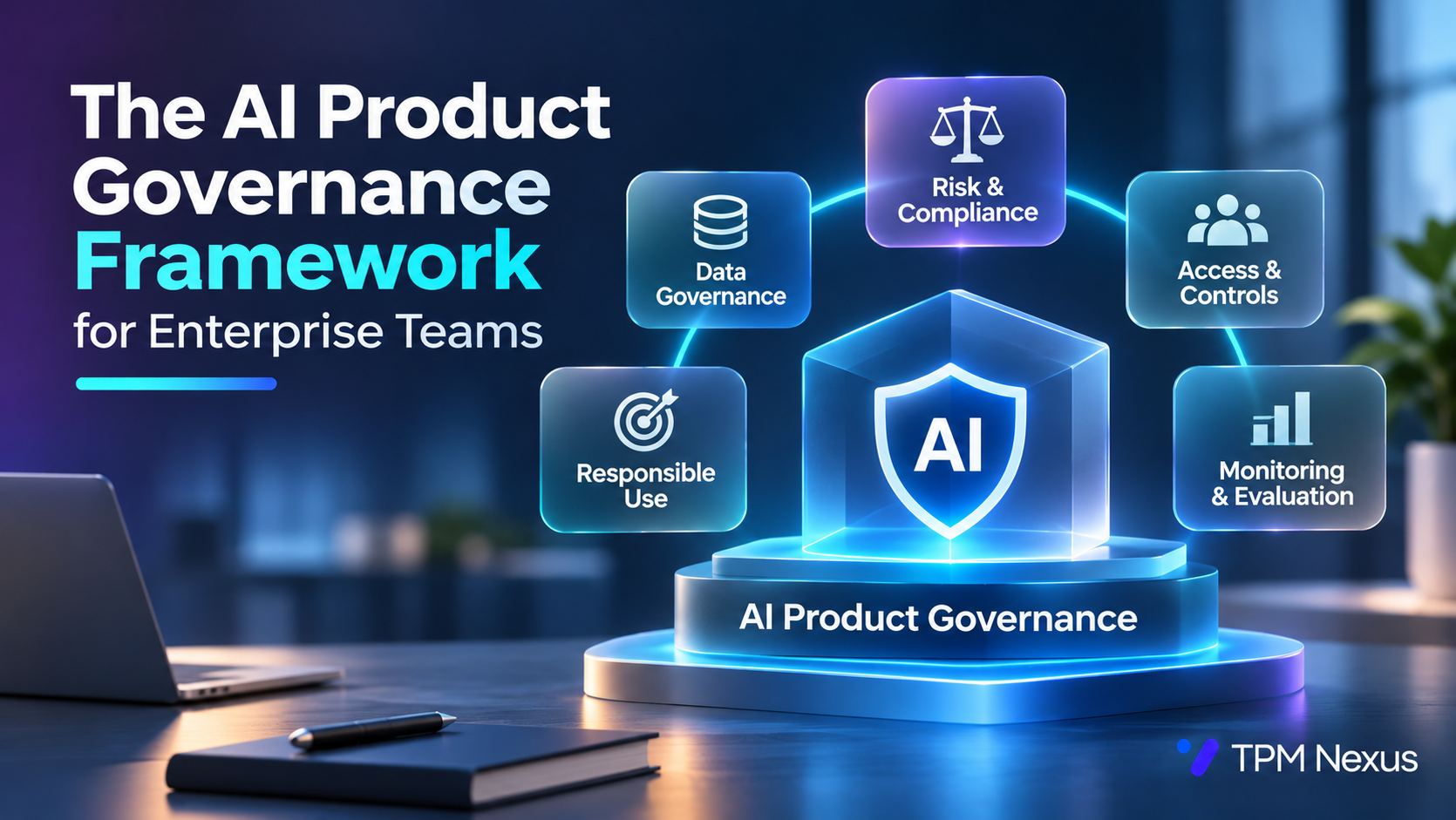
3. The Eight Pillars of an Enterprise AI Product Governance Framework
I recommend organizing enterprise AI governance around eight connected pillars.
Pillar 1. Business Purpose and Product Accountability
Every AI product should begin with a clearly defined business purpose.
Before selecting a model or designing an AI workflow, the team should understand what problem it is solving and who is accountable for the outcome.
Important questions include:
- What business problem are we addressing?
- Why is AI appropriate for this use case?
- Who are the intended users?
- What decisions or workflows will AI influence?
- What is the expected business outcome?
- Who owns the product and its associated risks?
- What conditions would justify stopping or redesigning the solution?
Recommended governance controls
- Documented business use case.
- Defined product owner.
- Named business sponsor.
- Clear success criteria.
- Identified stakeholders.
- Defined product boundaries.
- Documented accountability.
Expected deliverable: AI Product Charter.
The charter establishes the purpose, scope, ownership, intended users, expected outcomes, and initial risk considerations.
Pillar 2. Data Governance and Privacy
Data is one of the most important dependencies of enterprise AI.
An AI product is only as useful as the information it can access and process appropriately.
Consider an enterprise knowledge assistant connected to SharePoint, internal databases, and document repositories.
The system must respect the organization’s existing data permissions.
An employee should not gain access to confidential information simply because an AI assistant can retrieve it.
Recommended governance controls
- Data classification.
- Role-based access control.
- Permission-aware retrieval.
- Data minimization.
- Sensitive information protection.
- Data retention and deletion policies.
- Secure API integrations.
- Data lineage and traceability.
- Appropriate privacy assessments.
Expected deliverable: AI Data Governance Specification.
This document should identify the data sources, sensitivity levels, access rules, processing requirements, retention expectations, and responsible data owners.
Pillar 3. Model Governance and Evaluation
Choosing an AI model is an important product decision, but model selection alone does not establish product reliability.
Teams need a structured process for evaluating model behaviour. For a Generative AI product, evaluation may cover:
- Response accuracy.
- Groundedness.
- Relevance.
- Completeness.
- Hallucination behaviour.
- Bias and harmful output.
- Instruction following.
- Prompt injection resistance.
- Performance consistency.
- Regression after model changes.
For RAG-based products, retrieval quality and generation quality should be evaluated separately.
For AI agents, evaluation should also cover tool selection, permissions, action execution, failure handling, and escalation.
Recommended governance controls
- Approved model inventory.
- Documented model selection criteria.
- Version management.
- Representative evaluation datasets.
- Defined acceptance thresholds.
- Regression testing.
- Human expert evaluation.
- Model change approval.
- Evaluation records.
Expected deliverable: Model Evaluation and Approval Report.
The report should explain which model or configuration was evaluated, the scenarios tested, the results, known limitations, and approval conditions.
Pillar 4. Security and Access Control
Enterprise AI products introduce security considerations beyond traditional application security.
A system may retrieve internal information, process external inputs, connect to APIs, and execute actions through tools.
Security needs to be considered across the complete AI architecture.
Important areas include:
- Authentication and authorization.
- Role-based permissions.
- API security.
- Encryption.
- Secrets management.
- Prompt injection protection.
- Data leakage prevention.
- Tool execution restrictions.
- Network and infrastructure security.
- Audit logging.
For AI agents, access to external tools should follow the principle of least privilege.
An agent designed to summarize customer records should not automatically receive permission to modify financial transactions.
Recommended governance controls
- Threat modelling.
- Security architecture review.
- Access control validation.
- Vulnerability testing.
- Prompt injection testing.
- Tool permission boundaries.
- Security monitoring.
- Incident response procedures.
Expected deliverable: AI Security Assessment.
Pillar 5. Human Oversight and Accountability
Human oversight should be designed according to the potential impact of the AI use case.
Not every AI-generated output needs manual approval.
However, high-impact decisions and sensitive actions may require human review, authorization, or the ability to intervene.
Consider three examples:
| AI Use Case | Human Oversight Approach |
|---|---|
| Internal meeting summarization | User reviews before sharing |
| Customer support response suggestions | Agent reviews before sending |
| Financial transaction execution | Authorized human approval before execution |
The controls should reflect the actual business risk.
Human oversight should also be practical.
If employees need to review hundreds of low-risk outputs manually, the product may introduce unnecessary operational effort.
Recommended governance controls
- Defined human review requirements.
- Approval thresholds.
- Escalation mechanisms.
- Override capabilities.
- Clear responsibility for decisions.
- Documented exception handling.
- User feedback mechanisms.
Expected deliverable: Human Oversight and Escalation Matrix.
Pillar 6. Transparency and Explainability
Enterprise users should understand when AI is involved in a workflow and what they can reasonably expect from it.
This does not mean every AI product needs to expose complex model internals.
It means providing appropriate transparency about outputs, limitations, supporting information, and important decisions.
For example, an AI knowledge assistant should provide references to relevant source documents wherever feasible.
A recommendation system should make it clear when a recommendation is generated by AI and whether additional human review is required.
Recommended governance controls
- AI-generated content identification.
- Source references where applicable.
- Clear product limitations.
- User-facing explanations.
- Confidence indicators only where meaningful and validated.
- Feedback and correction mechanisms.
- Human escalation options.
Expected deliverable: AI Transparency and User Communication Guidelines.
Pillar 7. Production Monitoring and Incident Management
AI governance must continue after deployment.
Production monitoring should cover technical performance, output quality, security, user behaviour, and operational cost.
Some important monitoring areas include:
- Response latency.
- System availability.
- Model errors.
- Output quality.
- Hallucination and correction rates.
- Data access violations.
- Security events.
- Unusual usage patterns.
- Human intervention.
- Cost per completed task.
The organization should also establish an AI incident management process.
For example, if an AI assistant exposes restricted information, the team should know:
- How to identify and report the incident.
- Who owns the investigation.
- Whether the affected capability needs to be disabled.
- How the incident should be communicated.
- What corrective actions are required.
- How the product can safely resume operation.
Recommended governance controls
- Production monitoring dashboards.
- Defined incident severity levels.
- Incident ownership.
- Escalation paths.
- Rollback and disable mechanisms.
- Root cause analysis.
- Corrective action tracking.
- Post-incident evaluation.
Expected deliverable: AI Production Monitoring and Incident Response Plan.
Pillar 8. Continuous Improvement and Lifecycle Governance
AI products evolve continuously.
Models change. Data sources change. Business requirements change. Users discover new use cases. New risks emerge.
A governance framework must therefore support continuous improvement.
Important activities include:
- Periodic risk reassessment.
- Model evaluation after significant changes.
- Prompt and configuration versioning.
- Regular access reviews.
- Data quality monitoring.
- User feedback analysis.
- Performance reviews.
- Governance policy updates.
- Product retirement planning.
Expected deliverable: AI Product Lifecycle Review.
The objective is to ensure that governance remains relevant throughout the product’s operational life.
4. The Enterprise AI Governance Lifecycle
The eight pillars define what needs to be governed.
The next question is when these controls should be applied.
I recommend integrating governance into six product lifecycle stages.
| Lifecycle Stage | Key Activities | Governance Deliverable |
|---|---|---|
| 1. Discovery | Identify business problem, users, and initial risks | AI Product Charter |
| 2. Design | Define architecture, data boundaries, oversight, and requirements | AI Governance Requirements |
| 3. Development | Implement security controls and evaluation | Technical and Evaluation Evidence |
| 4. Validation | Conduct risk, quality, security, and user testing | AI Readiness Assessment |
| 5. Deployment | Approve release, monitoring, ownership, and escalation | Production Approval |
| 6. Continuous Monitoring | Review performance, risks, incidents, and changes | Lifecycle Review |
The important principle is that governance should not operate as a separate process outside product delivery.
It should be part of the normal product lifecycle.
For example, data access requirements should be defined during design, implemented during development, validated before release, and monitored in production.
This reduces the likelihood of discovering fundamental governance gaps immediately before launch.
5. A Practical Risk Classification Model for AI Products
Not every AI use case needs the same governance treatment.
A practical internal risk classification can help teams determine the level of assessment and controls required.
The following model is intended as a product planning tool. It is not a substitute for formal legal or regulatory risk classification.
| Risk Category | Example Use Cases | Typical Governance Requirements |
|---|---|---|
| Low | Internal content drafting, non-sensitive summarization | Basic access controls, user review, standard monitoring |
| Medium | Customer support assistance, internal knowledge retrieval, document processing | Data protection, output evaluation, auditability, exception handling |
| High | Financial recommendations, employment-related decisions, consequential automated actions | Formal risk assessment, stronger validation, human oversight, legal and compliance review, enhanced monitoring |
Risk classification should consider more than the type of AI model.
It should account for:
- The intended purpose.
- The sensitivity of information.
- The users affected.
- The potential impact of incorrect outputs.
- The degree of automation.
- The reversibility of decisions.
- The regulatory environment.
- The level of human oversight.
For example, an AI assistant that summarizes publicly available information may be relatively low risk.
The same technology connected to confidential financial records and authorized to execute transactions has a very different risk profile.
Governance should follow the use case and its potential impact, not simply the technology being used.
6. Who Owns AI Product Governance?
Governance becomes difficult when ownership is unclear.
An effective enterprise operating model needs defined responsibilities across functions.
Here is a practical responsibility structure.
| Function | Primary Responsibility |
|---|---|
| Product Management | Business purpose, product requirements, roadmap, user impact, product risk coordination |
| Engineering | Architecture, security implementation, integrations, reliability |
| AI / Data Science | Model selection, evaluation, performance and quality |
| Data Governance | Data classification, access, lineage and retention |
| Security | Threat assessment, access controls, vulnerabilities and incident response |
| Legal / Compliance | Regulatory obligations, legal review and policy alignment |
| Business Owner | Business accountability, acceptable operational risk and outcome ownership |
| Operations | Production monitoring, support and incident management |
The exact ownership model will vary by organization.
Some enterprises may have a centralized AI governance committee. Others may distribute responsibilities across existing risk, security, architecture, and product governance structures.
What matters is that every important decision has a clear owner.
The AI Product Manager’s Role
The AI Product Manager does not need to personally perform every security assessment or legal review.
However, the Product Manager must ensure that governance requirements are translated into product scope, priorities, acceptance criteria, and release decisions.
This includes:
- Identifying governance dependencies during discovery.
- Bringing relevant stakeholders into planning.
- Converting risk requirements into product requirements.
- Ensuring evaluation criteria are agreed upon.
- Managing governance-related dependencies.
- Tracking unresolved risks.
- Aligning release readiness.
- Monitoring product outcomes after launch.
Governance should influence the roadmap, not exist separately from it.
7. A Practical AI Governance Scorecard
A framework becomes useful when teams can measure whether it is working.
I recommend creating a governance scorecard across eight areas.
| Governance Area | What to Measure | What It Tells Us |
|---|---|---|
| Accountability | Percentage of AI products with named owners | Is responsibility clear? |
| Data governance | Access violations and data exposure incidents | Is information protected? |
| Model quality | Evaluation pass rate and correction rate | Are outputs reliable? |
| Security | Open vulnerabilities and security incidents | Are controls effective? |
| Human oversight | Required reviews completed and escalations | Is appropriate oversight happening? |
| Transparency | Source traceability and user feedback | Can users understand and assess outputs? |
| Operations | Incident frequency and recovery time | Can the product be operated safely? |
| Lifecycle management | Periodic reviews and reassessments completed | Are controls maintained over time? |
These indicators should be supported by evidence.
For example, reporting that a product has completed a security review does not automatically mean the security controls are effective.
Similarly, a high evaluation pass rate is meaningful only when the evaluation dataset reflects real business scenarios.
The scorecard should help teams identify gaps, assign corrective actions, and make better product decisions.
8. How to Implement AI Product Governance Without Slowing Delivery
This is where governance strategy meets execution.
Enterprise teams often worry that governance will introduce additional approvals, documentation, and dependencies.
That concern is valid when governance is implemented as a disconnected administrative process.
The answer is to make governance repeatable and integrated into existing delivery practices.
I would recommend seven practical steps.
Step 1. Create a Reusable AI Use Case Assessment
Use a standard template to capture business purpose, users, data sources, automation level, and initial risk.
Step 2. Define Minimum Governance Requirements
Establish baseline requirements for authentication, authorization, data protection, logging, evaluation, and monitoring.
Step 3. Build Reusable Technical Controls
Create shared components for access management, audit logging, model evaluation, prompt management, and human approval workflows.
Step 4. Establish Risk-Based Review Paths
Define which use cases require standard review and which require deeper security, legal, or compliance assessment.
Step 5. Automate Repeatable Validation
Integrate security checks, evaluation tests, regression testing, and monitoring into the development and release process wherever practical.
Step 6. Define Clear Decision Ownership
Make it clear who can approve, reject, escalate, or accept residual risks within the organization’s authority structure.
Step 7. Review Governance After Deployment
Use production evidence, incidents, user feedback, and changing requirements to improve controls continuously.
The objective is to reduce uncertainty for delivery teams.
When requirements and decision paths are clear, governance can actually improve delivery predictability.
9. Relevant AI Governance Standards and Frameworks
Enterprise teams should understand the external standards and regulatory frameworks relevant to their operating environment.
Three useful references are:
NIST AI Risk Management Framework
The NIST AI RMF provides guidance for managing AI risks through four functions: Govern, Map, Measure, and Manage.
It can help organizations structure risk management activities across AI development and deployment.
Reference: https://www.nist.gov/itl/ai-risk-management-framework
ISO/IEC 42001
ISO/IEC 42001 specifies requirements for establishing, implementing, maintaining, and continually improving an AI management system.
It provides an organizational management system approach to AI governance.
Reference: https://www.iso.org/standard/81230.html
EU AI Act
The EU AI Act establishes a risk-based regulatory framework for AI systems in the European Union.
Its requirements and implementation timelines depend on the applicable provisions, AI system classification, and organizational role.
Reference: https://artificial-intelligence-act.ec.europa.eu/
These frameworks serve different purposes.
The NIST AI RMF is a risk management framework. ISO/IEC 42001 is a management system standard. The EU AI Act is legislation.
Organizations should work with their legal and compliance teams to determine which obligations apply.
A governance framework should use these references appropriately rather than treating them as interchangeable checklists.
10. A 90-Day AI Governance Implementation Roadmap
For an organization establishing its AI governance operating model, a phased implementation approach can help.
Days 1 to 30: Establish the Foundation
Focus on understanding the current AI landscape and defining ownership.
Activities:
- Identify existing AI products and initiatives.
- Document business use cases.
- Identify product and business owners.
- Map data sources and integrations.
- Perform initial risk assessments.
- Identify existing security and compliance processes.
- Define governance roles and decision ownership.
Key deliverables:
- AI use case inventory.
- AI Product Charter template.
- Initial risk classification model.
- Governance responsibility matrix.
Days 31 to 60: Define and Operationalize Controls
Focus on creating reusable governance requirements.
Activities:
- Define data governance requirements.
- Establish model evaluation standards.
- Define human oversight requirements.
- Create security and privacy review processes.
- Establish production monitoring expectations.
- Define incident management procedures.
- Integrate governance requirements into product delivery.
Key deliverables:
- AI governance checklist.
- Data governance specification.
- Model evaluation template.
- Security assessment template.
- Human oversight matrix.
- Production monitoring plan.
Days 61 to 90: Pilot and Improve
Focus on applying the framework to selected AI products.
Activities:
- Select representative AI use cases.
- Apply risk classification.
- Validate governance controls.
- Conduct cross-functional reviews.
- Test monitoring and escalation mechanisms.
- Measure governance effectiveness.
- Identify process bottlenecks.
- Refine the framework based on evidence.
Key deliverables:
- Governance pilot assessment.
- AI governance scorecard.
- Corrective action plan.
- Scaled implementation recommendations.
This is a suggested implementation roadmap, not a universal compliance timeline. Organizations with complex or highly regulated use cases may require additional time and specialist assessment.
11. Common AI Governance Mistakes to Avoid
Even organizations with formal AI policies can struggle with implementation.
Here are seven mistakes I would watch for.
1. Treating governance as a final approval gate
Governance introduced too late creates expensive rework. Involve stakeholders during discovery and design.
2. Applying identical controls to every AI use case
Controls should reflect the potential impact and risk of the intended application.
3. Focusing only on model accuracy
A model can produce accurate outputs while the overall product still has data access, security, workflow, or accountability problems.
4. Ignoring AI agents and tool permissions
An AI agent with access to business systems requires clear boundaries around which actions it can perform.
5. Treating human oversight as a checkbox
Human review must be meaningful, appropriately timed, and supported by the right information and authority.
6. Assuming governance ends after launch
Production behaviour, data, models, and business requirements change. Governance must evolve with the product.
7. Confusing documentation with effective controls
A completed policy or assessment does not prove that the underlying control is working.
Governance needs implementation evidence, monitoring, and corrective action.
12. The Product Leadership Perspective
AI governance is often discussed as a security, legal, or compliance responsibility.
Those functions are essential, but product leadership has an equally important role.
The AI Product Manager must connect governance with the actual product experience and business objectives.
For example:
- A data access policy must become an enforceable product requirement.
- A human oversight policy must become a defined workflow.
- A model evaluation standard must become a measurable release criterion.
- An incident response process must become an operational capability.
- A business risk assessment must influence product scope and prioritization.
This is where product management creates alignment across otherwise disconnected functions.
It also requires the ability to make difficult trade-off decisions.
- Sometimes the right decision is to release a limited capability with clearly defined boundaries rather than launch a fully automated solution.
- Sometimes a promising use case should remain in pilot until output quality improves.
- Sometimes the business value does not justify the cost and risk of production deployment.
A strong governance framework gives leaders the information needed to make these decisions.
Final Thoughts: Governance Should Enable Responsible Innovation
Enterprise AI is entering a phase where organizations need more than successful pilots and impressive demonstrations.
They need products that can operate reliably, protect information, support users, and create measurable business value.
That requires governance to become part of product strategy and execution.
The eight pillars outlined in this article provide a practical foundation:
- Business purpose and accountability.
- Data governance and privacy.
- Model governance and evaluation.
- Security and access control.
- Human oversight and accountability.
- Transparency and explainability.
- Production monitoring and incident management.
- Continuous improvement and lifecycle governance.
The framework should be adapted to the organization’s industry, risk profile, operating model, and regulatory obligations.
My view is straightforward:
Good AI governance should not make innovation impossible. It should make the path to responsible innovation clearer.
When teams understand the boundaries, ownership, evaluation requirements, and approval processes, they can spend less time resolving uncertainty and more time building products that matter.
The goal is not simply to launch AI safely.
It is to build AI products that organizations can confidently trust, operate, improve, and scale.
That is the foundation of sustainable enterprise AI product leadership.
A Practical Starting Point for Enterprise Teams
Before starting your next AI initiative, answer these five questions:
- What business problem is the AI product solving?
- What data can the system access, and under whose permissions?
- How will we evaluate output quality and potential risks?
- Which actions require human review or approval?
- Who owns the product and its ongoing production governance?
If these questions do not have clear answers, the team should address them before moving toward production.
For more practical frameworks, product breakdowns, and AI Product Management resources, visit TPM Nexus: www.tpmnexus.pro
#AIProductManagement #EnterpriseAI #AIGovernance #ResponsibleAI #ProductLeadership #AITransformation #GenerativeAI #TPMNexus