Airbnb: The Customer Discovery Decisions That Changed Everything
Explore how Airbnb's early customer discovery shaped its product strategy, trust model, marketplace experience and growth from a Product Manager's perspective.
Airbnb Was Not Simply a Marketplace Problem
Airbnb is often presented as a story about a clever marketplace idea. That explanation misses the more interesting part.
The early product was not obviously broken. People could find listings. Hosts could publish spaces. Guests could make bookings.
Yet the business struggled to grow consistently.
The important question was not:
"How do we add more features?"
It was:
"Why are people not behaving the way our product expects them to behave?"
That question led Airbnb's founders much closer to their customers.
They visited hosts in person. They photographed homes themselves. They experienced the product as hosts and guests. They looked beyond what users said and paid attention to what actually prevented a booking.
Those decisions helped reveal something deeper.
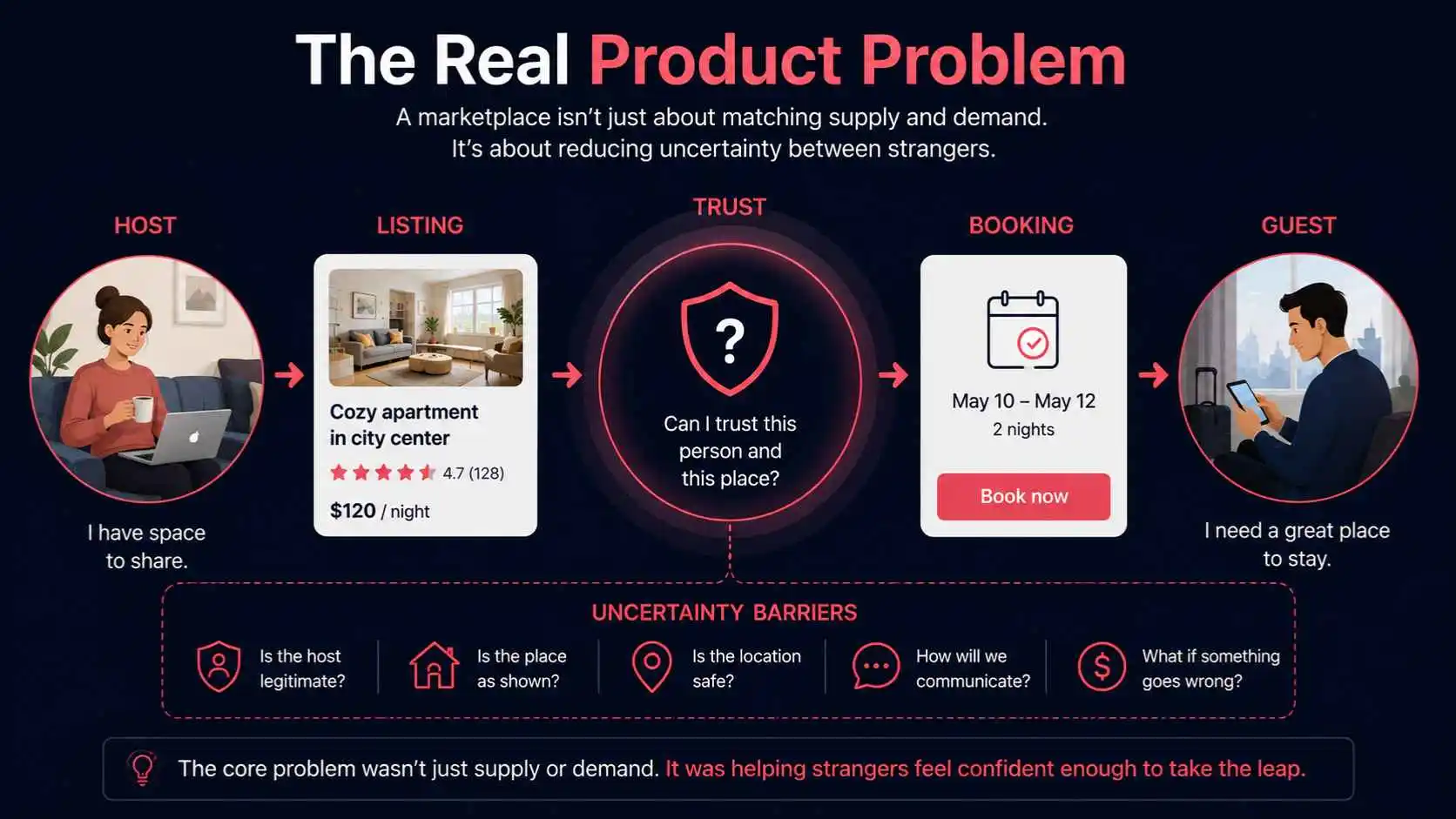
The problem was not simply discovering available accommodation.
It was creating enough quality, confidence and trust for a stranger to book a stay in another person's home.
Case study classification: Public-product history + Product Management analysis. This is not an account of Airbnb's confidential internal decisions or undocumented metrics.
The Product Looked Simple. The Problem Was Not.
In 2007, Brian Chesky and Joe Gebbia were trying to solve a very immediate problem: they needed to make rent.
A design conference was coming to San Francisco, hotels were sold out, and the two roommates opened their apartment to three guests using air mattresses.
That first experience became the seed of Airbnb.
The initial product idea was straightforward:
People have unused space. Other people need somewhere to stay. Connect them.
That sounds like a marketplace.
But marketplaces have a difficult property. The product has to solve two problems simultaneously.
Supply
Can we convince people to list?
Demand
Can we convince people to book?
Airbnb had an additional problem that hotels did not. The inventory was not standardized.
A hotel room is generally expected to meet a recognizable set of expectations. A stranger's apartment does not.
The guest has to decide:
- Is this place actually as good as the listing suggests?
- Is the host legitimate?
- Will the host show up?
- Is the neighborhood safe?
- Will the experience match what I expect?
- What happens if something goes wrong?
The product therefore had a trust problem before it had a scaling problem.
The First Discovery Decision: Go Where the Customers Are
One of the most important early decisions was also one of the least scalable.
The founders went to their customers.
Paul Graham later described how Airbnb was encouraged to go to New York and meet its users directly rather than trying to solve the problem remotely. Y Combinator also describes the founders' decision to take the "do things that don't scale" approach, including visiting hosts and improving their listings personally.
This sounds obvious today.
It was not.
The founders could have spent their time improving the website. They could have added features. They could have optimized acquisition.
Instead, they went apartment by apartment.
That changed the quality of information they could collect.
An online survey might tell a Product Manager:
"I want better listings."
A conversation inside someone's home can reveal:
"I am not sure guests understand what they are actually getting."
Those are very different insights.
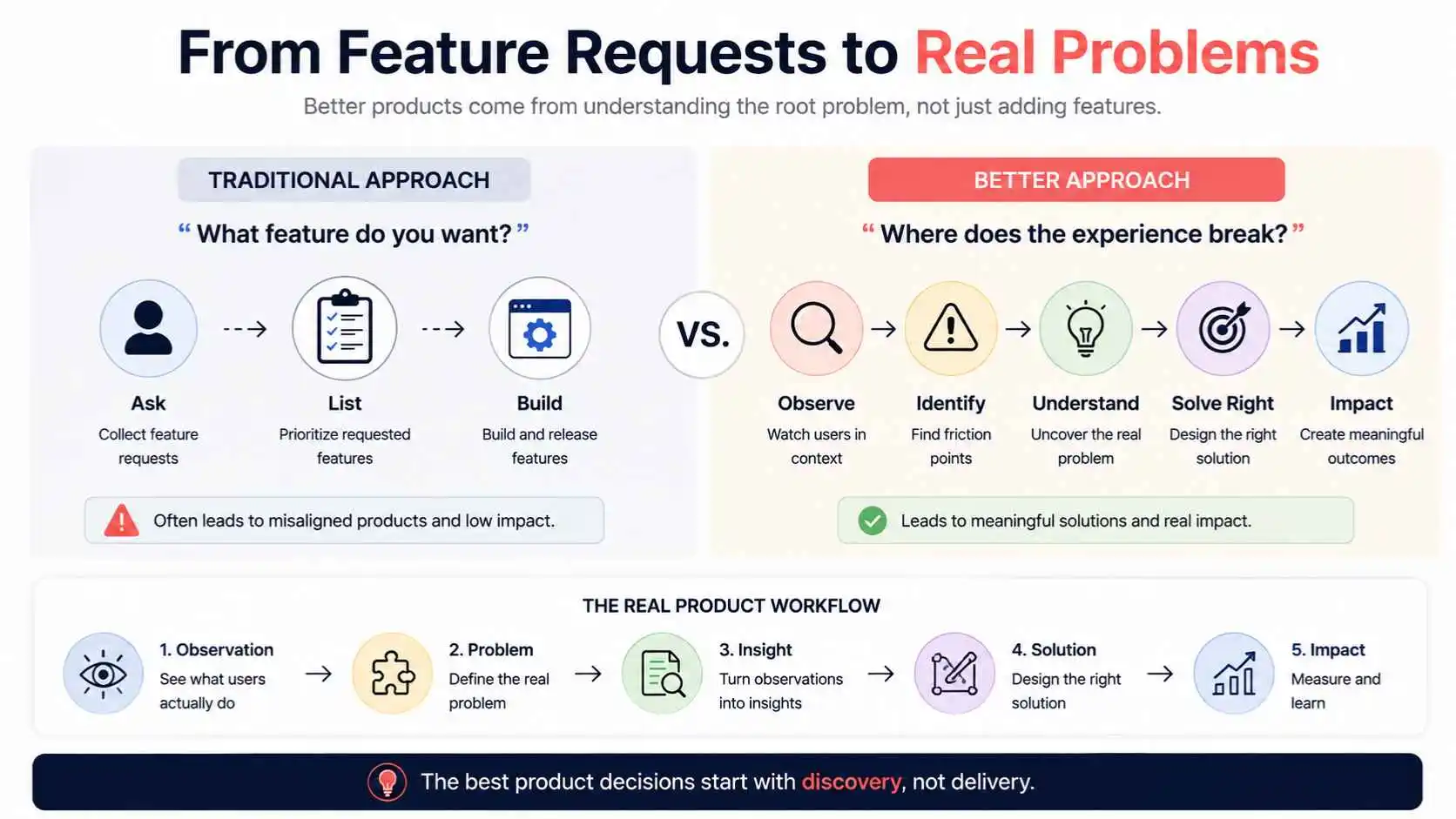
The first suggests a feature. The second suggests a product problem.
Discovery Was Not a Meeting. It Was an Environment.
The founders did not only ask customers what they wanted. They observed the environment in which the product was being used.
They saw the homes. They saw the photographs. They saw how hosts described their spaces. They experienced the interaction between host and guest.
Joe Gebbia later described the importance of ethnographic research and sitting in customers' living rooms to understand the complete experience rather than only the website interaction.
That changes the Product Manager's question.
"What feature should we build?"
The question becomes:
"Where does the experience break down?"
That is a much better discovery question.
The Photography Decision Looks Small. It Was Not.
One of the most famous early Airbnb actions was improving listing photography.
The founders personally photographed hosts' spaces.
Airbnb has confirmed that going door-to-door and personally photographing listings was part of its early approach. Y Combinator describes the photography work as one of the practical applications of doing things that do not scale.
At first glance, this sounds like a design improvement.
Better photos. Better listings. Better presentation.
But from a Product Management perspective, there was a deeper hypothesis:
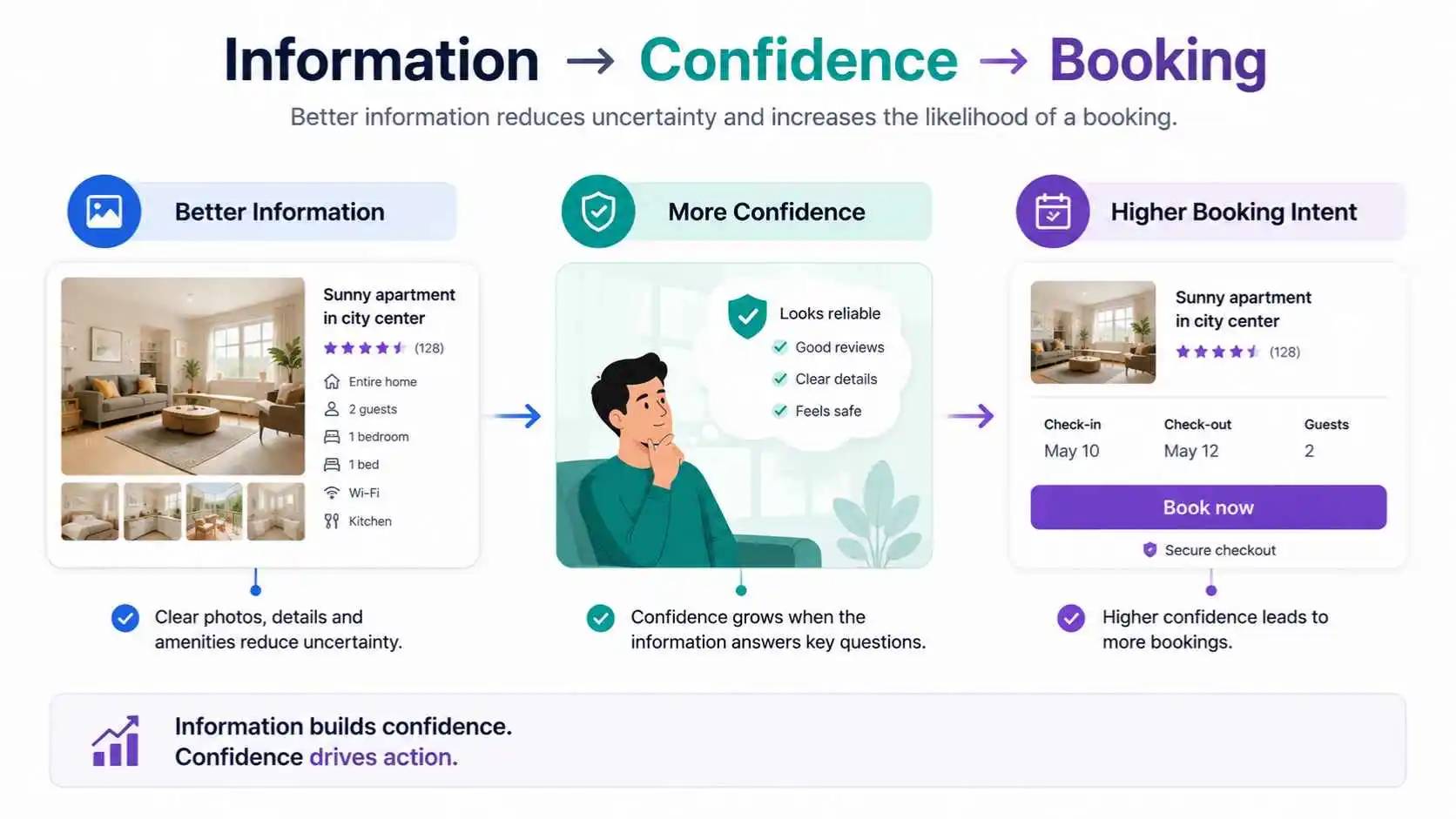
If guests cannot confidently understand what they are booking, improving the quality of the listing may improve conversion.
That is a product hypothesis.
The problem was not simply:
"Our images look bad."
The problem was:
"Guests cannot confidently evaluate unfamiliar inventory."
That distinction matters.
The Insight Behind the Photo
Imagine a guest comparing two listings.
Listing A has dark, poorly framed photographs.
Listing B has bright, clear photographs showing the room, sleeping arrangement and surrounding space.
The guest does not need to consciously say:
"Listing B has higher information quality."
They simply feel more confident.
That confidence can influence the decision to book.
This is an important Product Management principle:
Sometimes a conversion problem is actually an information problem.
And sometimes an information problem is actually a trust problem.
The Product Manager has to keep asking "why" until the real problem emerges.
The Founders Became Their Own Research Instrument
Another important discovery advantage came from the fact that the founders were not detached observers.
They had been hosts themselves.
Brian Chesky and Joe Gebbia had experienced the original problem personally. Y Combinator's Jessica Livingston later noted that the founders had unusually strong insight because they were using their own product and had direct experience as hosts.
That gave them a useful starting point.
But founder experience can also become a trap.
A founder can easily assume:
"I have this problem, therefore everyone has this problem."
The better use of founder experience is different.
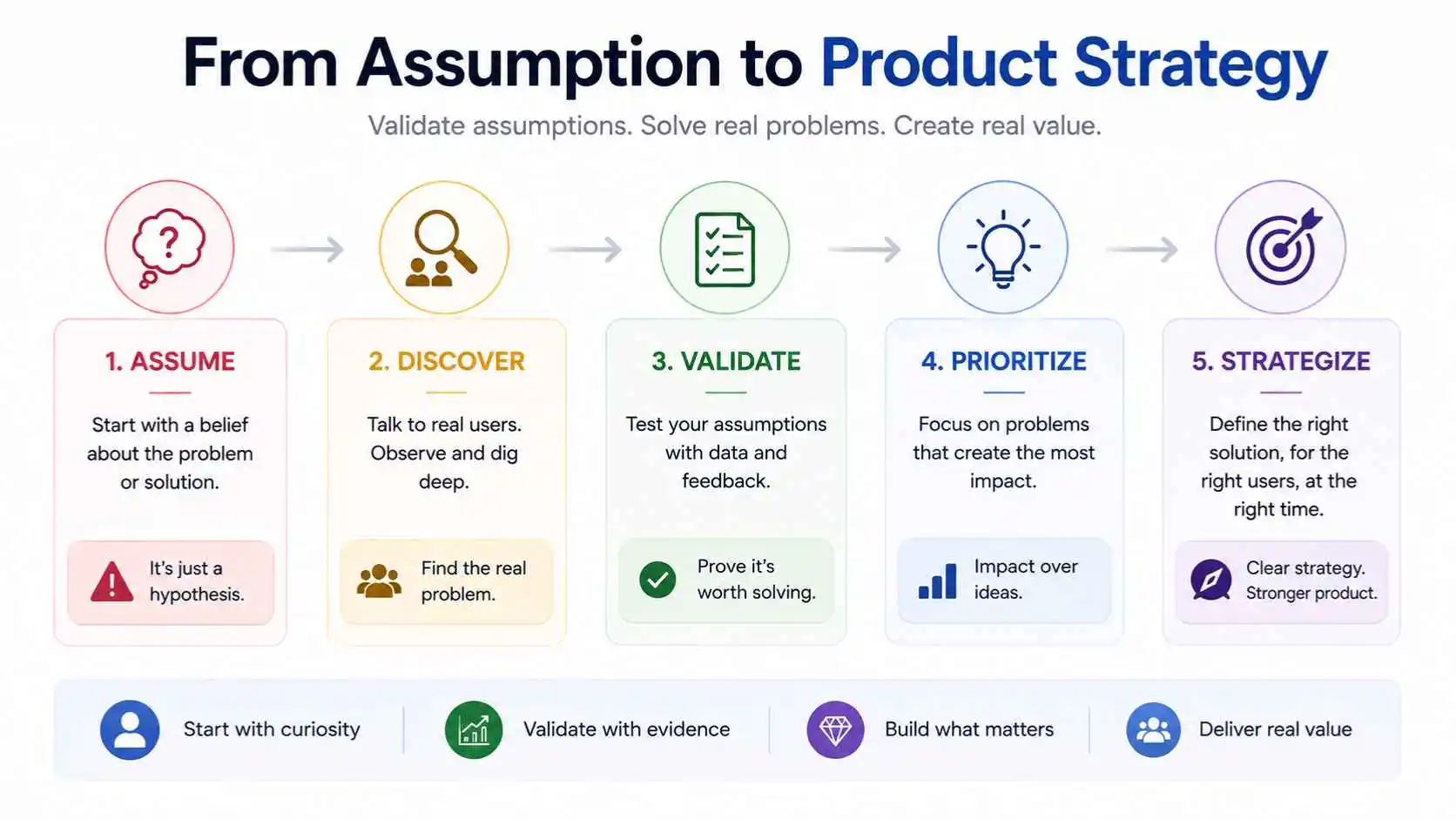
Use it to form hypotheses.
Then go outside yourself to test them.
Airbnb's early customer visits helped do exactly that.
What Did the Customer Discovery Actually Reveal?
The most important insight was not one feature.
It was the structure of the problem.
Airbnb was dealing with a marketplace where:
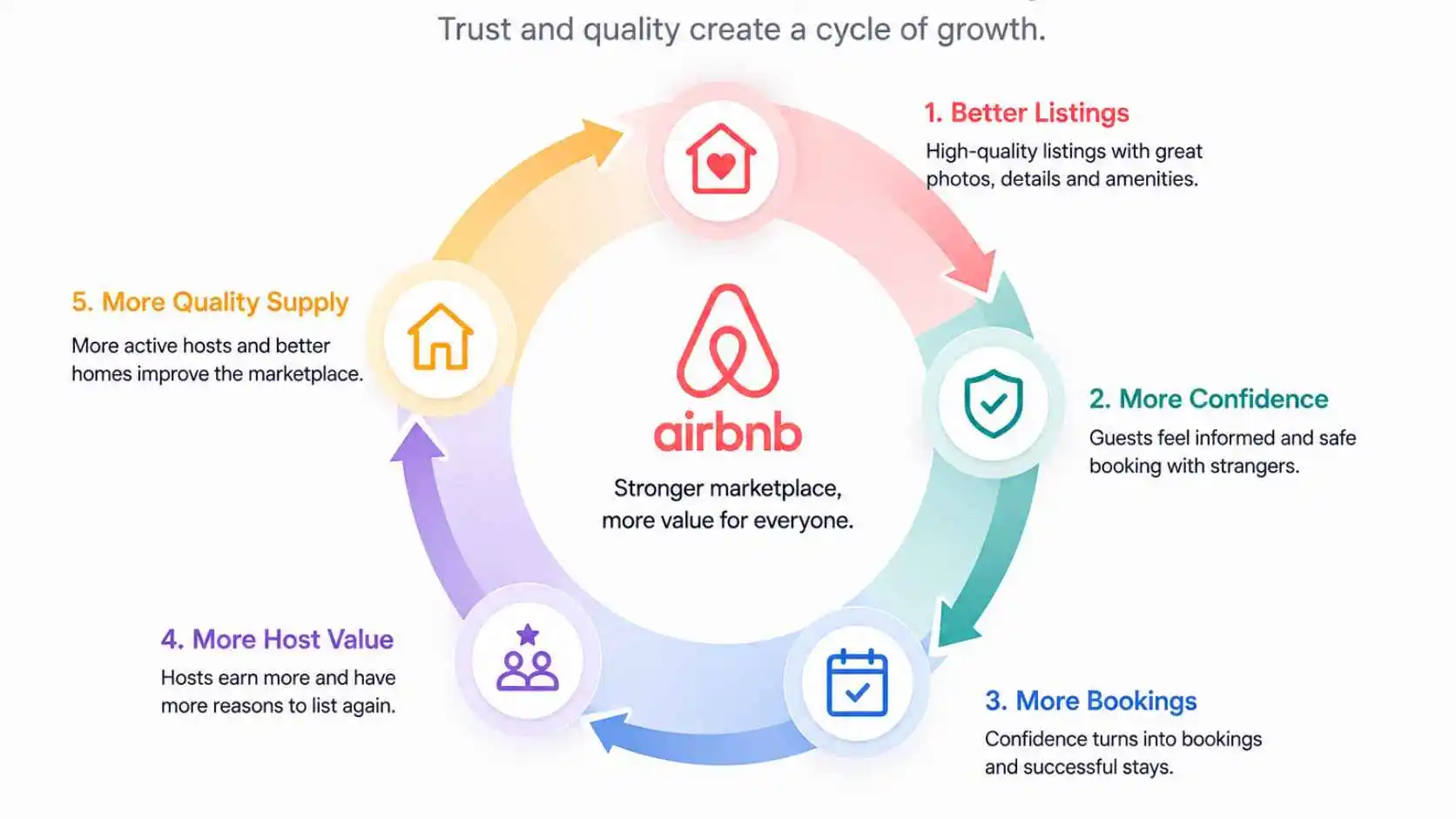
More hosts create more inventory.
More inventory creates more choice.
But more choice does not automatically create more bookings.
If the inventory feels uncertain, additional listings can actually increase the decision burden.
So the product needed to make unfamiliar inventory easier to evaluate.
That meant improving things such as:
- Listing quality
- Photos
- Profiles
- Reviews
- Communication
- Payments
- Customer support
- Trust mechanisms
Some of these mechanisms emerged over time rather than from one documented discovery meeting. Airbnb itself describes trust as fundamental to the business and says its core innovation was designing a framework that allows millions of people to trust one another.
A marketplace does not only match supply and demand. It reduces the uncertainty between them.
The Second Discovery Decision: Solve the Experience, Not the Interface
A common product mistake is to define the product boundary too narrowly.
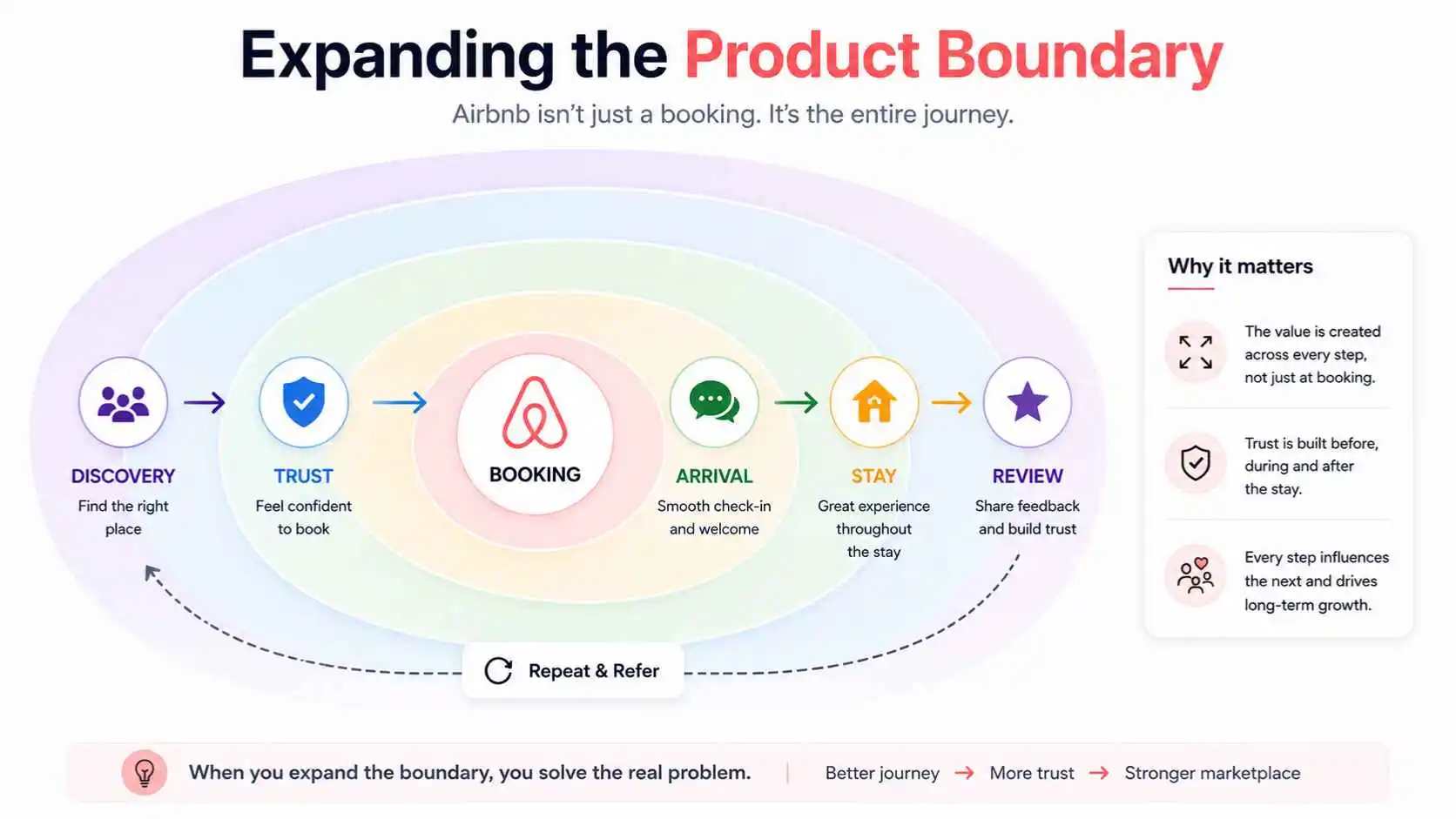
For Airbnb, the product was not simply the website.
The experience started before booking. It continued during communication. It continued at arrival. It continued during the stay. It continued after checkout.
Y Combinator's discussion with Joe Gebbia specifically highlights the importance of designing the full chain of the travel experience rather than treating Airbnb as simply a website for accommodation.
A Product Manager could map the journey:
A problem at any point can reduce the value of the entire product.
Customer Discovery Changed the Product Boundary
If a team defines Airbnb as:
"A website where people list rooms."
Then likely priorities include:
- Search
- Listing creation
- Booking
- Payments
If the team defines Airbnb as:
"A trusted system for strangers to stay in one another's spaces."
The product surface becomes much broader.
Now trust becomes a product capability.
Communication becomes important. Identity becomes important. Reviews become important. Support becomes important.
The host experience becomes important. The guest experience becomes important. The physical arrival experience becomes part of the product journey.
That is a major product-definition decision.
Customer Discovery Also Changed the Research Philosophy
Airbnb eventually built a much more formal research organization.
In a 2016 Airbnb Design article, Judd Antin described research as an embedded part of the product process. Airbnb's researchers worked closely with product teams and were involved from the beginning rather than being brought in only for late-stage usability validation.
That evolution matters.
Early-stage discovery often looks like:
Founders → Customers → Observation → Decision
At scale, that cannot remain entirely manual.
It has to evolve into:
Research + Data + Customer Support + Product Analytics + Experiments
Airbnb's research organization explicitly described combining multiple methods and data sources to reduce blind spots.
That is a useful product operating model.
Customer discovery should not disappear when the company grows. It should become institutionalized.
The Product Manager's Discovery Loop
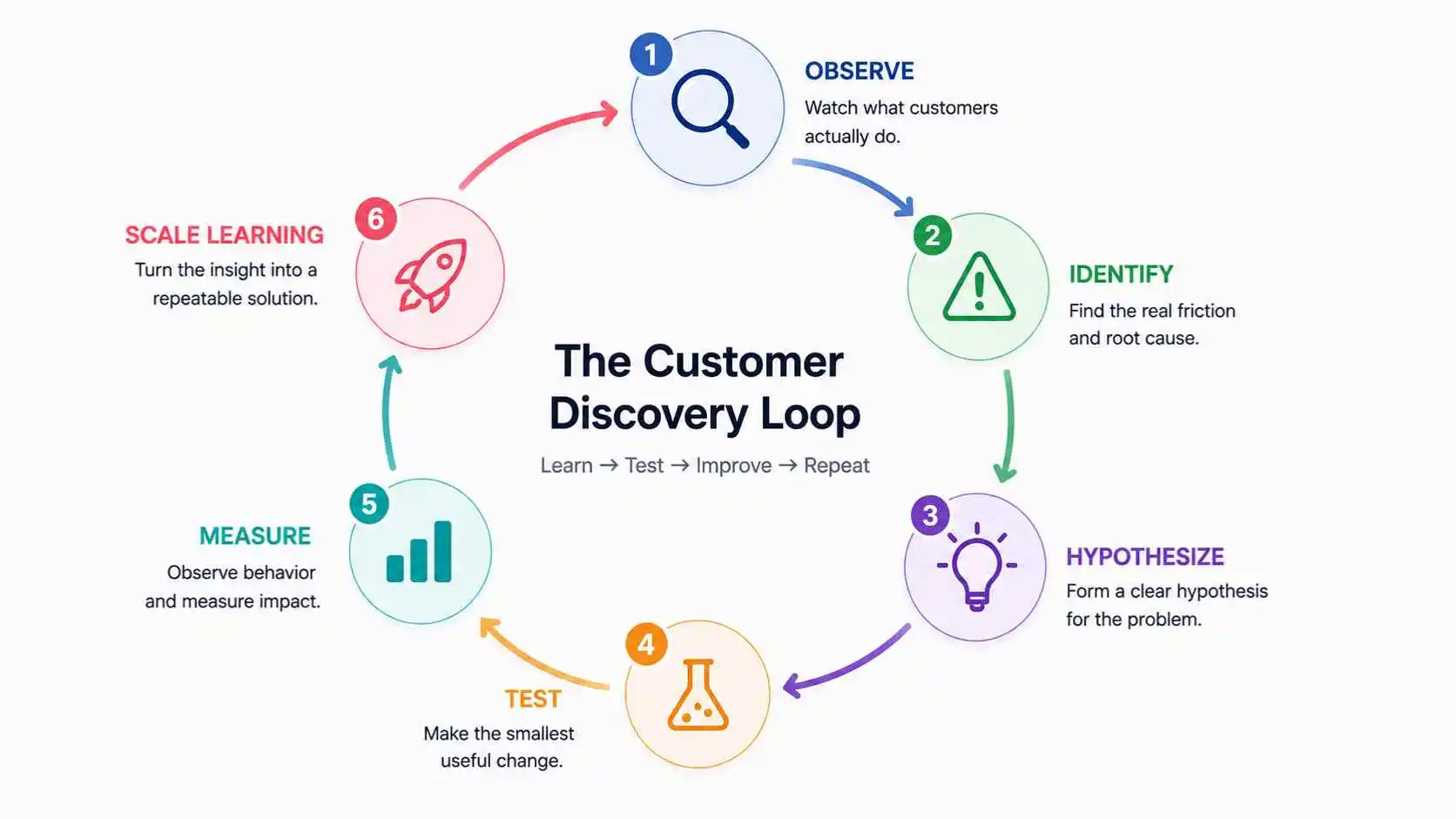
The Airbnb example suggests a practical discovery loop:
Observe
Watch what customers actually do.
Identify Friction
Find where the journey breaks.
Form a Hypothesis
Explain why the friction exists.
Make the Smallest Change
Do not immediately build a large feature.
Observe Again
Look for evidence of improvement.
Scale the Learning
Turn validated insight into a repeatable product capability.
Discovery is a continuous loop.
This is much stronger than:
Idea → Feature → Launch → Hope
What Airbnb Did Not Do
The obvious response to slow marketplace growth could have been:
"Add more features."
But that would have been premature.
If the core problem was confidence, additional features would not necessarily solve it.
The better sequence was:
- Understand the friction first.
- Solve the friction closest to the transaction.
- Measure whether behavior changes.
Do not prioritize the most visible problem. Prioritize the constraint that is preventing the product from working.
The Discovery Decision That Changed the Roadmap
People need alternative accommodation.
People need to feel confident about unfamiliar accommodation.
Improve information + trust.
Build the trusted marketplace.
This is why customer discovery can change a roadmap without changing the original business idea.
Airbnb did not necessarily need to abandon the marketplace. It needed to understand what had to be true for that marketplace to work.
How I Would Analyze Airbnb as a Product Manager
If I joined Airbnb during this stage, I would structure the product analysis around one question:
Where is the marketplace losing momentum?
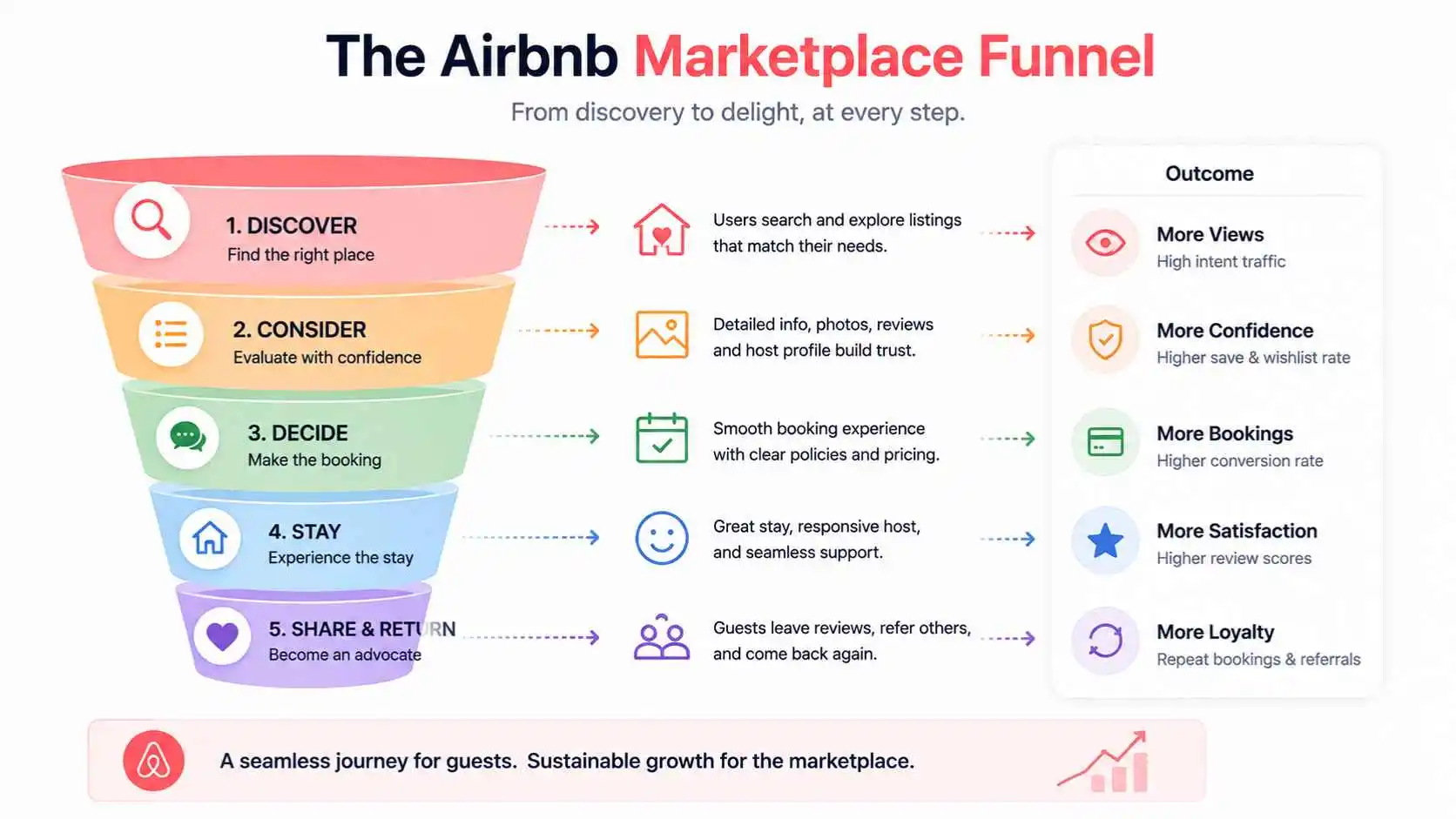
I would break the journey into four major stages.
| Stage | Core Question |
|---|---|
| Supply | Are enough quality hosts listing? |
| Discovery | Can guests find relevant options? |
| Confidence | Do guests trust what they see? |
| Transaction | Can they book without friction? |
Then I would look for the largest constraint.
This is important because a marketplace can have strong traffic and still struggle.
For example:
Traffic ↑ but Booking Conversion ↓
might indicate a problem with relevance, trust, price, listing quality or another part of the decision journey.
The Product Manager's job is not to celebrate traffic. It is to understand where the value chain breaks.
The Metrics I Would Watch
For this stage of the product, I would not rely on one North Star metric. I would create a diagnostic funnel.
Supply
- Active listings
- Quality listings
- Listing completeness
- Host response rate
Discovery
- Search to listing view
- Listing views per search
- Search refinement
Confidence
- Listing engagement
- Review interaction
- Host profile engagement
- Guest questions
- Cancellation signals
Conversion
- Listing view to booking
- Booking completion
- Payment success
Experience
- Guest satisfaction
- Host satisfaction
- Repeat usage
- Referral
Why "Do Things That Don't Scale" Worked Here
There is a common misunderstanding about the famous startup principle.
Doing things manually is not the lesson.
Learning manually is the lesson.
The founders personally photographed listings because they were trying to understand and improve the experience.
They visited customers because they needed information they could not get from dashboards alone.
They handled customer interactions because they needed to understand friction directly.
Airbnb later described those early behaviors as part of a host-centered approach.
A Product Manager should therefore ask:
What can we do manually today that teaches us what should eventually be automated?
That is the useful interpretation.
What Would I Do Differently Today?
The original Airbnb team operated in a very different environment.
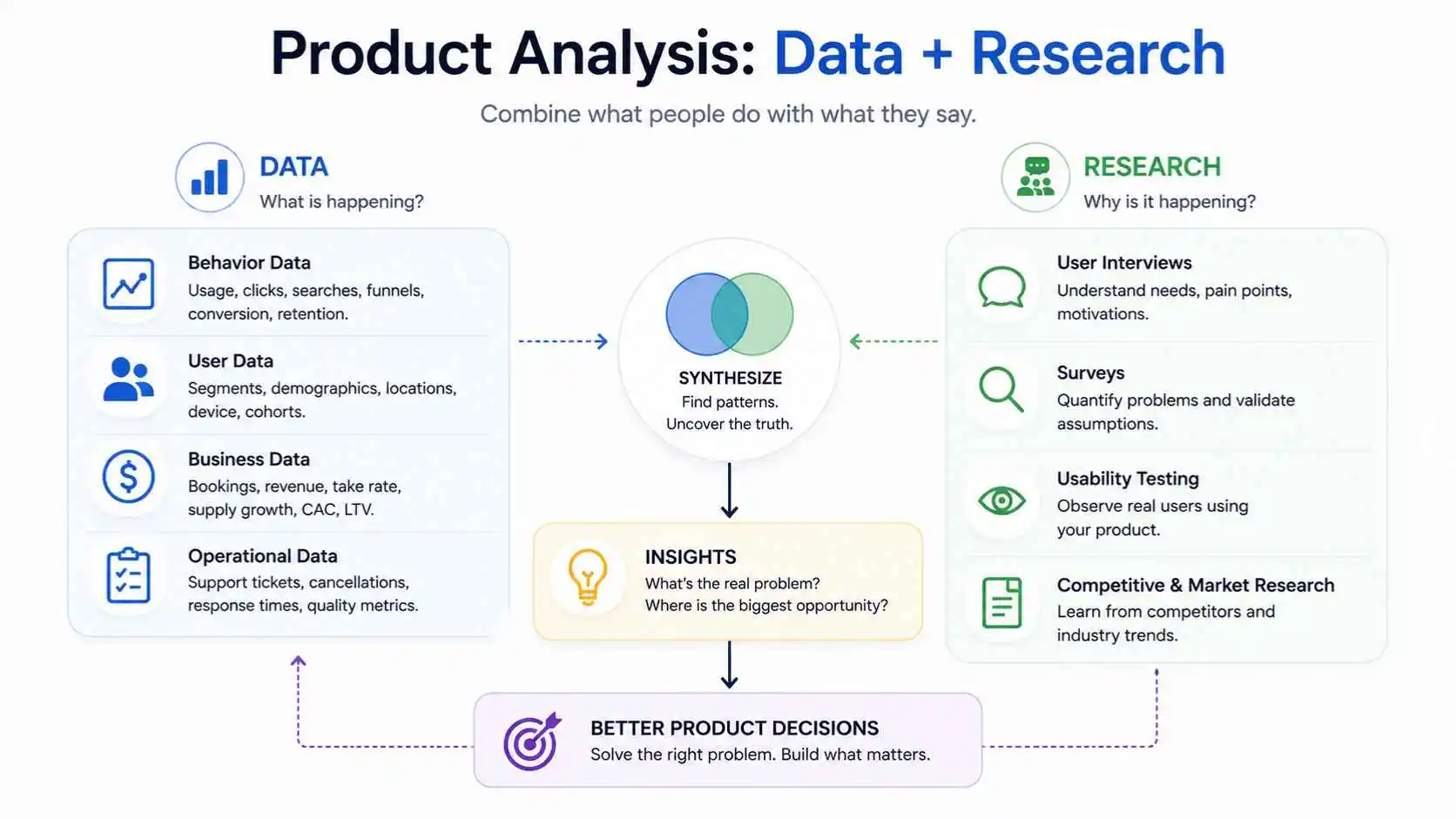
A Product Manager today has access to much richer discovery tools.
Qualitative
- Customer interviews
- Contextual inquiry
- Usability sessions
- Customer support conversations
Quantitative
- Funnel analysis
- Cohort analysis
- Conversion data
- Search behavior
- Cancellation patterns
- Experiment results
Operational
- Host feedback
- Guest complaints
- Support tickets
- Trust and safety incidents
The goal is not to choose qualitative research over data.
The goal is to make the two explain each other.
Data tells me: Where is the problem?
Research helps answer: Why is it happening?
The Deeper Lesson: Customers Do Not Always Describe the Problem
This may be the most transferable lesson from Airbnb.
A host might say:
"I need more bookings."
That is a desired outcome. It does not tell us why bookings are not happening.
The underlying problem could be:
- Poor photos
- Weak descriptions
- Unclear pricing
- Low trust
- Poor location information
- Slow host response
- Weak reviews
- Booking friction
A Product Manager who immediately converts "more bookings" into a feature request is skipping discovery.
"What is preventing the booking today?"
That question creates room for analysis.
What Airbnb Teaches About Product Analysis
Feature Analysis
"Better photos could improve listings."
User Analysis
"Guests need better information to evaluate listings."
Journey Analysis
"Guests need confidence before they commit to an unfamiliar host and home."
Marketplace Analysis
"Trust and information quality influence the conversion between supply and demand."
Product Strategy
"Airbnb needs to build mechanisms that reduce uncertainty throughout the host-guest relationship."
The Product Manager's Decision Framework
When facing an Airbnb-like marketplace problem, I would ask seven questions:
| Question | What It Reveals |
|---|---|
| Where is the customer journey breaking? | Friction |
| What behavior do we want to change? | Desired outcome |
| What evidence shows the problem exists? | Validation |
| What is the likely root cause? | Diagnosis |
| What is the smallest intervention? | Experiment |
| What metric should move? | Measurement |
| If it works, can we scale it? | Product strategy |
This prevents the team from jumping directly from:
Customer complaint → Feature
Instead, the flow becomes:
Final Product Manager Take
The most interesting part of Airbnb's early history is not that the founders discovered a new way to book accommodation.
It is that they were willing to get close enough to customers to discover why their original marketplace was not working as expected.
They went to hosts. They photographed homes. They experienced the product. They looked beyond the interface.
They learned that marketplace growth depended on more than adding inventory.
The experience had to create confidence.
Airbnb itself now describes trust as fundamental to its business, while its later research organization formalized the idea that customer research should be embedded throughout product development rather than used only for late-stage validation.
Customer discovery is not about collecting opinions. It is about reducing uncertainty in product decisions.
The best discovery work does not simply tell you what customers want.
It tells you:
what is actually preventing them from achieving what they want.
That is what changed the Airbnb product.
And that is the difference between collecting feedback and doing product analysis.
Before Turning Customer Feedback Into a Roadmap Item
- What behavior are we trying to change?
- Where exactly does the customer journey break?
- What evidence supports the problem?
- Have we observed customers in context?
- Are customers describing a symptom or a root problem?
- What alternative explanations exist?
- What is the smallest intervention we can test?
- Which metric should change if our hypothesis is correct?
- What did we learn from the experiment?
- Is the solution scalable?
- Does solving this problem strengthen the overall product strategy?
Airbnb Customer Discovery
Sources and Research Notes
This case study uses publicly available information, primarily from Airbnb and Y Combinator.
- Airbnb, "An Important Announcement from Airbnb." The article documents Airbnb's first hosts, the founders' early host-centered approach, door-to-door host visits and personally photographing spaces.
- Airbnb, "What Makes Airbnb, Airbnb." Provides Airbnb's account of its origin, first guests and its emphasis on connection and belonging.
- Airbnb, "Building on Our Commitment to Trust." Describes trust as fundamental to Airbnb's business and explains the company's broader trust strategy.
- Airbnb Design, "From the Ground Up." Describes Airbnb's research culture, embedded research model and use of multiple research methods and data sources.
- Y Combinator, "The Airbnbs." Paul Graham's account of Airbnb during its Y Combinator period and the founders' early approach.
- Y Combinator, "Scaling Product at Airbnb with Joe Gebbia and Reid Hoffman." Discusses doing things that do not scale, photography, ethnographic research, trust and designing the complete travel experience.
Case study classification: Public-product history + Product Management analysis. This is not an account of Airbnb's confidential internal decisions or undocumented metrics.
Do not ask customers only what they want you to build.
Ask what is preventing them from achieving what they are already trying to do.
That is where customer discovery becomes product analysis.