Why Most AI Transformation Programs Struggle
Enterprise leaders are investing billions into AI.
Yet despite executive sponsorship, significant budgets, and access to increasingly powerful models, many AI initiatives struggle to move beyond pilots.
The reason is simple.
Most organizations treat AI as a technology project.
In reality, AI transformation is an enterprise transformation program.
The challenge is not selecting the right model.
The challenge is aligning people, processes, governance, technology, risk management, and business outcomes into a single execution system.
After leading large-scale SaaS, cloud, automation, and AI-enabled programs, I have found that successful AI transformations are rarely technology-led.
They are execution-led.
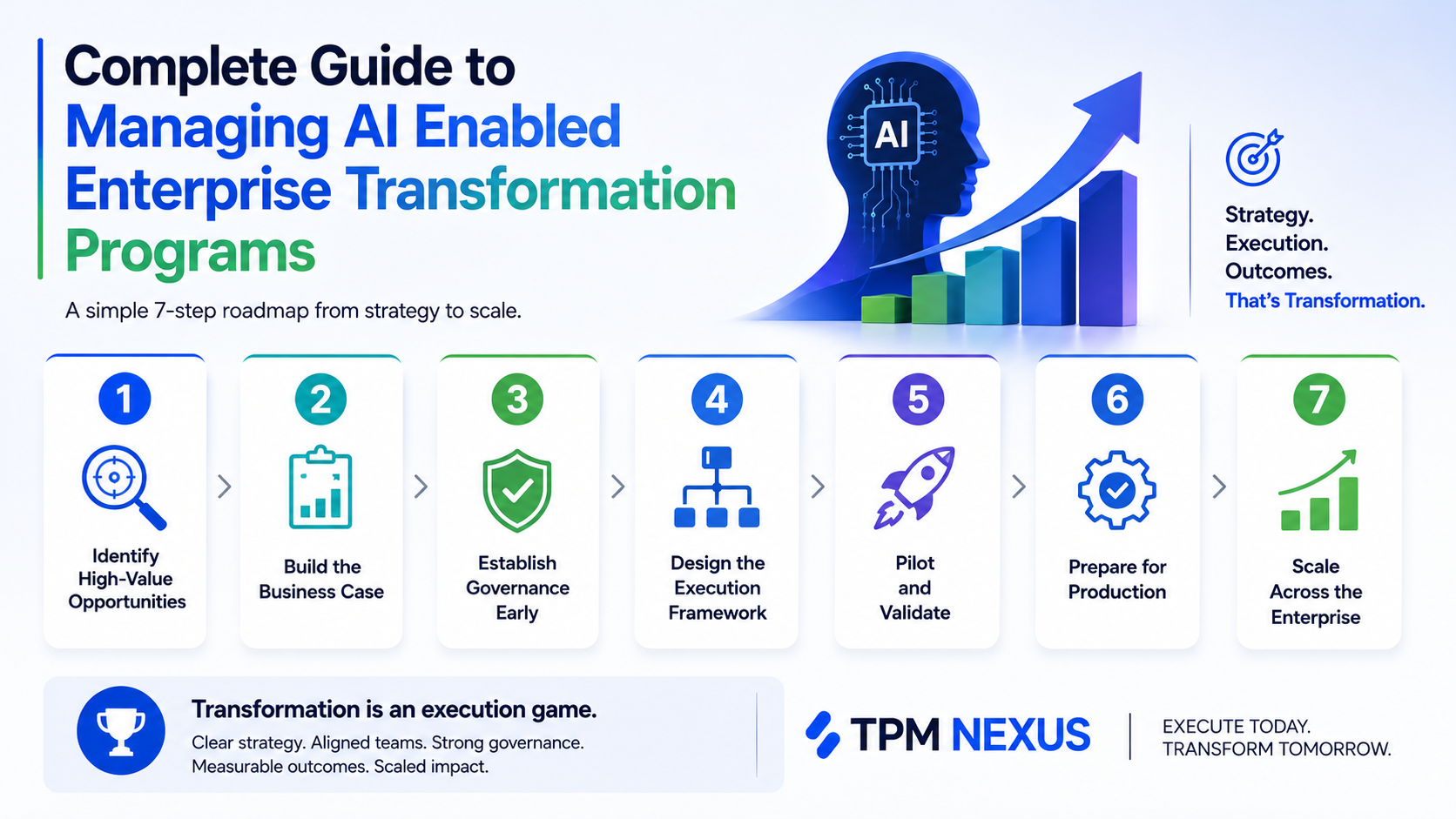
This guide breaks down how to manage AI-enabled enterprise transformation programs from idea to scaled adoption.
Understanding What AI Transformation Really Means
Many organizations define AI transformation as implementing AI tools.
That is only a small part of the journey.
Real AI transformation changes how work gets done.
It impacts:
- Business processes
- Operating models
- Decision making
- Customer experience
- Employee workflows
- Governance structures
- Technology architecture
This is why AI programs typically involve far more stakeholders than traditional software projects.
A single initiative may require coordination between:
- Executive leadership
- Product teams
- Engineering teams
- Data teams
- Security teams
- Legal teams
- Compliance teams
- Operations teams
- Business stakeholders
- External vendors
Managing this complexity becomes the primary responsibility of program leadership.
Phase 1: Identifying High-Value AI Opportunities
The biggest mistake organizations make is starting with technology.
Successful programs start with business problems.
Instead of asking:
“Where can we use AI?”
Ask:
“What business problem are we trying to solve?”
Strong use cases usually target:
Revenue Growth
Examples:
- Personalized recommendations
- Intelligent sales assistance
- Customer segmentation
- Lead qualification
Productivity Improvement
Examples:
- Knowledge management
- Content generation
- Employee support assistants
- Process automation
Cost Reduction
Examples:
- Document processing
- Customer support automation
- Workflow optimization
- Reporting automation
Risk Reduction
Examples:
- Fraud detection
- Compliance monitoring
- Risk assessments
- Security intelligence
The best AI programs begin with measurable business outcomes rather than technology excitement.
Phase 2: Building the Business Case
Many AI initiatives fail because success was never clearly defined.
Before execution begins, establish:
Business Objectives
Examples:
- Reduce manual effort by 40%
- Improve turnaround time by 60%
- Increase conversion by 15%
- Reduce support costs by 25%
Success Metrics
Define:
- Adoption metrics
- Productivity metrics
- Financial metrics
- Operational metrics
- Customer metrics
Investment Requirements
Estimate:
- Technology costs
- Infrastructure costs
- Vendor costs
- Team costs
- Governance costs
AI programs need business accountability from day one.
Phase 3: Governance Before Development
One of the most overlooked aspects of AI transformation is governance.
Most teams focus on models.
Mature organizations focus on control.
Key governance areas include:
Data Governance
Questions to answer:
- What data can be used?
- Who owns the data?
- How is data protected?
- What retention policies exist?
AI Governance
Define:
- Model approval process
- Model monitoring standards
- Human review requirements
- Escalation procedures
Regulatory Governance
Consider:
- GDPR
- Industry regulations
- Intellectual property
- Privacy requirements
Governance should be designed before deployment, not after deployment.
Phase 4: Designing the Execution Framework
This is where TPMs and Program Managers create the foundation for delivery.
Every AI transformation program should define:
Ownership Structure
Clarify:
- Executive sponsor
- Program owner
- Product owner
- Engineering owner
- Operations owner
Without ownership, accountability disappears.
Decision Framework
Define:
- Escalation paths
- Approval authorities
- Risk review processes
- Change management procedures
Dependency Management
Track:
- Team dependencies
- Vendor dependencies
- Infrastructure dependencies
- Governance dependencies
Large programs rarely fail because of engineering.
They fail because dependencies are unmanaged.
Phase 5: Pilot Execution
The purpose of a pilot is learning.
Not proving success.
Good pilots answer:
- Does the use case create value?
- Is the data sufficient?
- Are outputs reliable?
- Can users adopt the solution?
- Can operations support it?
Avoid trying to scale immediately.
Focus on validation.
Pilot success should be measured against predefined business metrics.
Phase 6: Production Readiness
This is where most AI programs fail.
The demo works.
Production does not.
Before launch, evaluate:
Reliability
Can the solution operate consistently?
Monitoring
Can performance degradation be detected?
Cost Management
Can usage costs be controlled?
Security
Can risks be managed?
User Adoption
Will people actually use it?
Support Model
Who handles incidents?
Production readiness is often more important than model quality.
Phase 7: Scaling Across the Enterprise
Scaling introduces new challenges.
What worked for one team may fail across ten teams.
Organizations must standardize:
Governance
Consistent policies.
Architecture
Reusable patterns.
Operations
Common monitoring frameworks.
Security
Unified controls.
Change Management
Consistent adoption strategies.
The goal is moving from isolated pilots to repeatable enterprise capability.
The Critical Role of Program Management
As AI programs grow, execution complexity increases faster than technical complexity.
Program leadership becomes responsible for:
- Stakeholder alignment
- Dependency management
- Risk management
- Governance coordination
- Resource planning
- Executive communication
- Outcome tracking
The strongest AI programs are not led by the best technologists alone.
They are led by teams that combine technology expertise with execution discipline.
Common Reasons AI Transformation Programs Fail
The same patterns appear repeatedly:
- ❌ No clear ownership
- ❌ Undefined business outcomes
- ❌ Weak governance
- ❌ Poor dependency management
- ❌ Lack of adoption planning
- ❌ No production readiness strategy
- ❌ Technology-first thinking
- ❌ Inadequate change management
Most failures are execution failures, not model failures.
Final Thoughts
The future of enterprise AI will not be determined by who has access to the best models.
Access is becoming commoditized.
The differentiator will be execution.
Organizations that build strong governance, clear ownership, measurable outcomes, and repeatable delivery systems will create sustainable competitive advantage.
The rest will remain trapped in an endless cycle of pilots and experimentation.
AI transformation is not a technology journey.
It is an execution journey.
And execution is where winners are created.
About TPM Nexus
TPM Nexus helps professionals and organizations understand the reality of AI execution, enterprise delivery, technical program management, and large-scale transformation.
For more practical insights on AI delivery, governance, program leadership, and enterprise transformation, follow TPM Nexus and subscribe to the newsletter. www.tpmnexus.pro