Walk into any executive meeting discussing AI and you will hear plenty of excitement.
You will hear discussions about large language models, AI agents, automation, copilots, productivity gains, and competitive advantage.
What you will not hear very often is a debate about prompts, embeddings, vector databases, or model architectures.
That is because enterprise leaders are not buying AI. They are buying outcomes. This is one of the biggest disconnects I see in AI transformation programs today.
Delivery teams often focus on technology. Executive leaders focus on business impact. The organizations that successfully scale AI understand the difference.
They know that an AI transformation program is not judged by the sophistication of the technology. It is judged by the value it creates.
The AI Excitement Trap
Over the past few years, organizations have rushed to launch AI initiatives. Many started with pilots. Others created innovation teams. Some invested heavily in new platforms and vendors. The initial excitement was understandable. The technology was impressive. The possibilities seemed endless.
However, something interesting happened when executives started reviewing results. The questions changed.
Instead of asking:
- Which model are we using?
- How many prompts were created?
- What is the architecture?
Leaders started asking:
- What business problem did we solve?
- What value did we create?
- What changed because of this investment?
That shift is important. Because it reveals what executives actually care about.
Expectation #1. Measurable Business Outcomes
The first thing enterprise leaders expect is measurable impact. AI initiatives consume budget, resources, leadership attention, and organizational energy.
Executives want to understand what they are getting in return. The most successful programs connect AI investments directly to outcomes such as:
Revenue Growth
Examples include:
- Increased conversions
- Improved customer retention
- Faster sales cycles
- Better personalization
Productivity Improvements
Examples include:
- Reduced manual effort
- Faster processing times
- Higher employee efficiency
- Improved decision-making speed
Cost Reduction
Examples include:
- Lower operational expenses
- Reduced support costs
- Process automation
- Infrastructure optimization
Risk Reduction
Examples include:
- Improved compliance
- Better fraud detection
- Reduced operational errors
- Stronger governance
The executive conversation almost always returns to one question:
“How is this improving the business?”
If a program cannot answer that clearly, executive confidence begins to decline.
Expectation #2. Predictable Delivery
Many leaders have experienced technology programs that promised transformational outcomes but delivered uncertainty. As a result, predictability matters.
Executives want confidence that:
- Timelines are realistic
- Risks are managed
- Dependencies are understood
- Escalations are handled quickly
- Delivery commitments can be trusted
This is one reason TPMs become so important in AI transformation programs. AI introduces uncertainty naturally. Leadership expects program teams to create predictability despite that uncertainty. The ability to provide confidence often matters as much as the technology itself.
Expectation #3. Responsible AI Governance
Enterprise leaders are excited about AI. They are also concerned about risk.
Questions around privacy, compliance, intellectual property, security, bias, and regulatory requirements are becoming increasingly important.
No executive wants to discover six months later that:
- Sensitive data was exposed
- Compliance controls were ignored
- Governance processes were bypassed
- Regulatory issues were created
This is why governance is no longer optional. Strong leaders expect AI programs to balance innovation with control.
The organizations that scale AI successfully are usually the ones that treat governance as a foundation rather than an obstacle.
Expectation #4. Adoption, Not Just Deployment
One of the most common misconceptions in AI delivery is believing that deployment equals success. It does not.
An AI solution can be technically perfect and still fail. Why?
Because people never use it. Enterprise leaders understand this reality.
They care about:
- User adoption
- Behavioral change
- Business process integration
- Operational effectiveness
If employees continue working the same way they did before the AI solution was introduced, transformation has not occurred.
Technology adoption is ultimately a people challenge. That is why change management becomes a critical part of AI execution.
Expectation #5. Scalability
Most organizations can build a successful pilot. Far fewer can scale one. Executives do not invest in AI to run isolated experiments forever. They expect repeatable enterprise capability.
This means AI solutions must be:
- Secure
- Governed
- Reliable
- Operationally sustainable
- Cost effective
The question eventually becomes:
“Can this scale across the organization?”
Programs that cannot answer that question struggle to secure long-term support.
Expectation #6. Clear Ownership and Accountability
One of the fastest ways to create executive frustration is unclear ownership.
AI initiatives often involve:
- Product teams
- Engineering teams
- Data teams
- Security teams
- Legal teams
- Compliance teams
- Business stakeholders
Without clear accountability, decisions slow down and risks increase.
Enterprise leaders expect clarity around:
- Who owns the outcome?
- Who makes decisions?
- Who manages risk?
- Who is accountable for success?
The more complex the program becomes, the more important ownership becomes.
Expectation #7. Sustainable Competitive Advantage
At the highest level, executives are not investing in AI simply to automate tasks. They are investing because they believe AI can create strategic advantage.
They want to understand:
- How AI strengthens the business
- How it improves customer experience
- How it differentiates the organization
- How it creates long-term value
This is where AI transformation moves beyond technology and becomes a business strategy discussion.
The most successful programs connect daily delivery activities to strategic outcomes.
The Leadership Perspective Most Teams Miss
One lesson I have learned from working with senior leaders is that executives rarely evaluate AI programs through a technical lens. They evaluate AI programs through a business lens, focusing on outcomes rather than model selection.
They wake up thinking about:
- Growth
- Efficiency
- Risk
- Customers
- Competitive advantage
That perspective changes how successful AI programs should be managed. The conversation must move beyond technology and focus on outcomes.
Because ultimately enterprise leaders are not funding AI projects, they are funding business transformation.
Final Thoughts
The organizations winning with AI today are not necessarily the ones with the most advanced models. They are the ones that understand what leadership actually expects.
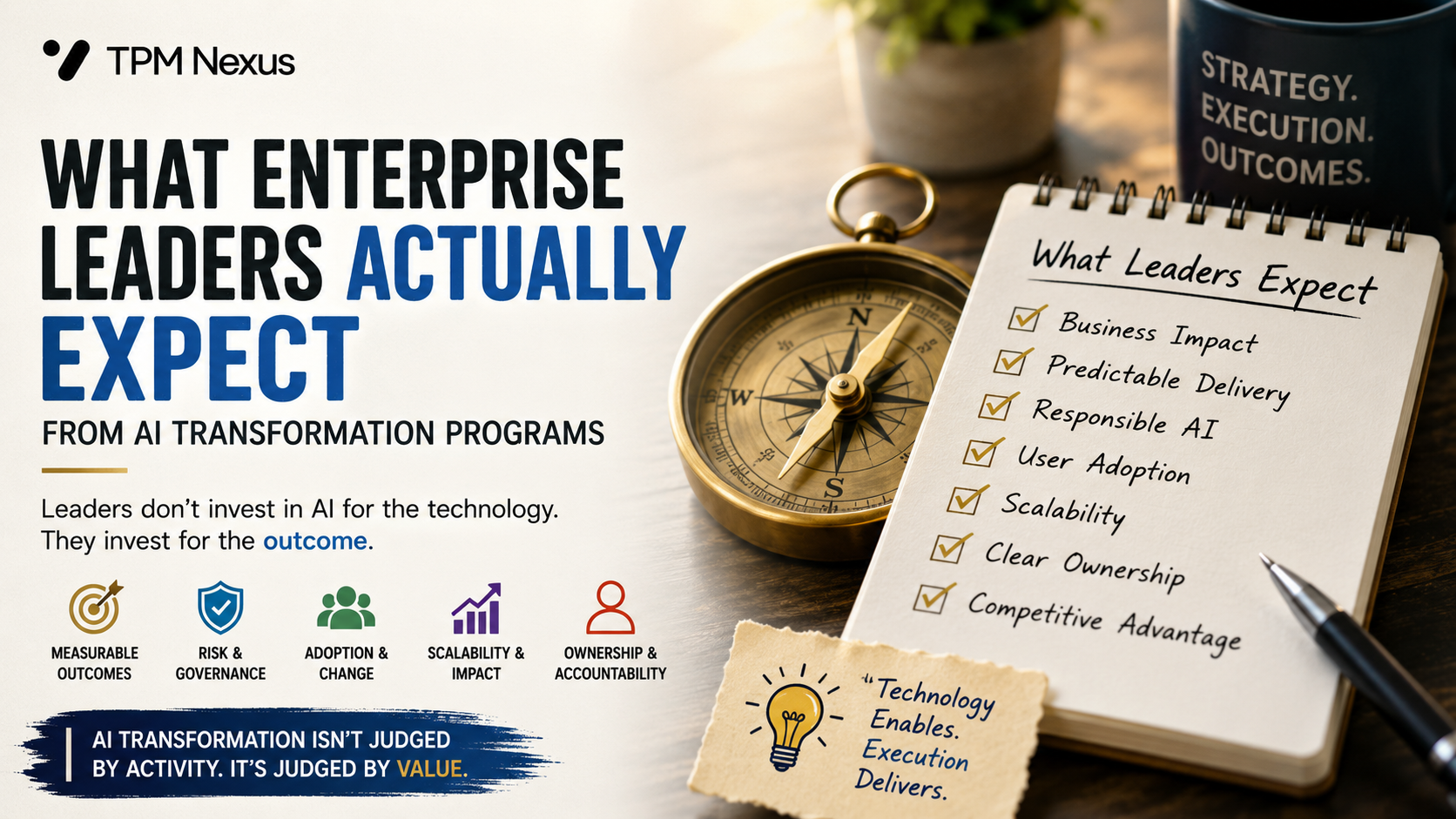
Executives expect:
- Measurable outcomes
- Predictable execution
- Strong governance
- User adoption
- Scalability
- Accountability
- Business value
When AI transformation programs deliver those outcomes, executive sponsorship grows. When they do not, enthusiasm fades quickly.
The future of enterprise AI will belong to organizations that treat AI as a business transformation initiative rather than a technology experiment.
And that starts by understanding what enterprise leaders truly care about.
For more practical insights on AI execution, enterprise transformation, program leadership, and the realities of delivering AI at scale. Visit www.tpmnexus.pro