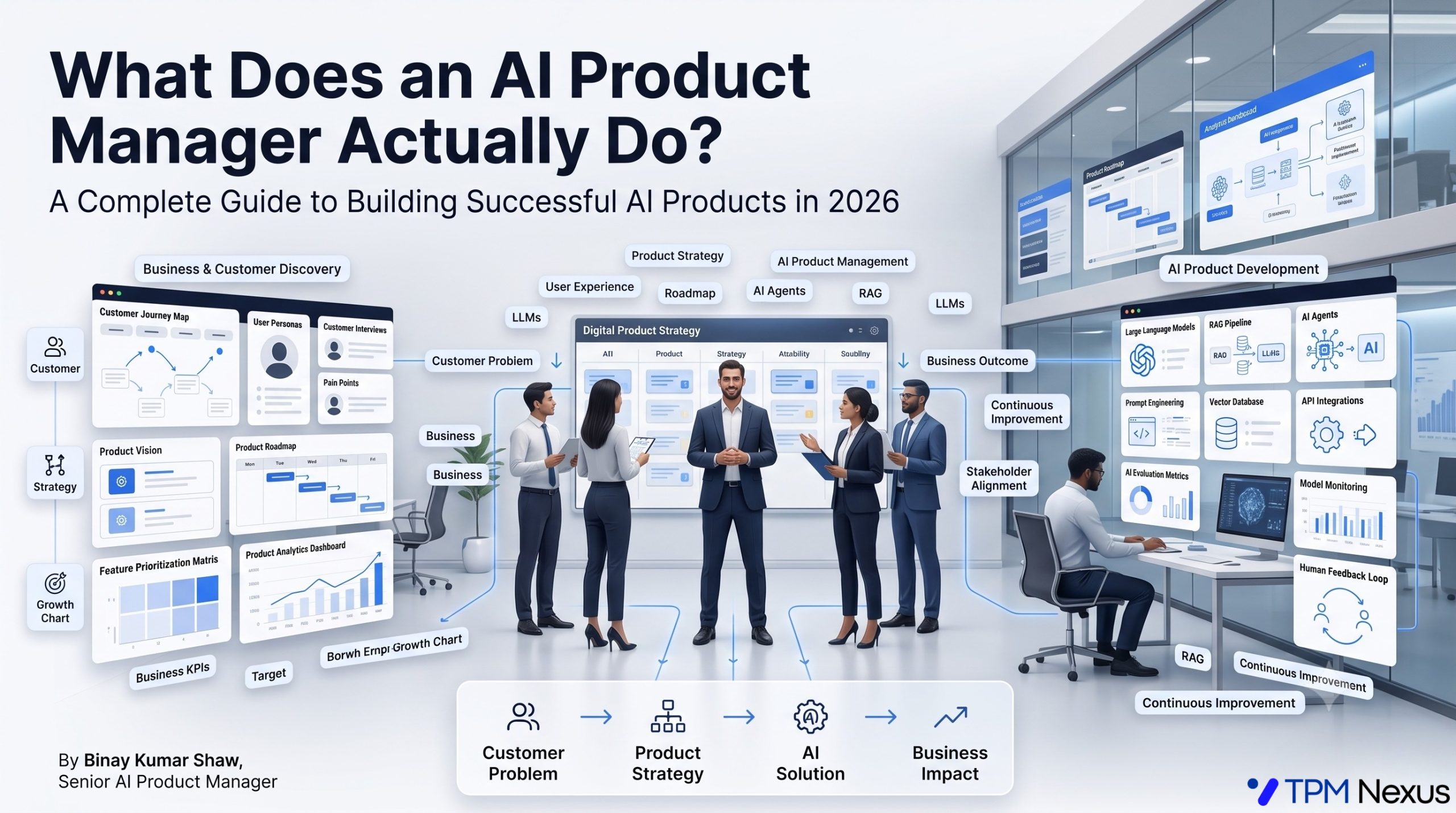
A Complete Guide for 2026
Artificial Intelligence has transformed how software products are designed, built, and delivered. Organizations across every industry are investing in AI to automate workflows, improve customer experiences, and create new business opportunities. As AI adoption grows, so does the demand for professionals who can bridge business strategy, customer needs, and technology.
One role has become central to this transformation: the AI Product Manager.
Yet, despite the growing demand, many people still misunderstand what the role involves.
Some believe AI Product Managers spend their day writing prompts. Others think the job is simply integrating ChatGPT into existing products. While understanding AI is important, that is only a small part of the role.
An AI Product Manager is responsible for identifying valuable problems, defining product strategy, working closely with engineering and design teams, and ensuring AI delivers measurable business outcomes.
In this guide, you will learn what an AI Product Manager actually does, the skills required to succeed, how the role differs from traditional Product Management, and why product thinking matters more than ever in the age of AI.
Who Is an AI Product Manager?
An AI Product Manager is responsible for discovering customer problems and building products that use Artificial Intelligence to solve them effectively.
The role combines three disciplines:
- Product Management
- Business Strategy
- Artificial Intelligence
Unlike Machine Learning Engineers or Data Scientists, AI Product Managers do not build AI models. Instead, they decide where AI creates value, define product requirements, prioritize features, measure success, and ensure AI capabilities align with customer needs and business goals.
Think of an AI Product Manager as the bridge between customers, business stakeholders, designers, engineers, and AI specialists.
Their success is not measured by how advanced the AI model is.
It is measured by the business outcomes the product delivers.
What Does an AI Product Manager Actually Do?
Although responsibilities vary across organizations, most AI Product Managers spend their time across several key areas.
1. Discover Customer Problems
Every successful AI product starts with understanding the customer.
Before discussing models or prompts, AI Product Managers invest time in learning:
- What customers are trying to accomplish
- Where they struggle
- Which tasks are repetitive
- What prevents them from being productive
Without this understanding, AI often becomes an unnecessary feature instead of a meaningful solution.
2. Identify AI Opportunities
Not every problem requires Artificial Intelligence.
One of the most important responsibilities is determining whether AI is the right solution.
Some challenges are better solved through:
- Better user experience
- Workflow automation
- Search improvements
- Process redesign
AI should only be introduced when it creates clear value for users and the business.
3. Define Product Vision and Strategy
Once an opportunity has been identified, the AI Product Manager defines:
- Product vision
- Business objectives
- Success metrics
- Product roadmap
- Priorities
This ensures every AI initiative supports broader business goals rather than becoming an isolated experiment.
4. Write Product Requirements
AI Product Managers convert business problems into clear requirements for engineering teams.
Typical documentation includes:
- Product Requirement Documents (PRDs)
- User stories
- Acceptance criteria
- Functional requirements
- AI behavior expectations
- Success metrics
Clear documentation reduces ambiguity and accelerates execution.
5. Collaborate Across Teams
Building AI products requires collaboration across multiple functions.
An AI Product Manager regularly works with:
- Engineering
- UX Design
- AI Engineers
- Data Scientists
- QA
- Legal
- Security
- Sales
- Customer Success
- Executive Leadership
Success depends on aligning all stakeholders around a common product vision.
6. Prioritize Features
Every organization has more ideas than resources.
AI Product Managers constantly evaluate features based on:
- Customer value
- Business impact
- Engineering effort
- Technical feasibility
- Cost
- Risk
The goal is not to build more features.
The goal is to build the right features.
7. Define AI Behavior
Unlike traditional software, AI products produce probabilistic outputs.
An AI Product Manager helps define:
- Expected responses
- Prompt strategy
- Human review points
- Guardrails
- Error handling
- Feedback mechanisms
This ensures AI behaves consistently and earns user trust.
8. Measure Product Success
Launching an AI feature is only the beginning.
AI Product Managers continuously monitor performance using metrics such as:
- User adoption
- Customer satisfaction
- Time saved
- Task completion rate
- Revenue impact
- Cost per request
- AI response quality
- Retention
These insights drive future product decisions.
9. Continuously Improve the Product
Unlike traditional software, AI products improve through continuous learning.
AI Product Managers analyze:
- Customer feedback
- Failed responses
- Prompt effectiveness
- Usage patterns
- Edge cases
- Business metrics
Every release creates new opportunities to improve the product.
Essential Skills Every AI Product Manager Needs
Being successful requires much more than understanding AI.
Product Skills
- Customer Discovery
- Product Strategy
- Roadmap Planning
- Prioritization
- PRD Writing
- Product Analytics
- User Research
AI Knowledge
- Large Language Models
- Retrieval Augmented Generation (RAG)
- AI Agents
- Prompt Engineering
- AI Evaluation
- Context Windows
- Model Selection
Technical Skills
- APIs
- System Design
- Cloud Platforms
- Authentication
- Data Flow
- Enterprise Integrations
Technical depth helps Product Managers make better decisions without writing production code.
Business Skills
- Market Research
- Pricing
- Competitive Analysis
- Go to Market Strategy
- ROI Analysis
Leadership Skills
- Stakeholder Management
- Executive Communication
- Cross Functional Collaboration
- Decision Making
- Negotiation
AI Product Manager vs Traditional Product Manager
| Traditional Product Manager | AI Product Manager |
|---|---|
| Focuses on software products | Focuses on AI enabled products |
| Defines product requirements | Defines product and AI behavior |
| Works primarily with engineering | Works with engineering and AI specialists |
| Measures product metrics | Measures both product and AI performance |
| Predictable software behavior | Probabilistic AI behavior |
| Feature delivery | Continuous AI improvement |
The core responsibilities remain similar, but AI Product Managers must understand the unique challenges of AI systems, including reliability, hallucinations, latency, cost, and trust.
Common Misconceptions
Many people misunderstand the role.
Here are some common myths.
Myth: AI Product Managers build machine learning models.
Reality: They define the product strategy while engineers build the models.
Myth: The role is mostly prompt engineering.
Reality: Prompt engineering is one small part of delivering an AI product.
Myth: Every product needs AI.
Reality: AI should only be used when it creates measurable customer value.
Myth: Choosing the best model guarantees success.
Reality: Customer understanding, product design, and execution matter far more than the choice of model.
Why Companies Are Hiring AI Product Managers
Organizations are rapidly investing in AI, but technology alone is not enough.
Companies need professionals who can answer questions such as:
- Which customer problems should AI solve?
- Which workflows should remain human driven?
- How should success be measured?
- Which AI model best fits the business?
- How should AI integrate into existing products?
These decisions directly impact adoption, customer satisfaction, and return on investment.
That is why experienced AI Product Managers have become one of the most valuable roles in modern product organizations.
Final Thoughts
AI Product Management is not about adding ChatGPT to a product.
- It is not about using the newest Large Language Model.
- It is not about building AI for the sake of innovation.
- It is about understanding customers, solving meaningful problems, and delivering measurable business outcomes.
The best AI Product Managers combine product thinking, business strategy, technical understanding, and leadership to build products that people trust and use every day.
As AI continues to evolve, the tools will change.
The fundamentals of great Product Management will not.
If you want to build successful AI products, start with the customer.
Everything else follows from there.
Continue Learning with TPM Nexus
If you are preparing for a career in AI Product Management, explore more practical resources on TPM Nexus, including:
- AI Product Management Foundations Newsletter
- AI Product Manager Interview Guides
- AI Product Manager Toolkit
- Product Strategy Templates
- PRD Templates
- AI Product Management Learning Roadmap
Build products that solve real problems, not just products that use AI.





1 thought on “What Does an AI Product Manager Actually Do?”