Every Great Product Begins With a Conversation, Not Code
In 2008, three founders in San Francisco had an unusual idea.
People would pay to sleep on an air mattress in a stranger’s apartment.
On paper, it sounded ridiculous.
Most investors thought so too.
But the founders didn’t start by building a sophisticated platform. They started by talking to travelers who couldn’t find affordable accommodation during conferences. They hosted guests in their own apartment, listened to every complaint, observed every interaction, and refined the experience one conversation at a time.
That company became Airbnb.
The lesson isn’t that every startup should copy Airbnb.
The lesson is that great products don’t begin with brilliant ideas—they begin with understanding real customer problems.
Yet many Product Managers still skip this step.
A stakeholder requests a feature.
Someone suggests adding AI.
A roadmap is created.
Development begins.
Months later, the product launches… and customers barely use it.
The issue usually isn’t poor execution. It’s poor discovery.
The most successful Product Managers spend less time asking, “What should we build?” and more time asking, “What problem is worth solving?”
That’s where Customer Discovery begins.
What Is Customer Discovery?
Customer Discovery is the structured process of understanding your customers before deciding what to build.
It helps answer questions like:
- Who has the problem?
- How are they solving it today?
- Why is the current solution frustrating?
- How often does the problem occur?
- Is it important enough for customers to change their behavior?
Notice something important.
None of these questions are about features.
They’re about people.
That’s because customers don’t buy features.
They buy better outcomes.
Customer Discovery vs. Product Discovery
These two terms are often used interchangeably, but they serve different purposes.
| Customer Discovery | Product Discovery |
|---|---|
| Validates the problem | Validates the solution |
| Focuses on customers | Focuses on the product |
| Answers “Why?” | Answers “How?” |
| Happens first | Happens second |
Think of it as a simple sequence:
Customer Discovery
↓
Understand the problem
↓
Product Discovery
↓
Validate the solution
↓
Product Development
Skipping the first step often leads to beautifully built products that nobody needs.
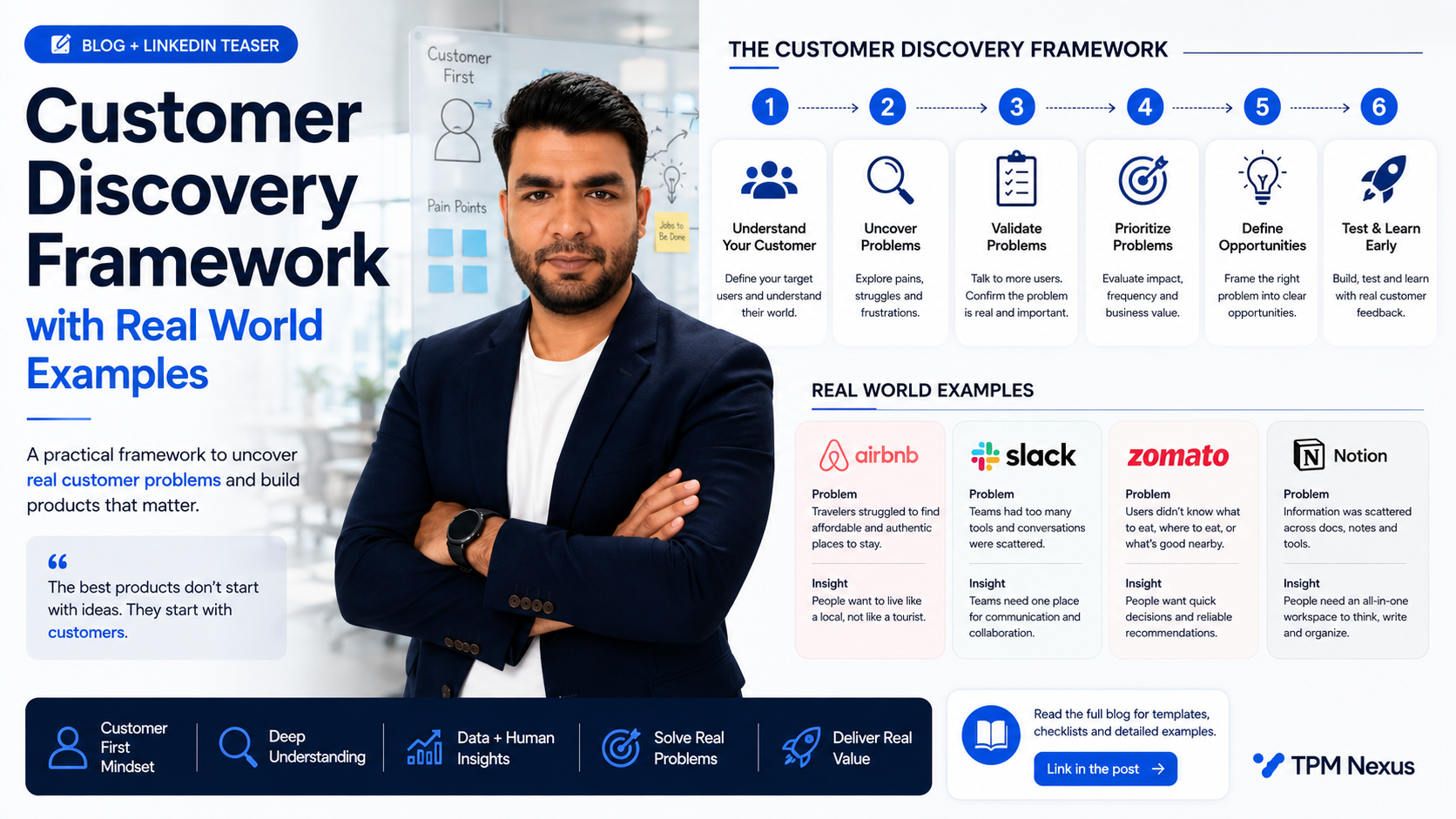
A Practical 6-Step Customer Discovery Framework
Step 1: Define Your Customer
Many products fail because teams try to solve problems for “everyone.”
That’s impossible.
Instead, identify one specific customer segment.
For example:
Instead of:
“Small businesses.”
Define:
“Travel agencies with 5–20 employees managing customized international itineraries.”
The narrower your audience, the clearer the insights.
Step 2: Understand Their Goals
Customers rarely want your product.
They want what your product helps them achieve.
A project manager doesn’t want another dashboard.
They want better visibility.
A recruiter doesn’t want AI.
They want to hire faster.
An operations manager doesn’t want automation.
They want fewer manual tasks.
Understanding the desired outcome is more valuable than collecting feature requests.
Step 3: Identify Real Pain Points
Now it’s time to gather evidence.
Some of the best discovery methods include:
- Customer interviews
- Product analytics
- Customer support tickets
- Sales call recordings
- User observation
- Product reviews
- Community forums
- Beta feedback
Don’t rely on a single source.
Patterns across multiple sources reveal the biggest opportunities.
Step 4: Validate the Problem
Not every complaint deserves a roadmap item.
Ask questions like:
- How frequently does this happen?
- How much time or money does it cost?
- How are customers solving it today?
- What happens if the problem isn’t solved?
If customers have already built spreadsheets, manual workflows, or workarounds, you’ve likely found a meaningful problem.
Step 5: Test Before Building
Avoid expensive assumptions.
Instead of building the final product, validate your ideas using:
- Wireframes
- Clickable prototypes
- Landing pages
- Fake door tests
- Concierge MVPs
The goal isn’t to prove your idea is right.
The goal is to learn quickly and cheaply.
Step 6: Prioritize Based on Evidence
By this stage, you’ll have multiple opportunities.
Don’t prioritize based on the loudest stakeholder.
Prioritize using evidence.
Consider:
- Customer impact
- Business value
- Technical effort
- Strategic alignment
- Confidence level
Great Product Managers don’t chase every request.
They solve the most valuable problems first.
Real-World Example 1: Uber
Before Uber, finding a taxi in many cities was frustrating.
Customers weren’t asking for another taxi company.
They were asking for:
- Reliability
- Transparency
- Convenience
- Faster pickups
Uber didn’t invent transportation.
It solved the frustration around accessing it.
That’s Customer Discovery in action.
Real-World Example 2: Slack
Slack wasn’t originally built as a messaging platform.
It started as an internal communication tool for a gaming company.
The game failed.
But the team noticed something interesting.
Their communication tool solved a bigger problem than the game itself.
By observing how people collaborated, they discovered an opportunity that became Slack.
Sometimes your biggest product isn’t the one you planned.
It’s the one customers naturally adopt.
Real-World Example 3: Spotify
Music streaming existed before Spotify.
The problem wasn’t access to music.
The problem was convenience.
People wanted instant access across devices without downloading songs or managing files.
Spotify discovered that customers valued simplicity over ownership.
That insight transformed an industry.
Common Customer Discovery Mistakes
Asking Leading Questions
Don’t ask:
“Would you like an AI assistant?”
Ask:
“Tell me about the last time this process frustrated you.”
Falling in Love With Solutions
Customers describe problems.
Product Managers design solutions.
When customers begin prescribing features, keep digging until you understand the underlying need.
Interviewing Only Happy Customers
Satisfied users provide valuable feedback.
Former customers often provide even better insights.
They tell you why they left.
Ignoring Data
Interviews explain why.
Analytics explain what.
Use both.
One without the other creates blind spots.
Customer Discovery in the AI Era
Today, many organizations begin product discussions with one question:
“How can we use AI?”
I believe that’s the wrong starting point.
Instead, ask:
“Where are customers struggling?”
Only after identifying a meaningful problem should AI become part of the conversation.
AI is an incredibly powerful capability.
But capability alone isn’t strategy.
Customers don’t care whether your solution uses GPT, Claude, Gemini, or another model.
They care whether it saves them time, reduces effort, improves decisions, or helps them achieve their goals.
Technology should support the solution—not become the solution.
Final Thoughts
The best Product Managers aren’t recognized because they build the most features.
They’re recognized because they consistently identify the right problems before anyone else.
Customer Discovery isn’t a one-time workshop or a checklist completed before development begins.
It’s a mindset.
It requires curiosity, empathy, observation, and a willingness to challenge assumptions.
Before your next roadmap meeting, AI initiative, or feature discussion, pause and ask one simple question:
“Do we truly understand the customer’s problem?”
Because when you understand the problem deeply, building the right product becomes dramatically easier.
And that’s what separates good Product Managers from great ones.
About the Author
Binay Kumar Shaw is a Senior AI Product Manager with 16+ years of experience building enterprise SaaS, cloud, and AI-powered products. He writes about AI Product Management, Product Strategy, Customer Discovery, and building products that solve real business problems.