A Practical Guide to Building Products That Create Lasting Business Value
Introduction
Every successful product begins with a strategy.
Yet, “strategy” is one of the most misunderstood terms in Product Management.
I’ve been in roadmap discussions where teams spent hours debating features without first agreeing on the customer problem they were trying to solve. I’ve also seen organizations build impressive products that failed to gain adoption because their strategy was driven by internal assumptions rather than customer needs.
A roadmap is not a strategy.
A backlog is not a strategy.
A collection of features is certainly not a strategy.
A product strategy is a set of deliberate choices that define how a product will create value for customers while achieving business objectives.
Without it, teams become busy instead of effective.
This framework has helped me think through product decisions more consistently, especially when building AI powered enterprise products where opportunities are endless but resources are always limited.
What Is Product Strategy?
Product strategy is the bridge between your product vision and product execution.
It answers one simple question:
How will we achieve our product vision?
A strong strategy provides direction.
It helps teams decide:
- Which problems to solve
- Which customers to serve
- Which opportunities to prioritize
- Which ideas to reject
- How success will be measured
The most important part is often what you choose not to do.
Strategy is about focus.
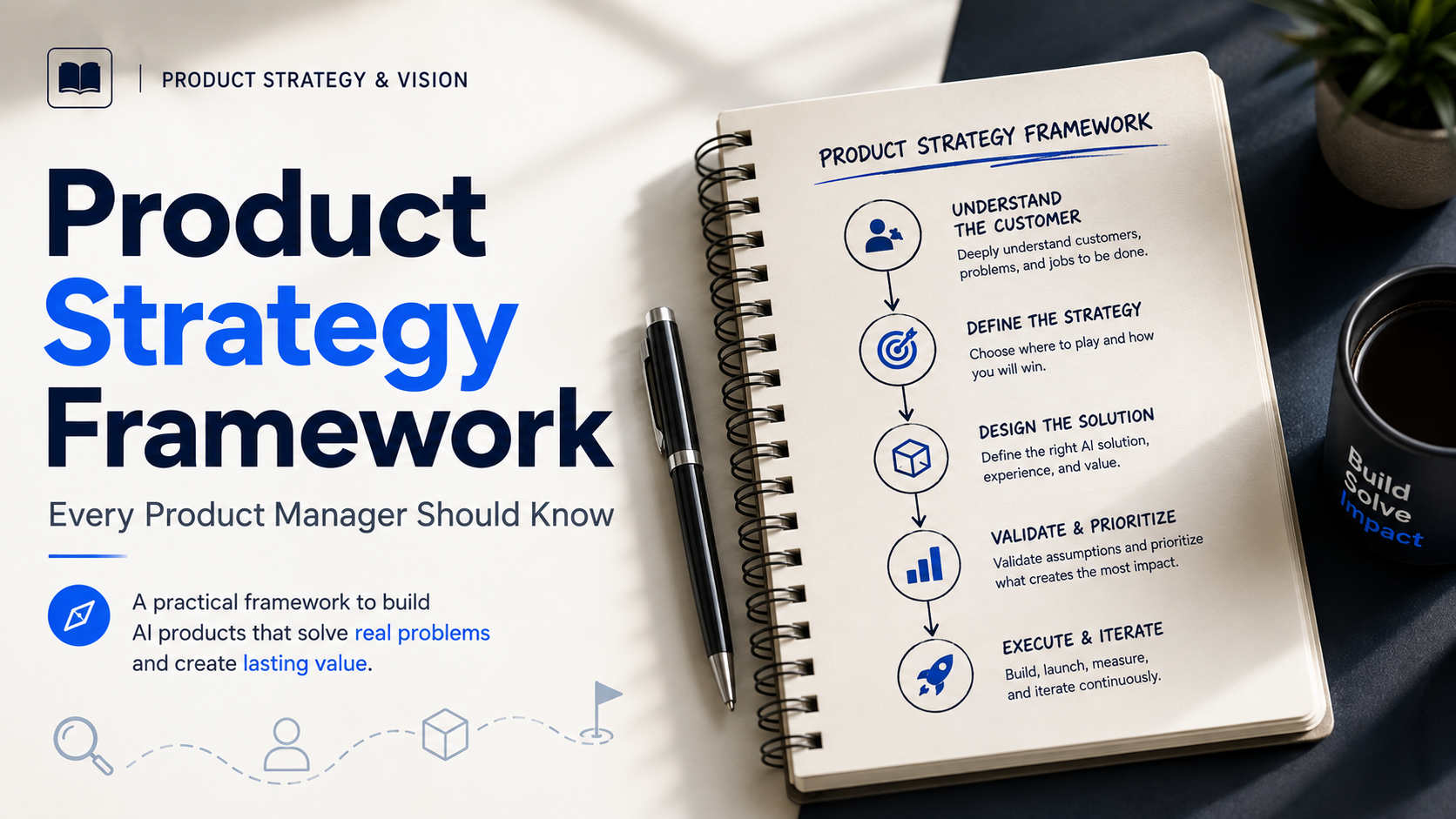
The Product Strategy Framework
Step 1. Start with the Customer Problem
Every product strategy should begin with understanding the customer.
Ask questions like:
- Who is experiencing the problem?
- How are they solving it today?
- What frustrates them?
- Why does this problem matter?
Avoid beginning with technology or feature ideas.
Customers care about outcomes, not implementations.
Step 2. Define the Product Vision
Once the problem is clear, define the future you want to create.
A strong product vision should be:
- Clear
- Inspiring
- Customer focused
- Long term
For example:
“Help enterprise sales teams spend less time on administrative work and more time building customer relationships.”
A vision should guide decisions for years, not quarters.
Step 3. Identify the Opportunity
Not every problem deserves a product investment.
Evaluate opportunities by asking:
- How large is the problem?
- How many customers experience it?
- What is the business impact?
- Is the market growing?
- Can we differentiate?
This helps separate interesting ideas from valuable opportunities.
Step 4. Make Strategic Choices
Every strategy involves trade offs.
You cannot build everything.
Decide:
- Which customer segments to prioritize
- Which problems to solve first
- Which features to delay
- Which markets to ignore
- Which opportunities create the greatest value
Good strategy is as much about saying no as it is about saying yes.
Step 5. Validate Before Investing
Before committing engineering resources, validate assumptions.
Use:
- Customer interviews
- Prototypes
- MVPs
- Usability testing
- Small experiments
Validation reduces risk and prevents expensive mistakes.
Step 6. Build the Roadmap
Only after strategy is defined should the roadmap be created.
The roadmap translates strategic decisions into execution.
Every roadmap item should support one or more strategic objectives.
If a feature cannot be connected back to the strategy, it deserves another review.
Step 7. Measure Outcomes
Product strategy doesn’t end at launch.
Measure whether the strategy is working.
Track metrics such as:
- Customer adoption
- User engagement
- Retention
- Customer satisfaction
- Revenue growth
- Time saved
- Business efficiency
These metrics determine whether your strategic choices created real value.
A Real-World Example
Imagine you’re building an AI assistant for customer support.
A feature driven approach might ask:
“What AI features can we add?”
A strategy driven approach asks:
- Why do customers contact support?
- Which issues consume the most agent time?
- Where do customers experience delays?
- Which interactions can AI improve without reducing trust?
Those questions lead to a completely different product.
Instead of adding AI everywhere, you introduce it where it delivers measurable value.
That’s the difference between building AI features and building AI products.
Common Product Strategy Mistakes
Confusing Vision with Strategy
Vision defines the destination.
Strategy defines the path.
Prioritizing Stakeholder Opinions Over Customer Needs
The loudest request is not always the most valuable.
Evidence should guide decisions.
Building Features Without Validation
Ideas are cheap.
Validation is what creates confidence.
Chasing Competitors
Competitors influence strategy.
They should never define it.
Focus on customer problems, not competitor feature lists.
Measuring Output Instead of Outcomes
Shipping more features doesn’t automatically create more value.
Measure customer and business impact instead.
A Simple Framework to Remember
Whenever I’m reviewing a product strategy, I mentally walk through this sequence:
Customer Problem
↓
Product Vision
↓
Opportunity Assessment
↓
Strategic Choices
↓
Validation
↓
Roadmap
↓
Execution
↓
Measurement
Each step builds on the previous one.
Skipping one usually creates problems later.
Final Thoughts
Technology changes.
Markets evolve.
Customer expectations continue to rise.
But one principle remains constant.
Great Product Managers don’t win by building the most features.
They win by making better decisions.
A strong product strategy provides clarity when priorities compete, resources are limited, and opportunities seem endless.
It keeps teams focused on solving meaningful customer problems instead of chasing every new idea.
Before your next roadmap planning session, ask one question:
“Are we making strategic choices, or are we simply choosing features?”
The answer often determines whether you’re building a successful product or just shipping more functionality.
If you’re building a career in Product Management or AI Product Management, explore more practical guides on TPM Nexus, where I share frameworks, lessons, and real-world insights from building enterprise SaaS and AI powered products.