How Product Managers can make better roadmap decisions when everything seems important
One of the hardest Product Management decisions is not deciding what to build.
It is deciding what not to build.
Every product team has more ideas than capacity.
Customers request features. Sales wants commitments. Engineering has technical improvements. Leadership has strategic initiatives. Competitors launch something new. And now AI creates an entirely new category of opportunities.
Everything can sound important.
But your team cannot build everything.
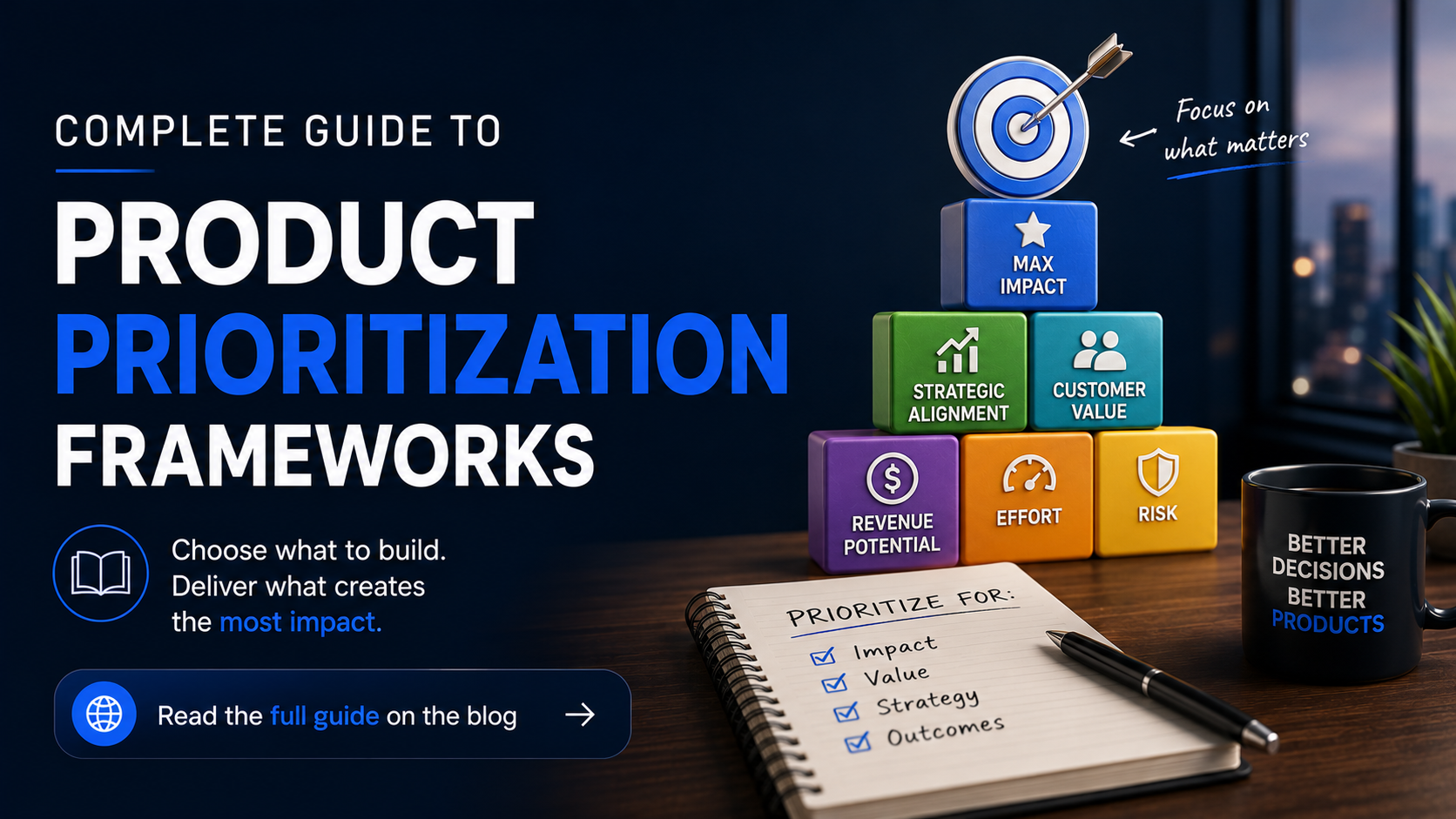
That is why prioritization is not simply a backlog exercise. It is a strategic decision about where limited resources should create the greatest customer and business value.
The right prioritization framework can bring structure to that decision.
But there is one important point to remember:
No prioritization framework is universally best.
The right framework depends on the decision you are trying to make.
What Is Product Prioritization?
Product prioritization is the process of deciding which problems, opportunities, features, or initiatives should receive resources first.
A good prioritization decision considers more than customer demand.
It can include:
- Customer value
- Business impact
- Strategic alignment
- Market opportunity
- Engineering effort
- Risk
- Confidence in the underlying evidence
- Opportunity cost
The goal is not to create the longest possible list of prioritized features.
The goal is to create focus.
Why Product Prioritization Is Difficult
Imagine you have 50 potential initiatives and capacity to deliver only 10.
There is no mathematical formula that can completely solve that problem.
Some initiatives may have high customer value but require significant engineering investment.
Others may be easy to build but have limited impact.
Some may support the long-term strategy while producing little immediate revenue.
Others may generate quick business results but distract the team from the product vision.
This is where Product Management judgment becomes important.
Frameworks help organize the decision.
They do not replace judgment.
1. RICE Framework
RICE is one of the most useful frameworks for comparing multiple product opportunities. The acronym represents Reach × Impact × Confidence ÷ Effort.
Reach
How many customers or users will be affected during a specific period?
Impact
How significantly will the initiative affect those users?
Confidence
How confident are you in your Reach, Impact, and Effort estimates?
Effort
How much engineering, design, product, or operational effort is required?
When should you use RICE?
RICE works well when:
- You have many competing opportunities
- You have reasonable access to data
- You need a structured ranking
- Several initiatives have similar strategic importance
Example
Suppose you are evaluating three initiatives:
| Initiative | Reach | Impact | Confidence | Effort |
|---|---|---|---|---|
| AI Email Summary | 8 | 3 | 80% | 4 |
| New Dashboard | 5 | 2 | 90% | 3 |
| Workflow Automation | 6 | 3 | 70% | 5 |
RICE helps create a more consistent comparison rather than relying entirely on stakeholder opinions.
Best question for RICE:
Which opportunity should we prioritize?
2. MoSCoW Prioritization
MoSCoW is particularly useful when defining scope for a release or project.
It divides requirements into four categories:
Must Have
Critical for the release.
Without these requirements, the release does not achieve its objective.
Should Have
Important, but the product can still function without them.
Could Have
Useful enhancements that can be included if capacity allows.
Won’t Have
Explicitly excluded from the current scope.
This last category is important.
It creates clarity around what the team has deliberately decided not to build right now.
When should you use MoSCoW?
Use it when:
- Release scope needs to be defined
- Teams have limited capacity
- Stakeholders need clear expectations
- You need to separate essential requirements from optional ones
Best question for MoSCoW:
What must we deliver for this release to succeed?
3. Kano Model
Kano approaches prioritization from the perspective of customer satisfaction.
It helps Product Managers understand how different capabilities influence the customer experience.
The model typically considers:
Basic Needs
Customers expect these capabilities.
When they are missing, customers become dissatisfied.
When they are present, customers may not be particularly impressed because they consider them normal.
Performance Needs
The better you perform on these attributes, the more customer satisfaction generally increases.
Delighters
Customers may not expect these capabilities, but they can create significant satisfaction when introduced.
This makes Kano particularly useful during product discovery and customer research.
Best question for Kano:
Which capabilities will customers expect, value, or find delightful?
4. Value vs Effort
Sometimes you do not need a complex scoring system.
You need a quick conversation.
That’s where Value vs Effort works well.
Plot initiatives on a simple two-axis matrix:
Value
vs.
Effort
This creates four broad categories.
High Value + Low Effort
Quick Wins
These are often attractive opportunities.
High Value + High Effort
Strategic Bets
These may require significant investment but can create substantial value.
Low Value + Low Effort
Fill-ins
Useful when capacity exists, but usually not strategic priorities.
Low Value + High Effort
Avoid
These initiatives consume significant resources without enough expected value.
When should you use it?
Use Value vs Effort when:
- You need a fast prioritization exercise
- The team is early in discovery
- Detailed data is unavailable
- You are facilitating a workshop
Best question:
Which initiatives provide the best balance between value and effort?
5. Weighted Scoring
Weighted scoring is useful when your organization has several strategic criteria that matter.
For example, you might score every opportunity against:
- Customer impact
- Revenue potential
- Strategic alignment
- Market opportunity
- Risk reduction
- Engineering effort
You then assign different weights to each criterion.
For example, strategic alignment may receive more weight than implementation effort if the organization is focused on a major strategic shift.
The advantage is flexibility.
You can create a model that reflects your company’s specific priorities.
The risk is false precision.
A score of 82 versus 78 does not necessarily mean the first initiative is objectively better.
The quality of the decision still depends on the quality of your assumptions.
6. WSJF
Weighted Shortest Job First, or WSJF, is commonly associated with scaled Agile environments.
It focuses on economic prioritization by considering factors such as:
- Business value
- Time criticality
- Risk reduction or opportunity enablement
- Job size
The basic idea is straightforward.
An initiative that delivers significant value quickly may deserve priority over a large initiative that takes much longer to deliver.
WSJF can be useful when organizations have many initiatives competing for delivery capacity.
Best question:
Which work should we do first to maximize economic value over time?
Which Framework Should You Use?
There is no single answer.
| Situation | Useful Framework |
|---|---|
| Compare many opportunities | RICE |
| Define release scope | MoSCoW |
| Understand customer expectations | Kano |
| Quick prioritization workshop | Value vs Effort |
| Organization-specific criteria | Weighted Scoring |
| Optimize economic sequencing | WSJF |
The important part is matching the framework to the decision.
Frameworks Are Not the Strategy
This is where Product Managers sometimes go wrong.
A team calculates RICE scores and assumes the highest score automatically wins.
That is dangerous.
Imagine an initiative scores highly because it affects many users but has weak strategic alignment.
Another initiative affects fewer users but is critical to the company’s long-term product strategy.
The framework cannot make that strategic decision for you.
You need Product Management judgment.
I prefer to think about prioritization through five questions:
1. Does it solve a meaningful customer problem?
2. Does it support our product strategy?
3. What business outcome can it influence?
4. How strong is our evidence?
5. What are we giving up by choosing it?
That last question is particularly important.
Every yes has an opportunity cost.
Prioritization in AI Product Management
AI has made prioritization even more challenging.
There are endless opportunities:
- AI assistants
- AI agents
- Automated workflows
- Generative AI
- RAG
- Predictive capabilities
- Personalization
- Intelligent recommendations
The technology can make almost anything look possible.
But possibility is not the same as priority.
Instead of asking:
“Where can we add AI?”
Ask:
“Where can AI create meaningful customer or business value?”
For example, an AI assistant that saves a customer two minutes once a month may be less valuable than workflow automation that saves employees 30 minutes every day.
The technology may be more impressive in the first example.
The business value may be much greater in the second.
That distinction matters.
A Practical Prioritization Process
A simple process I use is:
Step 1. Define the problem
Understand what you are actually trying to solve.
Step 2. Define the desired outcome
What should improve if you solve it?
Step 3. Gather evidence
Use customer research, analytics, experiments, and business data.
Step 4. Select an appropriate framework
Choose RICE, MoSCoW, Kano, Value vs Effort, or another method based on the decision.
Step 5. Make the trade-offs explicit
Discuss what gets delayed or rejected.
Step 6. Review strategic alignment
Make sure the priority supports the product vision and strategy.
Step 7. Measure the outcome
After delivery, determine whether the investment actually created value.
This last step closes the loop.
Prioritization should learn from outcomes.
Final Thoughts
Product prioritization is not about finding a perfect formula.
It is about making better decisions with imperfect information.
Frameworks provide structure.
Customer evidence provides context.
Business strategy provides direction.
And Product Management judgment brings everything together.
The best Product Managers do not ask:
“Which framework should we use?”
They ask:
“What decision are we trying to make, and what is the best way to make it?”
Because a prioritization framework should never become a substitute for product thinking.
It should make product thinking better.
The goal is not to build more. The goal is to build what matters most.
Want to build better products with a clear, practical product strategy?
Explore more Product Management frameworks, AI Product Management insights, and practical guides at TPM Nexus.