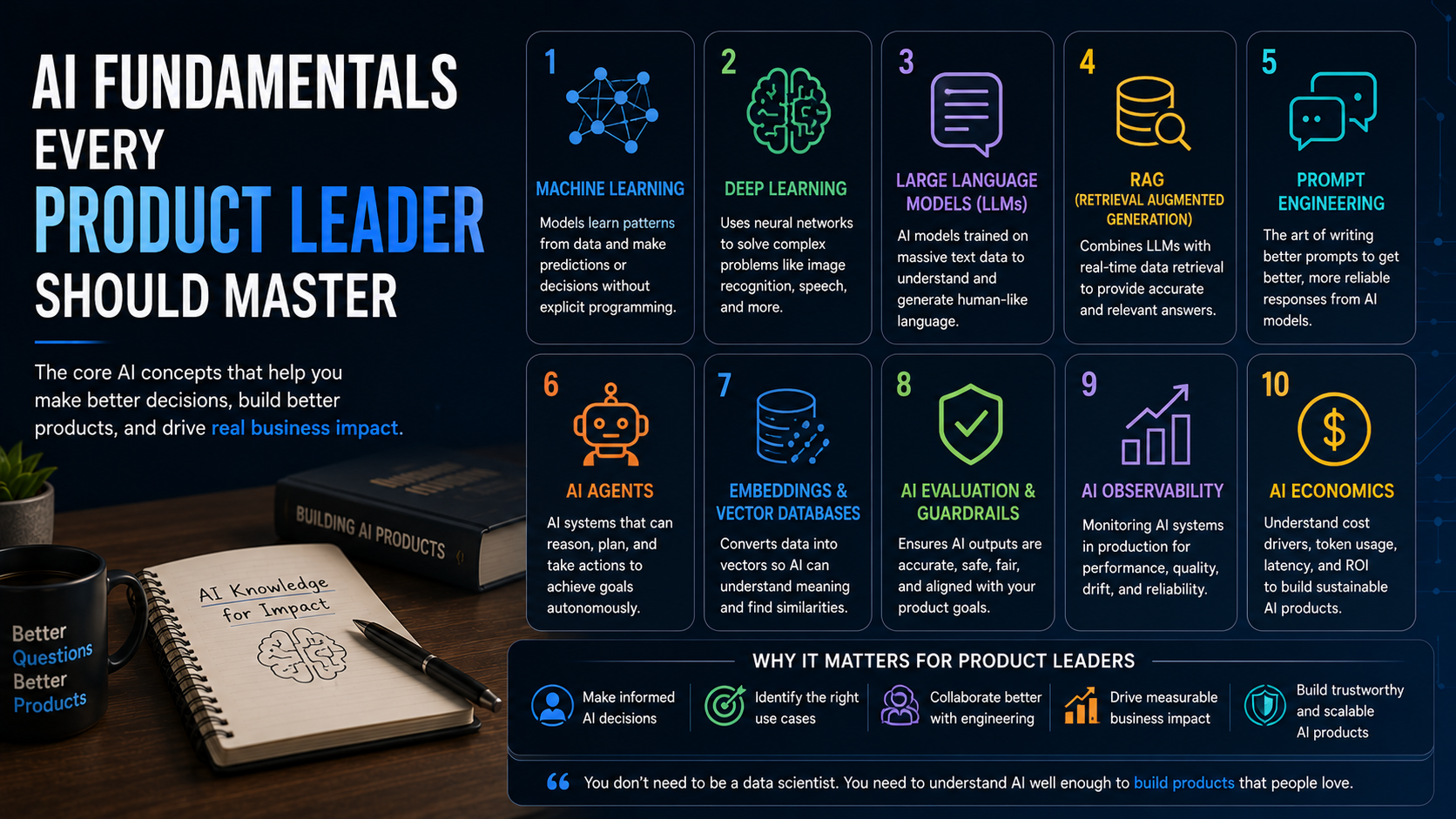
AI is no longer a technology conversation reserved for engineering teams.
For Product Leaders, AI is becoming part of product strategy, customer experience, roadmap decisions, and business models.
But there is a common misconception.
You do not need to become an AI engineer to lead AI products.
You do need enough AI knowledge to understand what is possible, what is reliable, what is expensive, and where AI can create meaningful customer value.
After working across SaaS, cloud, and AI initiatives, I have found that Product Leaders need a practical understanding of AI rather than deep theoretical knowledge.
Here are the fundamentals I believe matter most.
1. Understand What an LLM Actually Does
Large Language Models are at the center of many modern AI products.
You do not need to understand every mathematical detail behind them.
But you should understand the basic idea.
An LLM processes input as tokens, uses patterns learned during training, considers the available context, and generates an output based on that context.
At a product level, this creates several important considerations:
- What can the model reliably do?
- How much context can it handle?
- How accurate is the output?
- How quickly does it respond?
- What does each interaction cost?
- Where can it fail?
This knowledge helps Product Leaders make better decisions about model selection and product scope.
2. Know the Difference Between AI, ML, Deep Learning, and LLMs
These terms are often used interchangeably.
They are not the same.
Think about them as a hierarchy.
Artificial Intelligence
The broad field of creating systems capable of tasks associated with human intelligence.
↓
Machine Learning
Systems that learn patterns from data.
↓
Deep Learning
Machine Learning using multi-layer neural networks.
↓
LLMs
Deep Learning models designed primarily to understand and generate language.
Understanding this hierarchy helps Product Leaders communicate more effectively with technical teams and evaluate AI opportunities more realistically.
3. Understand RAG and Why Enterprise AI Needs Context
An LLM by itself does not automatically know your company’s private documents, policies, customer records, or internal knowledge.
This is where Retrieval-Augmented Generation, or RAG, becomes important.
A simplified flow looks like this:
User Question
↓
Retrieve Relevant Information
↓
Add Context
↓
LLM Generates Response
The important product insight is that the quality of the final answer depends not only on the model.
It also depends on:
- What information was retrieved
- Whether the information is current
- Whether the user has permission to access it
- Whether the retrieved information is relevant
For enterprise AI, data and retrieval are product concerns, not just engineering concerns.
4. Understand AI Agents
AI products are moving beyond simple question-and-answer experiences.
An AI agent can potentially:
- Understand a goal
- Break a task into steps
- Use tools
- Access systems
- Take actions
- Check results
- Continue or recover when something fails
That changes the product experience considerably.
A chatbot might answer:
“Your invoice is overdue.”
An agent could potentially:
Find the invoice → check payment status → draft a customer email → request approval → send it.
The Product Leader now has to define much more than the response.
You need to decide:
- What actions can the agent take?
- Which actions require approval?
- What happens when it makes a mistake?
- What systems can it access?
- How does the user regain control?
5. Learn AI Evaluation
One of the biggest differences between traditional software and AI products is variability.
A traditional application can often be tested against predictable inputs and outputs.
AI systems can behave differently across similar inputs.
That makes evaluation critical.
Product Leaders should understand metrics such as:
- Accuracy
- Relevance
- Groundedness
- Consistency
- Safety
- Task completion
- User satisfaction
The key question is not:
“Does the demo look good?”
It is:
“How do we know this system is good enough for our customers?”
That question should be answered before a major AI capability reaches production.
6. Understand AI UX
AI changes how users interact with products.
Traditional software often requires users to navigate menus, forms, and predefined workflows.
AI allows users to express intent more naturally.
That creates new UX considerations.
Confidence
Does the user know how reliable the response is?
Transparency
Can the user understand why the AI produced an answer?
Human Approval
Does the user need to approve an action before execution?
Feedback
Can users easily correct the AI?
Memory
Should the product remember previous interactions?
Recovery
What happens when the AI gets something wrong?
These are product design decisions, not simply AI engineering decisions.
7. Understand AI Limitations and Failure Modes
AI can produce impressive results.
It can also fail in ways that are difficult to predict.
Product Leaders should understand concepts such as:
- Hallucinations
- Prompt injection
- Incorrect reasoning
- Poor retrieval
- Bias
- Data leakage
- Overconfidence
- Model drift
The goal is not to eliminate every possible failure.
That is rarely realistic.
The goal is to understand the risks and design the product so that failures are detected, contained, and recoverable.
8. Understand AI Security and Governance
Enterprise AI cannot be designed around capability alone.
You also need to think about:
- Data privacy
- Access control
- Sensitive information
- Auditability
- Human oversight
- Compliance
- Model and vendor risk
For example, an AI assistant may technically be capable of retrieving information from multiple internal systems.
That does not mean every user should be allowed to see everything the assistant can access.
The product needs to respect existing permissions and business rules.
As AI becomes more autonomous, governance becomes part of the product experience.
9. Understand AI Economics
AI products have a different cost structure from many traditional SaaS products.
Every interaction can involve:
- Model inference
- Tokens
- Retrieval
- Tool calls
- Infrastructure
- Storage
A feature can be technically successful but commercially unattractive if the cost of delivering it is too high.
Product Leaders should therefore understand:
- Cost per interaction
- Cost per task
- Cost per customer
Value generated per interaction
The objective is not simply to make AI cheaper.
It is to ensure that the economics support a sustainable product.
10. Connect AI to Product Strategy
This is the most important fundamental.
Do not start with:
“Where can we add AI?”
Start with:
“What customer problem are we trying to solve?”
Then ask:
“Is AI the best way to solve it?”
- Sometimes the answer will be an LLM.
- Sometimes it will be traditional software.
- Sometimes it will be Machine Learning.
- Sometimes the best product decision is not to use AI at all.
That is Product Management.
AI is a capability.
The product strategy determines where that capability should be applied.
The AI Knowledge Stack for Product Leaders
If I had to simplify the entire topic into one framework, I would use this:
AI Fundamentals
Understand the landscape.
↓
LLMs
Understand language generation.
↓
RAG + Context
Understand how AI accesses knowledge.
↓
AI Agents
Understand how AI can take action.
↓
AI UX
Understand human and AI interaction.
↓
Evaluation
Understand whether the system works.
↓
Security + Governance
Understand how to deploy it responsibly.
↓
AI Economics
Understand whether the product makes business sense.
↓
Product Strategy
Understand whether AI should be used in the first place.
What You Do Not Need to Master
Product Leaders do not need to become specialists in:
- Training foundation models
- GPU architecture
- Neural network mathematics
- Distributed model training
- Building ML algorithms from scratch
Those are important technical disciplines.
Your role is different.
You need enough technical understanding to ask better questions, challenge assumptions, evaluate trade-offs, and connect technology decisions to customer and business outcomes.
Final Thoughts
The best AI Product Leaders are not necessarily the people who know the most about AI.
- They are the people who know enough about AI to make better product decisions.
- They understand the technology without becoming distracted by it.
- They understand customer problems before proposing AI solutions.
- They understand model limitations before promising capabilities.
- They understand evaluation before declaring success.
- They understand business economics before scaling an AI feature.
Technology will keep evolving with new models, agent architectures, and tools, but the fundamental Product Management question will remain the same.
What problem are we solving, and why is AI the right way to solve it?
That is the AI knowledge worth mastering.
Build Better AI Products
Want to strengthen your AI Product Management skills and learn how to turn AI concepts into practical product decisions?
Explore practical frameworks, case studies, and AI Product Management resources at TPM Nexus.