One of the biggest concerns I hear from Technical Program Managers entering AI initiatives is surprisingly consistent.
“I am not an AI engineer. How am I supposed to participate in architecture discussions?”
It is a fair question.
Many TPMs come from delivery, program management, SaaS, cloud, infrastructure, or platform backgrounds. They are comfortable discussing execution, dependencies, governance, risks, and stakeholder alignment.
Then they join an AI initiative.
Suddenly conversations are filled with terms like:
- LLMs
- RAG
- Embeddings
- Vector databases
- Fine-tuning
- Agents
- Context windows
- Inference
- MCP
- Multi-agent systems
The discussion quickly becomes intimidating.
The good news is that most TPMs are approaching the problem from the wrong angle.
You do not need to become the smartest AI architect in the room.
You need to become the person who asks the questions that connect architecture decisions to business outcomes.
That is where TPMs create value.
The Biggest Myth About AI Architecture
Many people assume architecture discussions are purely technical.
They are not.
Every architecture decision ultimately represents a trade-off.
For example:
- Cost versus performance
- Speed versus governance
- Flexibility versus complexity
- Accuracy versus latency
- Innovation versus risk
These are business decisions disguised as technical decisions.
That is why TPMs belong in the conversation.
Your job is not to decide which embedding model to use.
Your job is to understand why that decision matters.
The Questions TPMs Should Focus On
Whenever architecture discussions become highly technical, I focus on five areas.
1. What Problem Are We Solving?
This sounds obvious.
It is not.
Many AI initiatives start discussing architecture before they have clearly defined the business problem.
Before discussing models or frameworks, ask:
- What business problem are we solving?
- How will success be measured?
- What outcome are we optimizing for?
A surprising number of architecture debates disappear once the objective becomes clear.
2. What Are the Trade-Offs?
Every architecture choice creates consequences.
If the team chooses a larger model:
- Accuracy may improve
- Costs may increase
- Latency may increase
If the team chooses a smaller model:
- Costs decrease
- Speed improves
- Capability may decline
The most valuable question is often:
“What are we gaining and what are we giving up?”
That single question can uncover risks that technical discussions often overlook.
3. What Are the Dependencies?
Many AI projects fail because teams underestimate dependencies.
Architecture decisions often create new requirements involving:
- Data teams
- Security teams
- Infrastructure teams
- Legal teams
- Compliance teams
- Product teams
A TPM should immediately ask:
- What new dependencies does this create?
- Who owns them?
- How will they affect timelines?
This is often where delivery risk first becomes visible.
4. What Happens in Production?
One of the easiest ways to identify architectural weaknesses is to ask operational questions.
For example:
- What happens when the model fails?
- What happens if retrieval returns bad information?
- How is monitoring handled?
- How are incidents managed?
- How is quality measured over time?
Many solutions look impressive during demonstrations.
Production environments reveal the real challenges.
5. How Will This Scale?
A prototype and an enterprise capability are very different things.
Questions worth asking include:
- Can this support 10 users?
- Can it support 10,000 users?
- What happens when adoption increases?
- What are the infrastructure implications?
- What governance controls are required?
Scaling is where many architecture assumptions break down.
Understanding Common AI Terms Without Becoming an Engineer
TPMs do not need deep implementation knowledge.
However, understanding the purpose of common concepts is incredibly useful.
LLM
Think of it as the reasoning engine.
The model generates responses based on the information it receives.
RAG
Think of it as a knowledge retrieval system.
Instead of relying solely on model memory, the system retrieves relevant enterprise information before generating an answer.
Vector Database
Think of it as a specialized search engine that helps AI find relevant information quickly.
Fine-Tuning
Think of it as teaching a model specific behavior through additional training.
AI Agent
Think of it as software that can make decisions and execute tasks using AI.
You do not need to understand the mathematics behind these concepts.
You need to understand why they exist.
The Questions Executives Actually Care About
One lesson I learned early in my career is that executives rarely ask architecture questions.
They ask business questions.
Examples include:
- How much will this cost?
- What risk does this introduce?
- How accurate is it?
- How long will it take?
- What happens if it fails?
- How does this create value?
TPMs are often the bridge between technical teams discussing architecture and leadership teams discussing outcomes.
That translation capability is incredibly valuable.
The TPM Superpower in AI Programs
The most effective TPMs I have worked with were not always the most technical people in the room.
They were the people who could:
- Create clarity
- Surface risks
- Drive alignment
- Challenge assumptions
- Connect technical decisions to business outcomes
AI programs need those capabilities more than ever.
As AI systems become increasingly complex, organizations need leaders who can help technical and business teams make better decisions together.
That is exactly where TPMs excel.
A Simple Framework for Every AI Architecture Conversation
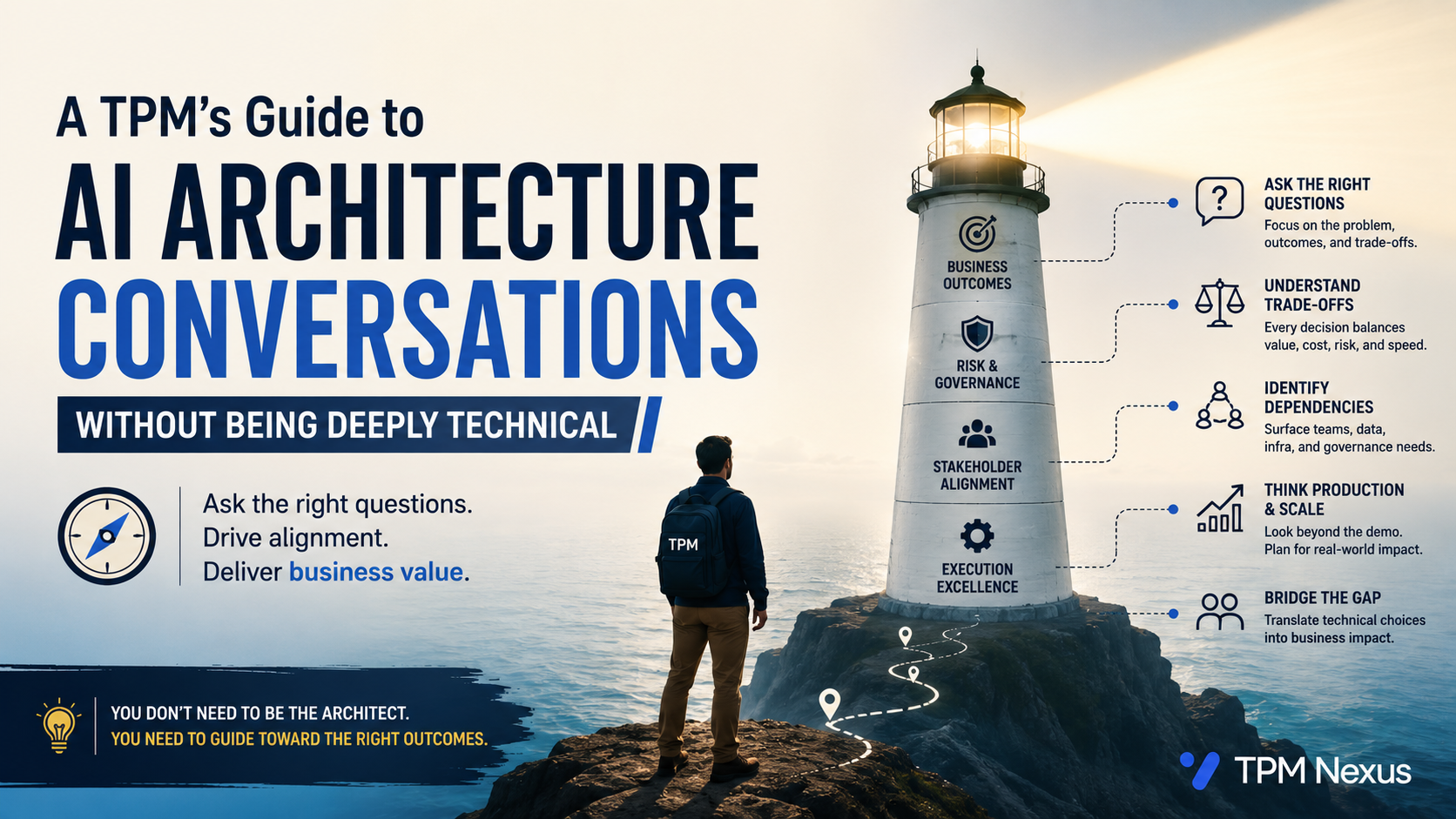
Whenever you find yourself in a highly technical AI discussion, remember these five questions:
- What problem are we solving?
- What are the trade-offs?
- What dependencies does this create?
- What happens in production?
- How will this scale?
You may not be the architect.
You do not need to be.
But if you can consistently guide discussions toward these questions, you will contribute more value than many people who understand the technology at a deeper level.
Final Thoughts
The future TPM does not need to become an AI researcher.
The future TPM needs to become fluent in the language of AI execution.
That means understanding enough architecture to ask better questions, identify risks earlier, align stakeholders faster, and connect technology decisions to business outcomes.
Because successful AI programs are not built solely through technical expertise.
They are built through a combination of technology, execution, governance, product thinking, and leadership.
And that is exactly where TPMs belong.
Subscribe to TPM Nexus for practical insights on AI execution, enterprise delivery, program leadership, and navigating the realities of AI transformation.