Artificial Intelligence has quickly moved from innovation labs into mainstream enterprise strategy.
Organizations across industries are investing heavily in Generative AI, AI agents, automation platforms, predictive analytics, and intelligent customer experiences. Yet despite significant investments, many AI initiatives fail to move beyond proof of concept.
The reason is rarely the technology itself.
Most failures occur because organizations underestimate the complexity of managing the end to end lifecycle of an enterprise AI initiative.
Successful AI transformation requires much more than selecting a model or building a chatbot. It involves strategy, governance, product thinking, execution discipline, stakeholder alignment, operational readiness, and continuous improvement.
Understanding the complete enterprise AI lifecycle is critical for leaders, TPMs, product managers, engineering teams, and executives responsible for delivering business outcomes.
Why Understanding the Enterprise AI Lifecycle Matters
Many organizations focus heavily on development while overlooking the stages before and after implementation.
As a result:
- AI projects solve the wrong problems
- Stakeholder expectations become misaligned
- Governance gaps emerge
- Adoption remains low
- Business value is never realized
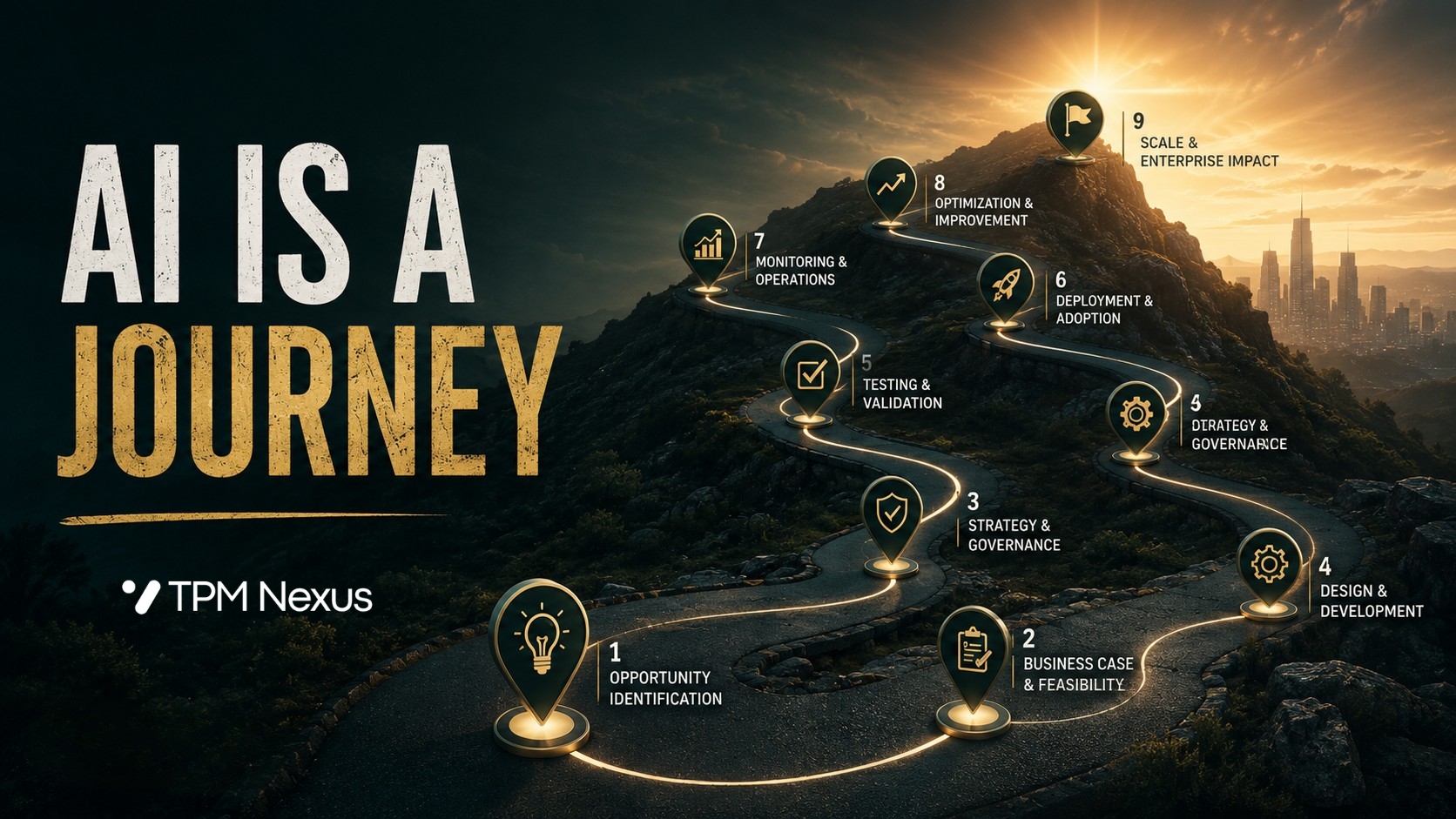
A structured enterprise AI lifecycle provides a framework for moving from idea to measurable business impact.
Phase 1: Opportunity Identification
Every successful enterprise AI initiative begins with a business problem.
One of the most common mistakes organizations make is starting with technology instead of business needs.
The conversation should not begin with:
- Which LLM should we use?
- Which vector database is best?
- Which framework should we select?
Instead, it should begin with questions such as:
- What problem are we trying to solve?
- What outcome are we trying to achieve?
- How will success be measured?
- Why is AI required?
Examples of business opportunities include:
- Reducing customer support costs
- Improving employee productivity
- Accelerating content generation
- Enhancing decision-making
- Automating repetitive processes
At this stage, leadership alignment is essential.
Phase 2: Business Case Development
Once the opportunity is identified, the next step is creating a business case.
Enterprise AI initiatives compete for funding alongside many other strategic investments.
The business case should clearly define:
- Expected benefits
- Costs
- Risks
- Success metrics
- Return on investment
- Strategic alignment
This phase determines whether the initiative receives executive sponsorship and funding.
Without a strong business case, even technically sound AI initiatives struggle to gain support.
Phase 3: Feasibility Assessment
Not every business problem requires AI.
This phase focuses on determining whether AI is the right solution.
Key evaluation areas include:
Data Availability
Does the organization have sufficient data?
Data Quality
Is the data accurate and reliable?
Technical Complexity
Can the solution be realistically implemented?
Risk Assessment
What legal, compliance, and operational risks exist?
The goal is to validate feasibility before significant investments are made.
Phase 4: AI Strategy and Roadmap Planning
Once feasibility is confirmed, organizations define the AI strategy.
This stage establishes:
- Vision
- Objectives
- Priorities
- Milestones
- Governance approach
- Success metrics
Roadmap planning helps organizations balance quick wins with long-term transformation goals.
Many organizations fail because they attempt to solve everything at once.
Successful programs typically begin with focused use cases that demonstrate value.
Phase 5: Governance and Risk Management
Enterprise AI governance should be established before development begins.
Governance defines:
- Accountability
- Security controls
- Compliance requirements
- Ethical guidelines
- Data management policies
- Approval processes
Strong governance enables organizations to innovate responsibly.
Without governance, AI adoption often creates unnecessary risk.
Phase 6: Solution Design and Architecture
This phase focuses on designing the AI solution.
Architecture decisions may include:
- Foundation models
- RAG architecture
- AI agents
- Data pipelines
- Vector databases
- Integration patterns
- Security architecture
The objective is to design a scalable, secure, and maintainable solution.
Technology decisions should always align with business goals established earlier.
Phase 7: Development and Implementation
Development transforms the design into a working solution.
Typical activities include:
- Data preparation
- Model integration
- Prompt engineering
- Workflow development
- Application development
- API integration
- Security implementation
Cross-functional collaboration becomes especially important during this stage.
Stakeholders often include:
- Product teams
- Engineering teams
- Security teams
- Data teams
- Compliance teams
- Business users
Effective execution management is critical.
Phase 8: Testing and Validation
Testing enterprise AI solutions requires a broader approach than traditional software testing.
Organizations must evaluate:
Functional Testing
Does the system work correctly?
Accuracy Testing
Are responses reliable?
Performance Testing
Can the system scale?
Security Testing
Is sensitive information protected?
Governance Validation
Does the solution comply with organizational policies?
AI systems require continuous validation because outputs can vary over time.
Phase 9: Deployment and Change Management
Many AI initiatives fail during deployment.
Not because the technology is broken.
Because users are not prepared.
Successful deployment includes:
- Training programs
- Communication plans
- User education
- Adoption strategies
- Support mechanisms
Change management often determines whether an AI initiative succeeds or fails.
Technology adoption is ultimately a human challenge.
Phase 10: Monitoring and Operations
Deployment is not the end of the journey.
Enterprise AI systems require continuous monitoring.
Organizations should track:
- Usage metrics
- Accuracy metrics
- Response quality
- Cost metrics
- Performance indicators
- Security events
Operational monitoring helps identify issues before they impact users.
This phase is critical for maintaining trust.
Phase 11: Optimization and Continuous Improvement
Business needs evolve.
Data changes.
User expectations increase.
Models improve.
Enterprise AI solutions must continuously adapt.
Optimization activities may include:
- Prompt refinement
- Model upgrades
- Knowledge base improvements
- Workflow enhancements
- Cost optimization
- User experience improvements
The most successful organizations treat AI as an ongoing capability rather than a one-time project.
Phase 12: Scaling Across the Enterprise
Once a use case demonstrates value, organizations begin scaling.
Scaling requires:
- Standardized governance
- Reusable architectures
- Shared platforms
- Operating models
- Center of Excellence support
- Executive sponsorship
This stage transforms isolated AI projects into enterprise-wide AI capabilities.
Common Reasons Enterprise AI Initiatives Fail
Throughout the enterprise AI lifecycle, several recurring challenges emerge:
Lack of Business Alignment
Technology without business value rarely succeeds.
Weak Governance
Governance gaps introduce risk and reduce trust.
Poor Data Quality
AI quality is heavily dependent on data quality.
Insufficient Change Management
Users must understand and trust the solution.
Unrealistic Expectations
AI is powerful but not magical.
Lack of Executive Sponsorship
Sustained leadership support is essential.
The TPM Perspective on the Enterprise AI Lifecycle
For TPMs, the enterprise AI lifecycle is fundamentally an execution challenge.
Success depends on:
- Stakeholder alignment
- Dependency management
- Governance coordination
- Risk management
- Delivery execution
- Adoption planning
The most effective TPMs understand both the technical and business dimensions of AI initiatives.
They bridge the gap between strategy and execution.
They ensure that AI programs move from concept to measurable business outcomes.
Final Thoughts
Enterprise AI initiatives are significantly more complex than traditional technology projects.
Success requires much more than selecting the right model or building the right architecture.
Organizations must manage the entire lifecycle, from opportunity identification to enterprise scale adoption.
The companies creating sustainable value with AI are not simply investing in technology.
They are investing in governance, execution, product thinking, stakeholder alignment, and continuous improvement.
Because in the end, successful AI transformation is not about building AI.
It is about delivering business outcomes through AI.
Subscribe to TPM Nexus for practical insights on AI execution, enterprise delivery, governance, and leadership in the era of enterprise AI transformation.